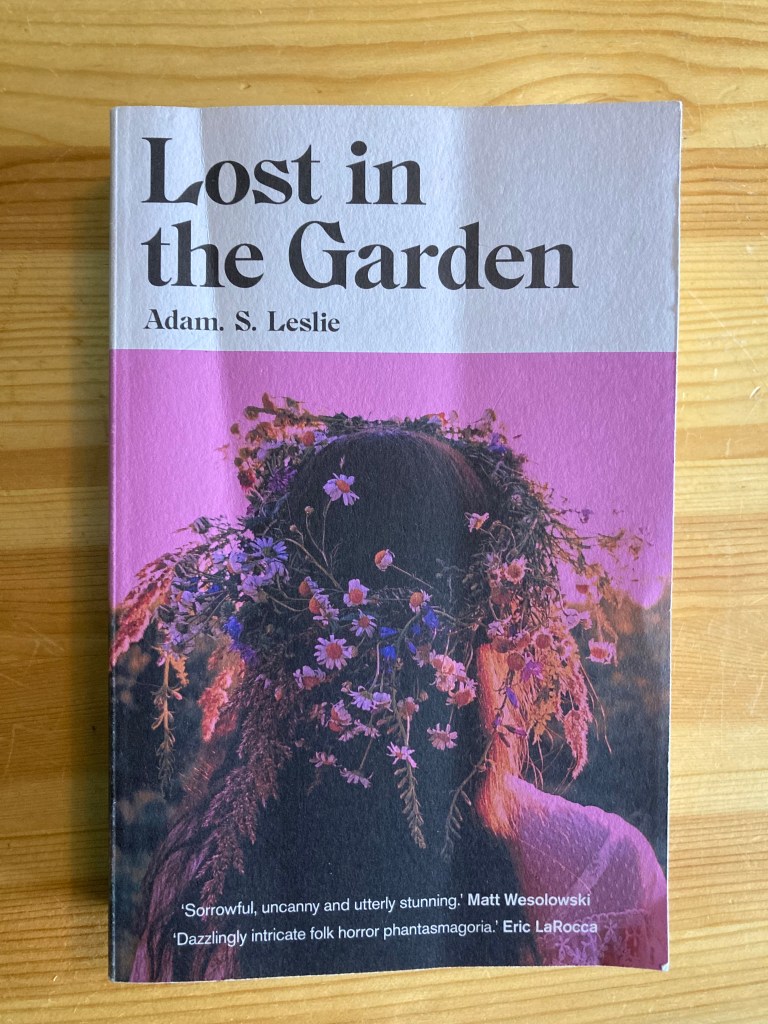
Adam S. Leslie, 2024
Edition read: Dead Ink Books, April – May 2025, 446 pages
Fiction – folk horror. Won a Nero Award for Best Fiction.
*Spoilers*
Three young women live in personal stases of varying degrees in a village in northern England where the dead meander and a six-year summer shows no sign of abating. This is the first interesting point (besides the dead roaming about and everyone seemingly just kind of…meh about it): a folk horror set in a warm, sunny, endless summer, inviting at least just a little bit of comparison to that most famous piece of work in the folk-horror oeuvre, The Wicker Man (we’ll come back to that later).
The title refers to the unnaturally ever-abundant vegetation created by the endless summer that these three female protagonists – Heather, Rachel and Antonia – inhabit. In this world, Leslie has a different take upon zombies; they are generally harmless until underestimated, at which point they close in, gang up and kill people with hard objects. No eating reported.
The descriptions of this eternal summer are rich without being saccharine (‘Very occasionally it was a dry heat, a soily heat smelling of bug carcasses and stones, but usually the air sweated as much as the people’), and rural scenes abound, with the action sticking to the countryside and villages.* In this garden, there are no old(er) people and no authority figures, although there does exist the accepted aphorism, ‘Don’t go to Almanby’. No one seems to know why; just going there is taboo. Plotwise, Heather is trying to find her boyfriend, Steven, who disappeared to – of course – Almanby around six months earlier, although a difficulty in keeping track of time is a recurring theme, getting pushed to extremes later on in the book, with one particularly atemporal slippage of reality.
Rachel needs to deliver a package – the contents of which she keeps a secret from Antonia and Heather – again, to Almanby! This is the start of the story proper. Roadtrip!
I started off quickly, then slowed down, finding the irreverence of Rachel and Heather a bit grating, then got back into it as the narrative drive picked up. Rachel clearly has something to hide, but we aren’t just let in on what. She receives mysterious, nonsensical transmissions via a portable radio. The unknowns, including an ever-elusive ice cream van, build up the mystery, driving the story via intrigue, and although the unanswered questions ultimately add to the feeling of a bad dream, these don’t all resolve as clearly as possible. For example, it’s implied that Antonia is a murderer, which doesn’t go anywhere, nor does it really seem to inform her character. Her love interest in (but seemingly never with) Heather also just fizzles away at the end, without any requisite epiphany.
Although it moves between the perspectives of each of the three main characters, it can sometimes be hard to remember the ‘whys’ in this novel; why did David hold them up? He is also being manipulated by Steven? What’s the deal with Rachel – is she addicted to something? At one point I wondered if Almanby was an analogy for addiction (‘it was the best feeling she’d ever experienced, and she never wanted it to stop, even as she knew it soon would’), but this isn’t developed and her motivation remains unclear.
Jumping back to that use of ‘folk horror’ and The Wicker Man – when they arrive in Almanby is when it really becomes clear that the normal rules of this universe have fallen aside and that something is off, although Leslie does a good job of maintaining the build-up and making it hard to place what. As suggested, a lot remains unexplained, which at times really adds to hazy feel, such as the farm building which turns into a looping maze, but this doesn’t deliver on all fronts. Is Heather struck by lightning towards the end? Is Steven trying to destroy Almanby? The theme of sacrifice also comes up, but not as a heavy-handed copy and paste of The Wicker Man. So, although the composition falls apart towards the end, the ending is still delivered with considerable interest, and does leave a satisfying chill.
Worth reading? Yes.
Worth re-reading? Yes, although the strength of the writing carries the plot a bit.
*These were pleasingly effective compared to another recent read, Benjamin Myer’s The Offing.
 The Page Count