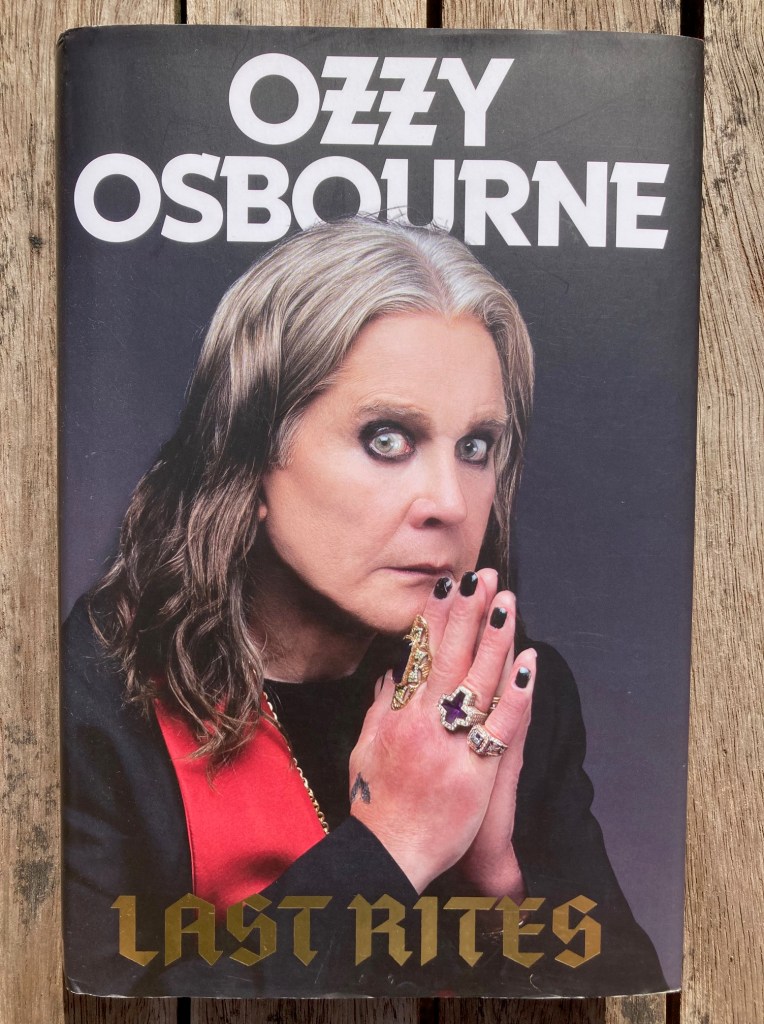
Ozzy Osbourne with Chris Ayres, 2025
Sphere, 2025, 351 pages
Read July – August 2026
Non-fiction, Autobiography, Music
Black Sabbath’s (first) vocalist; the animal-chomping rock star; the ageing media personality: Ozzy Osbourne had several looks over the years.1
Last Rites is the ageing media personality looking back on his animal-chomping rock-star days, and bits of being a forming member of Sabbath, while dealing with a litany of concurrent health issues. The book hinges upon these maladies and moves back and forth from there. The tone is conversational and it certainly sounds like Ozzy.2 Besides the erraticism of the shifting chronology, it also jumps from subject matter to subject matter (often concluding with ‘Anyway, [proceeds to get back to the original point]), rather than forming a chronological account of his life. Initially this feels a bit haphazard and clunky (as does his phonetic spelling-out of riffs), especially if you aren’t familiar with Ozzy’s mannerisms. However, he was nothing if not entertaining, and this comes across in the writing style (on surviving consecutive surgeries and health scares: ‘I celebrated by getting pneumonia again’). Not only does this carry the non-sequiturs, but given Ozzy’s characterful manner, with time it even comes to feel fitting.3
With that said, Last Rites is at its most interesting when covering Black Sabbath’s music, Ozzy’s upbringing and his post-Sabbath musical career. Fair enough, drink, drugs and the attendant mishaps are part of the Ozzy story, and he recounts them in an entertaining manner, but these are common to many a rockstar’s autobiography/biography, so these sections are OK, but nothing you won’t have read elsewhere about flights of self-destruction (‘Lemmy was the one guy I just could not keep up with’).
Although geriatric complaints don’t sound like particularly compelling reading, the health issues – Parkinsons, staph infections, a backbone seemingly consisting of apple crumble (there’s a lot of back surgery) – form an interesting counterpart to a lifetime of hard living – as well as a look into the more mundane, poignant reality of just getting old. The No More Tours II, er, tour, endlessly delayed because of these issues, becomes Ozzy’s white whale, and in his pursuit of this, what really comes across is his love of performing and singing. For all of the above set-up of Ozzy as a larger-than-life personality first and a musician second, he really comes alive when talking about music and his love of performing, as well as his love of the fans.4
It is called Last Rites, and it does cover his last gig, only 17 days before his death. This must have left co-writer Chris Ayres with a careful decision to make – acknowledge this, or write as though he’s still alive and cursing away? In the end, the only acknowledgement, besides the title, is on the dust jacket. Otherwise, the tone (and that it’s told in the first person) means that, should you not know of Ozzy, you wouldn’t know that this is posthumous. While he often talks of having well and truly used up his nine lives and how he could head off to the great gig in the sky tomorrow, he also talks about all of the things he still wanted to do and the people he wanted to see. This makes for several poignant moments as the end approaches.
I would have liked more on his time in Black Sabbath, album by album. He does remark upon Sabbath wanting to be heavier than anything that had come before, Geezer Butler’s lyrics, the influence of jazz on Bill’s Ward’s drumming, and the songwriting process, or lack thereof. He admits that Tony Iommi was the unofficial leader and does touch upon the sound of Black Sabbath and what they set out to create. There is some mention of Sabbath’s fractious nature, and how Bill Ward was left behind in the making of their reunion album 13, but again, I would have liked more detail on this – was it always the case; did it develop with time; did the mountains of cocaine have anything to do with it? Likewise, I would have liked more on songwriting post-Black Sabbath; he worked with an array of great guitarists, but the songwriting process isn’t covered in any detail.5
However, the discursive nature of the writing does allow for many a digression into unrelated subjects – driving in the UK versus the US, modern dating, social media, how Birmingham has changed, modern recording techniques, addiction, the legalisation of weed, guns, the Blitz, the Concorde, Guinness (‘I dream about Guinness almost every night. I fucking love the stuff, it’s like drinking a glass of pudding.’) Normally this wouldn’t be that interesting, but as stated, Ozzy’s voice is inimitable and entertaining (on eating up to 12 apples a day: ‘It’s a wonder I didn’t wake up one day with an apple tree sprouting out of my arse’.)
That first note of ‘Iron Man’ gets me every time, man. You feel it in your bowels. Your teeth. Our bones. It’s like the gates of hell grinding open. Like the groan of Heinkel bombers as they dipped below the clouds to try to take out the Castle Bromwich Spitfire factory, night after night. Like the thunder of the heavy machinery out fathers used to operate. And their fathers before them.
Worth reading? If you are already interested in Ozzy, yes.
Worth re-reading? No. I think this time would be better spent reading a Black Sabbath biography or a more comprehensive Ozzy biography.
If you are interested, also read listen to:
Black Sabbath – hear heavy metal being created.
Paranoid – their best album.
The Blizzard of Oz – Ozzy’s first solo album. It has a very different, more modern sound than Sabbath, arguably closer to rock than metal, aided and abetted by Randy Rhoads’ shredding.
1. Shortly after Lemmy died, I observed on my music blog that ‘Motörhead + past tense = strange’. Same here.
2. I normally refer to authors and their characters by surname only upon subsequent mentions, but Ozzy has earned his demonym and will be referred to as such.
3. A personal favourite is Ozzy recording a promo for the Radio 1 Rock Show, in which he mispronounces his own name as ‘Blozzy Osbourne’. Apparently, no one thought he had a better take in him and that’s how it stayed.
4. Lest we forget, he also helped to invent heavy metal.
5. There are at least two Ozzy autobiographies: I’m not sure what the difference is between this and I Am Ozzy, published in 2010. Or maybe the latter covers the subject areas I thought lacking herein. Maybe they form a series?

