George Orwell, 1939
Read: September 2025
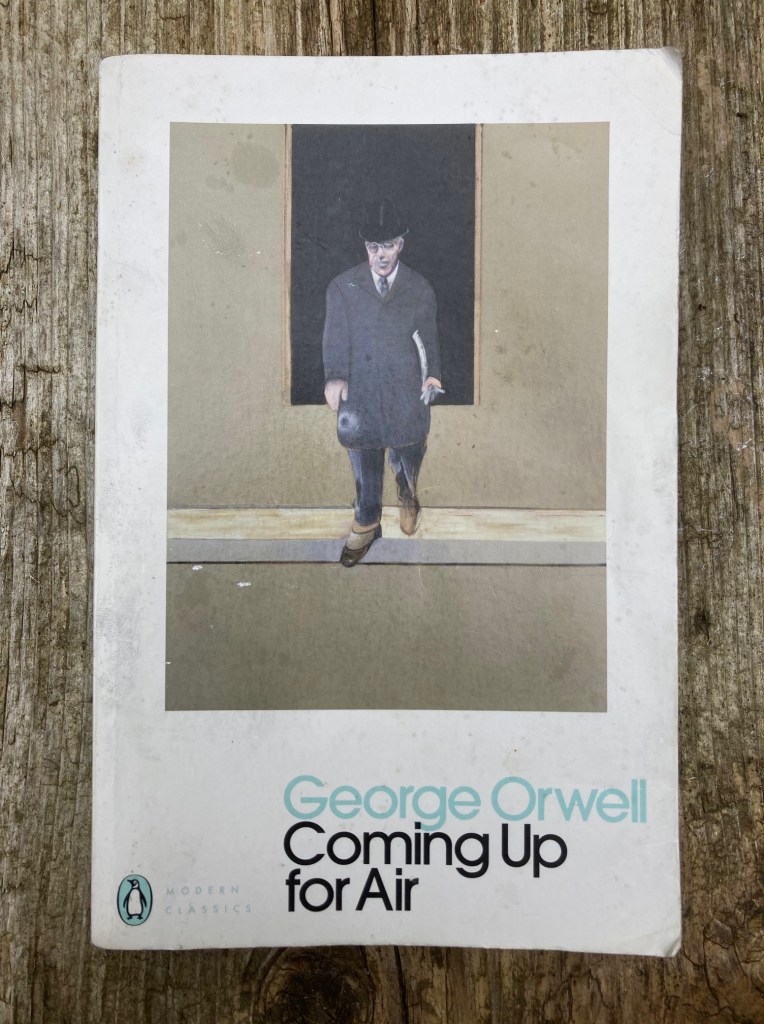
Edition read: Penguin Classics, 2020, 276 pages
Inter-war Literature
*Spoilers*
Flashbacks from a lower-middle class, middle-aged Englishman, on the eve of World War Two, to his childhood, World War One, his marriage, his working life, working his way up to his present day and an impulsive return to his hometown of Lower Binfield, inspired by a trip down memory lane (thankfully, Orwell kept it to 270 pages. Take note, Proust.)
An inter-war novel, the main themes are concurrent nostalgia and anxiety about the threat of forthcoming war. Written in the first person, what drives protagonist George Bowling is his oft-self-centred pursuit of happiness; he shows – and openly describes – his life since childhood as having been a dreary trudge. While recovering from an injury in the trenches, he is sent to a redundant, absurdist job posting for the remainder of the war. He got married and had children very much out of a sense of that was just what people do. He sees his family and house as a chore at best, taking no satisfaction in them. He dreads what he sees as another forthcoming war – primarily due to the shortages it will impose. He is overweight, middle-aged, newly equipped with false teeth, has already cheated on his wife and very much intends to continue doing so.
Even in what could be more considered his principled moments, such as when he attends a local Left Book Club meeting, he leaves both utterly apathetic and lamenting what he perceives to be the violence of contemporary politics, before visiting a friend who is stuck in the past (and not even his own past – in the age of antiquity). He is scathing about his wife and her penny-pinching ways. He goes on holiday with gambling wins he hides from his family.
This leads Bowling to become nostalgic about elements of a childhood that he knows he is misremembering: ‘I don’t idealise my childhood, and unlike many people I’ve no wish to be young again […] in a manner of speaking I am sentimental about my childhood – not my own particular childhood, but the civilisation which I grew up in and which is now, I suppose, just about at its last kick.’ He has no qualms in detailing how he saw unfettered capitalism slowly kill off his father’s small businesses or how his ne’er-do-well brother suddenly disappeared. He constantly offsets his existence and his perception of society against his memories of fishing – one of those wonderful childhood memories which he knows he is misremembering (‘My best fishing-memory is about some fish that I never caught. That’s usual enough, I suppose’). As such, fishing comes to serve as a metaphor for either the promises of life – or, in a slightly different reading, for the age in general.
Whilst he doesn’t think particularly kindly of anyone, women get a decidedly harsh treatment. Even taking his wider observations as largely true to life, this is a reflection of Bowling’s character more so than anything else. This is at its most evident when his ex-girlfriend doesn’t recognise him and, in his ensuing critique of her appearance, fails to realise that this might have something to do with his own condition.
Whilst I’m not sure if it’s possible for Orwell to have any obscure books, this is one of his lesser-known ones. As such, whilst not quite a sleeper hit, it is well worth reading in addition to his heavyweights. He is remembered for the ideas he expressed in his writing, but what seems to sometimes go forgotten is how quietly impressive his actual writing is; he makes the semi-nostalgic reflections of a middle-aged insurance salesman a page turner.
‘[…] in this life we lead – I don’t mean human life in general, I mean life in this particular age and this particular country – we don’t do the things we want to do. It isn’t because we’re always working. Even a farm-hand or a Jew tailor isn’t always working. It’s because there’s some devil in us that drives us to and fro on everlasting idiocies. There’d time for everything except the things worth doing. Think of something you really care about […] calculate the fraction of your life that you’ve actually spent in doing it. And then calculate the time you’ve spent on things like shaving, riding to and fro on buses, waiting in railway junctions, swapping dirty stories and reading the newspapers.’
Worth reading? Yes – big ideas expressed through deceptively good writing.
Worth re-reading? Yes – and I suspect a second reading will reveal further riches.
 The Page Count