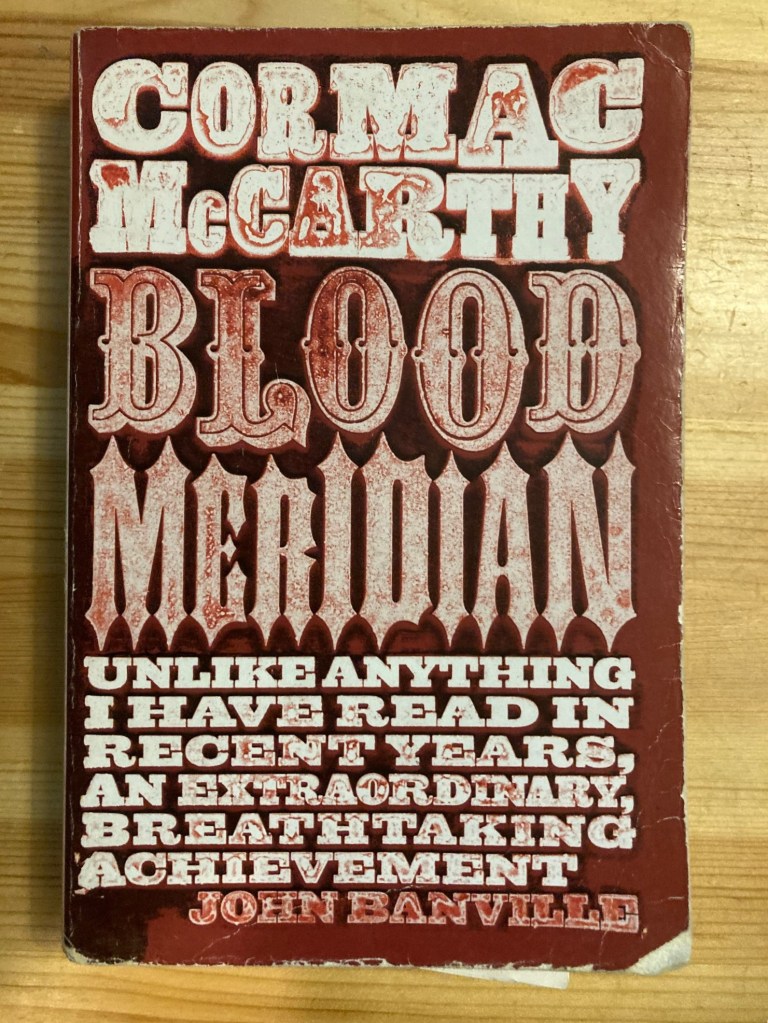
Cormac McCarthy, 1985
Re-read: November–December 2025
Edition read: Picador, 2011, 353 pages
Neo-Western, Historical fiction
*Spoilers*
The point of entry to this notorious book is that it is a Western, albeit, one closer to literary than genre fiction, with the primary theme being war, literal and spiritual, everlasting with man as its eternal maker. The scale is grandiose and the tone is Biblical. Considered to be one of the Great American Novels (comparisons to Faulkner, Melville, as well as Shakespeare, abound in the attendant literary analysis),* it’s a bracingly violent read.
The Mexican–American War, here, is presented as humanity’s nature writ large. Drawn from the diary of an American who signed up with the scalp-hunting Glanton Gang during said war,** McCarthy uses this (relatively) modern context to divine the nature of our species. The world in this book – which at times is quite distinctly the US–Mexican borderlands and at others could be neolithic – is the result. And what a thoroughly pessimistic exploration of human nature it is.
More plot- than character-driven, our protagonist, who is only ever named as ‘the kid’, is – as the lack of a name suggests – a figure with little expressed individuality or motivation except for a natural aptitude for violence. Born into a world lacking sentiment, his origin story is that he just wanders off from his home in Tennessee one day and never returns. From here, following an incompetent filibuster*** foray into Mexico made under the purview of Manifest Destiny (although throughout the novel, white men, Mexicans and Native Americans mete out violence with equally vicious proficiency), he joins the Glanton gang. Captain Glanton, being the sort of person you would move away from on public transport or in the pub, has been hired by the Mexican authorities to kill Apache. In the pursuit of money and steeped in the prosecution of colonialism, the gang soon devolve from regional assignments into killing anyone that they can: all scalps (referred to as a ‘receipt’ at one point) look the same by the time they are cashed in.
With that said, the kid and Glanton are in some ways a sideshow to what come to be the two main characters: the land and the Judge. Judge Holden is a driver of philosophical content, holding forth on the order of the universe and the nature of man frequently and extensively (a snippet: ‘It makes no difference what men think of war, said the judge. War endures. As well ask men what they think of stone.’) Abnormally big and completely hairless, he quickly comes to manifest as a supernatural being.
As for the land, the kid and the gang are outside nearly all of the time (brawling in tavernas is a recurring exception to this) traversing vistas colossal in scope, with the size of the open spaces often calling up references to other dimensions and worlds (‘The horses trudged sullenly the alien ground and the round earth rolled beneath them silently milling the greater void wherein they were contained’). The kid and the gang inhabit the liminal, with lots of descriptions of dawn and dusk and of being in places so remote and uninhabited (place names are rarely given) that they rightly seem like they should not exist in our world. It actually reached the point where it made me think of H.P. Lovecraft’s Weird Horror. This is coupled with frequent references to astronomy and the stars, but more in the sense of ‘you are alone in the universe’ rather than ‘isn’t this nice’. This is paired with descriptions of the wilderness so rich that there were times reading this where, minus the murder/scalping/raping/torture/freezing/dehydration/exposure/starving/theft/racism/getting shot, I wanted to be there, riding a horse, wearing a hat, being stoic. However, this is no bucolic, eco-primitivist treatise – man may be the one waging eternal war, but nature is a close second via sheer inhospitality. The various desert landscapes tend to reach the point of reading like hell: hot, empty (of nice things) and full (of the dead).
For those unaware, McCarthy has an idiosyncratic writing style, eschewing most punctuation and using what Wikipedia calls ‘polysyndeton’ (but which I think you and I can call ‘long sentences with no commas’). It is perhaps in Blood Meridian that McCarthy best encapsulates his grandiose, prophetic style, with archaic nomenclature abounding (you will need to bring your old-timey dictionary), somehow simultaneously terse and poetic, extravagant and as laconic as his characters. There is an embarrassment of riches in fantastic writing, but the ‘legions of horribles’ passage is a great example:
A legion of horribles, hundreds in number, half naked or clad in costumes attic or biblical or wardrobed out of a fevered dream with the skins of animals and silk finery and pieces of uniform still tracked with the blood of prior owners, coats of slain dragoons, frogged and braided cavalry jackets, one in a stovepipe hat and a bloodstained weddingveil and some in headgear of cranefeathers or rawhide helmets that bore the horns of bull or buffalo and one in a pigeontailed coat worn backwards and otherwise naked and one in the armor of a Spanish conquistador, the breastplate and pauldrons deeply dented with old blows or mace or sabre done in another country by men whose very bones were dust and many with their braids spliced up with the hair of other beasts until they trailed upon the ground and their horse’s ears and tails worked with bits of brightly colored cloth and one whose horse’s whole head was painted crimson red and all the horsemen’s faces gaudy and grotesque with daubings like a company of mounted clowns, death hilarious, all howling in a barbarous tongue and riding down upon them like a horse from a hell more horrible yet than the brimstone land of christian reckoning, screeching and yammering and clothed in smoke like those vaporous beings in regions beyond right knowing where the eye wanders and the lip jerks and drools.
Oh my god, said the sergeant.
Oh my god, said the book reviewer.
With this all said, this novel is certainly not for everyone. Criticism tends to focus on the lack of exposition and insight into any character (except for the judge), although my take on this is that this creates the very much intended effect that mankind is unknowable. This could also be said about any McCarthy novel, so you might already know whether you like this or not. The other common critique is that the violence is gratuitous. Admittedly, around page 200 it starts to feel like one long bender, akin to the anti-narrative of Suttree, but I felt this added to the effect of violence becoming its own purpose. The few female characters are also very minor, although, again, if you’ve read any other McCarthy books, you knew this already.**** My biggest criticism is that by a certain point the intensity of the descriptions becomes hard to process, although this a case of having a good problem.
As stated, where we come from, how we are and where we are going is here attested as thoroughly pessimistic. In McCarthy’s ouvre, if No Country for Old Men is the present and The Road is the future, then Blood Meridian is the past. The Kid’s refusal of the Judge at the end does suggests a rebuttal of determinism, although at the close it is a question without an answer.
Worth reading? Yes.
Worth re-reading? Yes.
‘The ultimate trade awaiting its ultimate practitioner’
*A body which includes my dissertation.
**Samuel Chamberlain’s My Confession: Recollections of a Rogue.
*** In the archaic meaning of the word.
****With the late exception of Stella Maris.
 The Page Count