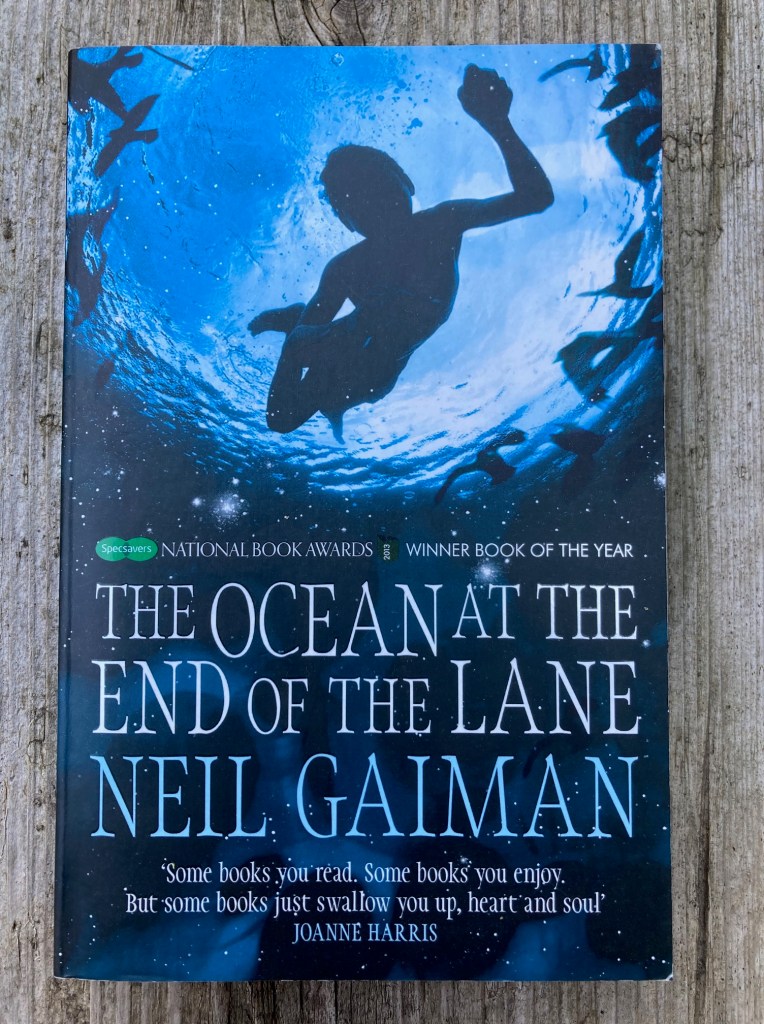
Neil Gaiman, 2013
Read: June 2025
Edition read: Headline Publishing Group, 2013, 235 pages
Fiction – Fantasy
Read on a trip to Edinburgh
*Spoilers*
I saw a National Theatre production of this in November 2023 and did my best to follow the plot, but at a certain point it just took an absolute left turn to comprehension and I had no idea what was going on. Let’s see if I can do any better with the book.
It starts with a funeral, which leads the (unnamed) narrator to revisit his childhood home, and the pond, or the ‘ocean’, at the end of the lane. In turn, he remembers a childhood memory – the story at hand – for the first time. As such, it is told in the form of analepsis. Here, death is a gateway.
Much like Gaiman’s Neverwhere, the story takes place in a universe that could be ours, until it very much doesn’t, with the introduction of a different – perhaps parallel – universe. I spent a while considering whether this was surrealism or fantasy; despite the title, I think it’s the latter. The element of surrealism that is a lack of understanding of the rules of the universe, and the suspension of the normal rules – those of reality – evolves into fantasy as the sense of normalcy completely gives way to another, strange and unfamiliar, world.
It is written from a child’s perspective, quickly deploying the trope of a child dealing with gaps in their knowledge and understanding, particularly of adult themes, with the early suicide of the opal miner. The narrator, who often articulates his feelings of a lack of agency, is convincingly passive as a child. I wondered what the significance of the opal miner was for a bit: he is gone almost as soon as he appears. Ultimately, besides this character providing a dark example of something beyond the child narrator’s understanding, as well as driving the plot forward, I read it as a note on the letdowns of adulthood. As this suggests, although it could be read by older children or young adults, it works on two levels, and in many ways this is quite a dark book; besides looking at loss (such as when Lettie is hurt protecting the narrator and has to ‘rest’ for what turns out to be a lifetime) it draws upon what adults say/look like versus what they actually do/how they act, the protagonist’s father’s affair with Ursula being an example.
As this early development suggests, the plot whips along (I read this over a long weekend), although the logic behind ‘why is this happening?’ is not always apparent and re-reading a couple of pages proved necessary (this made me feel better for not having been able to follow the play). Gaiman is inventive, creating his own tropes, such as the suicide of the miner summoning the spirit/Ursula to distribute money. Although he has written a compelling fantasy, this book could be read on a purely symbolic level for memory and loss of childhood, the ocean being something to return to and submerge in but never cross.
Worth reading? Yes.
Worth re-reading? Yes
 The Page Count