George Orwell, 1938
Re-read December 2024–January 2025*
269 pages
Vintage Classics, 2021
Non-fiction, Memoir
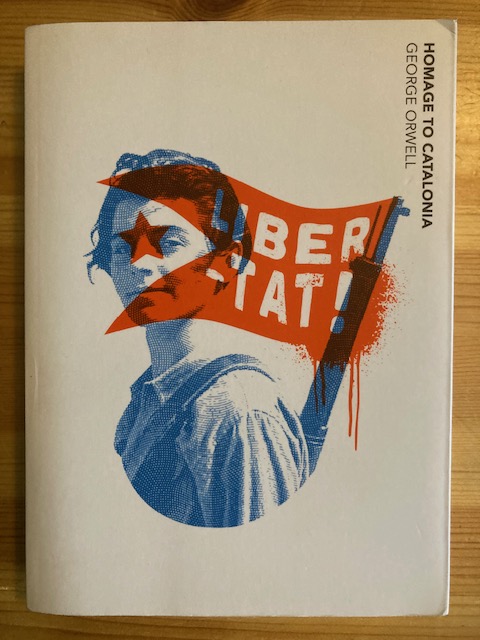
Bill Bryson once described George Orwell as a middle-class milksop who changed his name for street cred (maybe not word-for-word, but it’s something along those lines).** Bill: I rate you, I like you, and oh how we’ve laughed, but here, you’re wrong. Originally travelling to Spain to report on its civil war, within a week Orwell had joined the republican forces to fight Franco’s fascist forces, considering it ‘the only conceivable thing to do’. When it came to standing up for democratic ideals, Orwell walked the walk as much as he, er, wrote the words, eventually taking a bullet in the neck for his troubles.
Homage to Catalonia is Orwell’s resulting, retrospective account of his time in Spain from late 1936 to the summer of 1937, commencing in media res in December 1936 when Orwell joined the POUM (Partido Obrero de Unificación Marxista – the Worker’s Party of Marxist Unification) – a socialist, anti-Stalinist militia. It covers his time fighting in trenches in various spots around Aragon, the rupture between anarchist/socialist and Stalinist factions, the internecine street fighting that erupted while he was ‘on leave’ in Barcelona and the following atmosphere of suspicion and denunciation.
There are two key components – Orwell’s observations and analysis of revolutionary politics and society, and descriptions of war. These elements often overlap, although in this edition the two chapters originally dedicated to purely political analysis have been turned into appendixes. Orwell manages the romantic clichés of revolution carefully, avoiding idealisation. Towns are described as shabby and in disrepair, there is rationing and shortages, and this is before he even reaches the trenches. Once he does arrive on the frontlines (‘the gaunt trains full of shabby soldiers creeping to the front, the grey war-stricken towns further up the line, the muddy, ice-cold trenches in the mountain’), he is surrounded by used food tins and excrement, with the biggest challenges not being fascist bullets and mortars, but the mud, the lice, finding firewood to stay warm in the mountains of Aragon during winter, and getting hold of a working weapon:
I remember the desolate look of everything, the morasses of mud, the weeping of poplar trees, the yellow water in the trench-bottoms; and men’s exhausted faces, unshaven, streaked with mud and blackened to the eye with smoke.
However, while Orwell does cover how the militias were disorganised, barely armed and sometimes a bit rudderless, he also affirms their importance in holding the line while the regular army was brought up to scratch, and how, for a brief window of time, the revolution achieved its aim of people feeling to be and acting as equals, both in the trenches and in civilian life.
He writes on behalf of socialism, but not blindly so: the journalist in him is ever present.*** He describes in detail how the fight against Franco’s fascists is undermined by left-wing infighting (or rather, the betrayal of the cause by Stalinist elements), and he makes his loathing of Stalin clear. He also expresses how he wishes he could have been of more use to his chosen cause somehow, and that he could’ve prevented it from becoming a losing battle. This is paired with a clear idealism:
If you had asked me why I had joined the militia I should have answered: “To fight against Fascism”, and if you had asked me what I was fighting for, I should have answered: “Common decency”.
Although never a particularly ornate writer even in his fiction, here Orwell writes in an even more straightforward manner, and through it is able to both discuss Spanish politics and make apparent the muddle of war. This is not to say there are no great descriptive moments, such as when he describes a night-time raid on a fascist trench. Being a retrospective account, Orwell often makes it clear how vivid these memories – both good and bad – remained to him and expresses an appreciation for their intensity.
Worth reading? Yes – a fitting tribute to those who fought against Franco.
Worth re-reading? Yes – ninety years on, it’s unfortunate that the end once again feels prescient:
[S]outhern England, probably the sleekest landscape in the world. It is difficult when you pass that way […] to believe that anything is really happening anywhere. Earthquakes in Japan, famines in China, revolutions in Mexico? Don’t worry, the milk will still be on the doorstep tomorrow morning, the New Statesman will come out on Friday […] Down here it was still the England I had known in my childhood […] all sleeping the deep, deep sleep of England, from which I sometimes fear that we shall never wake till we are jerked out of it by the roar of bombs.
*A watch of Ken Loach’s Land and Freedom, a close film adaptation of Homage to Catalonia, motivated me to re-read this from the summer of 2013.
**Notes From a Small Island, I think.
*** For anyone in doubt: in 1946, Orwell wrote ‘Every line of serious work that I have written since 1936 has been written, directly or indirectly against totalitarianism and for democratic Socialism’.