Tag: History

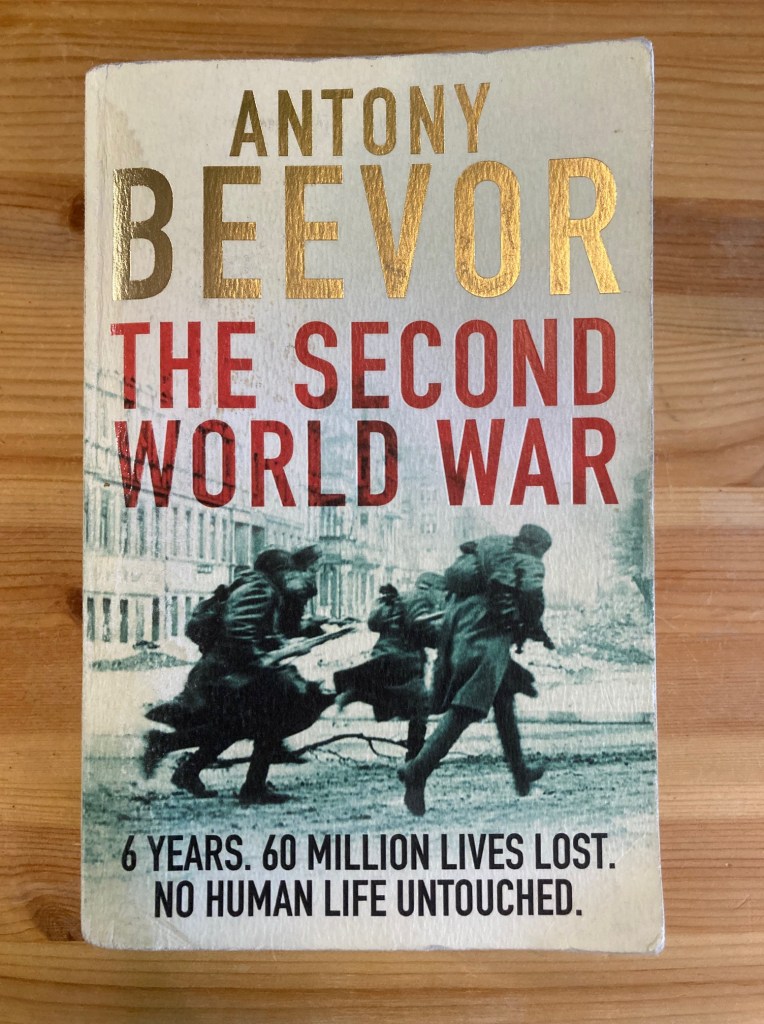
  • The Second World War 

    Antony Beevor 

    950 pages  

    Published 2012 

    Weidenfeld & Nicolson 

    Read from October 2025 – March 2026 

    History 

    Some historians focus on the minutiae of history: what is the history of the dice? Why did the shape of ringpulls on tinned food change? What role did shoelaces play in the Mongol Empire? Not Antony Beevor.  

    ‘Antony, what are you writing about next?’ 

    ‘The Second World War.’ 

    ‘Which bit-?’ 

     ‘ALL OF IT.’ 

    In reviewing non-fiction, and history books in particular, it can be tempting to list all of the information gleaned, and it is testament to the quality of this book that in writing this review it was tempting to list many, many things. Initially daunted by its length, once I got going the 950 pages were a pleasure to read. Narrative-driven but analytically insightful, The Second World War is well-paced and conveys the overall story of World War Two in a balanced manner. Despite being so long, there is a slight trade-off between scope and depth, with scope winning out. This isn’t to say that Beevor doesn’t have an eye for detail; he knows what to include while keeping the story moving, and given how long it would have been otherwise, this is a minor and sensible compromise and remains a highly educational read.* Beevor also makes just the right amount of space for the human element of the war and the interest that this generates is a good starting point for further, more specific, reading.   

    The national stories of the Second World War obviously vary, but Beevor – a British historian – makes efforts to cover all theatres. Besides the well-known events (from a British perspective) – the Blitzkrieg (which Beevor contends was improvised in the moment and on the ground rather than premeditated), the Battle of Britain, the Blitz, the North Africa campaign, the Eastern Front, D-Day – it covers lesser-known domains, such as the Winter War, the Italian invasion of Greece and the German invasion of the Balkans, and in particular, the Sino-Japanese theatre. 

    Beevor shows a particular focus, unsurprisingly, on military matters – particularly the distribution and movement of forces by commanders – and analysis of leaders, which in this war featured a lot of big personalities. Beevor doesn’t delve into the great man of history theory directly, but he does make it clear how important these particular people were, from Hitler’s uncompromising vision and interfering manner, to Stalin’s paranoia and ruthless obstinacy. I was also surprised at how badly world leaders, leaders-in-exile, military commanders and resistance-movement leaders, ostensibly on the same side, seemed to get along most of the time and how much politicking they engaged in. Many had post-war visions of their country or empire in mind and wanted to make sure that, come the cessation of hostilities, they would either be in charge or be able to pre-empt any civil war. 

    As with his analysis of citizens being caught between systems, Beevor also dispels the ‘good solider’ myth, and how it was more a case of people trying to survive the commanded action (whether combatant or civilian). His criticism is also balanced without producing any false equivalences. In particular, he looks at how British and American ‘targeted’ bombing was so inaccurate that it was more fitting to think of it as area bombing, and criticises this as morally indefensible. 

    Besides Beevor’s own analysis, his insights enable self-made analysis. One example, I already had some understanding of how poor Hitler was as a war-time leader, but didn’t appreciate the extent to which he interfered in command, believed in his own propaganda and refused to even consider strategic withdrawals. Both he and Stalin maintained hold of their subordinates through divide and rule in order to have direct control over all parts of their armed forces. 

    There are a couple of minor niggles: the front cover states that the war left no life untouched, but Latin America is barely mentioned and Sub-Saharan Africa is similarly limited. It would have been nice to have more on the end of the fighting in Italy, and overall, although it includes some post-war analysis, it ends a bit suddenly, although it’s fair to counter that a line had to be drawn somewhere as World War Two became the Cold War (‘Greece was another example of the Second World War merging into a latent third world war’). One point I would have liked Beevor to share his thoughts upon was if Hitler hadn’t believed in labensraum and the triumph of the will so stubbornly, and had been a more pragmatic military commander, would the Axis powers have won? There are several maps, but even so, a few more would have made it much easier to understand the progress of battles and how frontlines moved. Likewise, it would be useful to know what a division, battalion, army etc. consisted of, given that these varied from country to country. 

    However, befitting the title, Beevor does a good job of tying it all together, stating:  

    The Second World War, with its global ramifications, was the greatest man-made disaster in history. 

    Worth reading? Yes.

    Worth re-reading? Yes, although an alternative would be to read around the subjects that you find particularly interesting.

    *Winston Churchill’s history of the Second World War consists of six volumes if you really want what I assume to be a particularly splenetic account of the conflict. 

    ** It was interesting to contrast Beevor’s hyper-detailed Stalingrad with The Second World War and how Germany’s Russia campaign fitted into the wider story of the Second World War, particularly how it influenced the fighting in China and North Africa. 
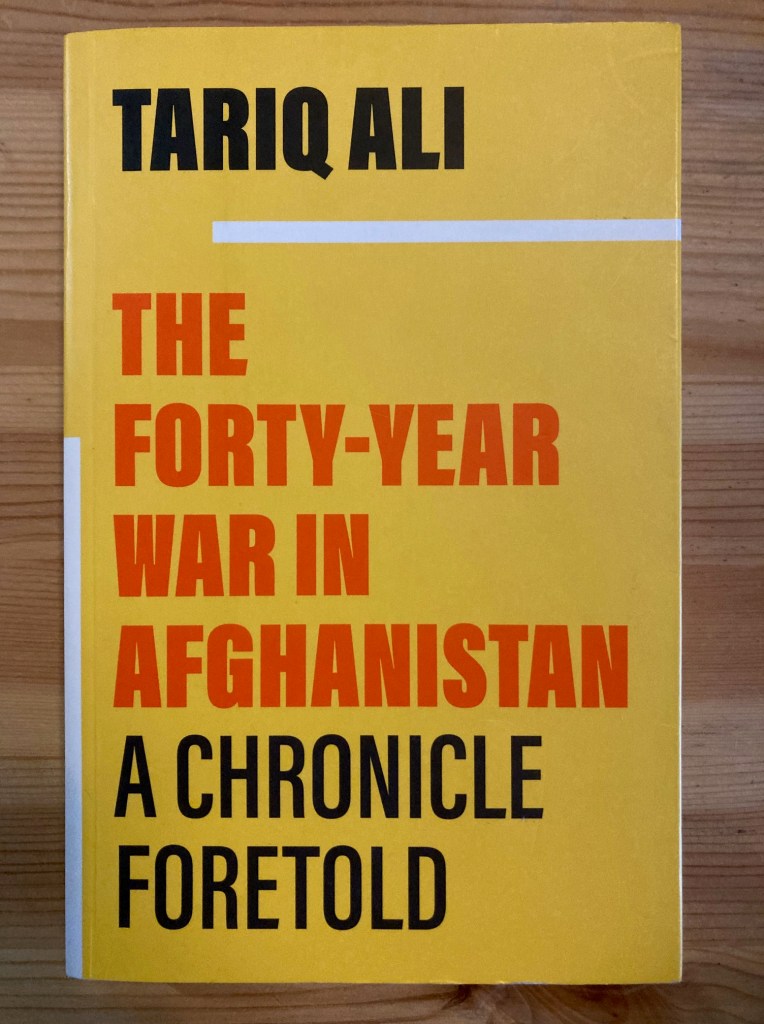
  • The Forty-Year War in Afghanistan

    Tariq Ali, 2021

    Edition read: Verso, 2021, 244 pages

    Non-fiction

    Read: October–November 2025

    The Forty-Year War in Afghanistan is a collection of twenty-six essays (and one exchange of letters) on the various occupations of Afghanistan, penned by the left-wing journalist Tariq Ali. It dates from 1980–2021, critiquing the Soviet occupation, the Afghanistan–Pakistan–US relationship (as well as the involvement of China and Saudi Arabia), through to the NATO withdrawal and the fall of Kabul to the Taliban. 

    Despite its disastrous ending, the invasion and occupation of Afghanistan is widely considered to have been a justified war (certainly compared to the invasion of Iraq). Ali gives this outlook short shrift, arguing that the NATO occupation repeated the mistakes of the Soviet one, such as installing unpopular puppet rulers (indeed, the subtitle is A Chronicle Foretold). 

    Looking at the occupation of Afghanistan in retrospect, and how badly it was managed and ended (and what life is now like for Afghans), it’s somewhat hard to argue that Ali doesn’t have prescient points to make. With hindsight proving him accurate on several matters, he regularly refers to his detractors’ contemporaneous criticisms that he is a cynic with a dark sense of humour. 

    He writes eloquently and his arguments are sophisticated. Because sophistication necessitates complexity, I would advise reading these commentaries one at a time, rather than treating this as a whole book: they’re not always the easiest pieces to read and digest, and being a series of essays, it’s not as comprehensive as a history book. There is plenty to learn, just not always in a straightforward format, and the bias is obvious (although I’m sure Ali would argue that these are just the facts). 

    However, a lot of the strength of his argument is drawn from how badly the occupation was managed (which he primarily believes was due to the corruption of the United States’ choice of new Afghan leadership and the failure to address elements within Pakistan and Saudi Arabia that supported the Taliban). This is slightly different to whether Afghanistan should have been invaded post-9/11, and there is a distinction to be made between ‘Was it justified?’ and ‘Was it well handled?’. If the occupation of Afghanistan had been successful (i.e., led to a reconstructed nation), would the invasion of it have then been justified? 

    As such, I wasn’t fully convinced by Ali’s argument that Afghanistan shouldn’t have been invaded post-9/11. He argues that Bin Laden should have been arrested and that the Taliban were ready to hand him over to the US: 

    It need hardly be added that the bombardment and occupation of Afghanistan has been a disastrous – and predictable – failure in capturing the perpetrators of 9/11. This could only have been the result of effective police work; not of international war and military occupation […] According to the official 9/11 Commission report, Mullah Omar’s initial response to Washington’s demands that Osama bin Laden be handed over and al-Qaeda deprived of a safe haven was ‘not negative’ […] but while the Mullah was playing for time, the White House closed down negotiations. It required a swift war of revenge. Afghanistan had been dominated the first port of call in the ‘global war on terror’, with Iraq already the Administrations’ first target […] Predictably, it only gave al-Qaeda leader the change to vanish into the hills. 

    My doubts come down to whether the Taliban would have actually done so, on which there are a myriad of conflicting sources. In The 9/11 Wars, author Jason Burke states that this was never going to happen. 

    I was also dubious about his argument that ‘What is really required in the region is an American/NATO exit strategy from Afghanistan, which should entail a regional solution involving Pakistan, Iran, India and Russia. These four states could guarantee a national government and massive social reconstruction in the at country.’ Given his own criticisms of Pakistan’s vested interests in its neighbour, I doubt that this measure would have led to a successful reconstruction. 

    Ali did, however, make me challenge my assumption that if Iraq hadn’t been invaded, the invasion of Afghanistan would have been successful. He argues that this occupation was mismanaged from the outset, criticising NATO’s selection of new, incompetent, corrupt leaders for Afghanistan, Hamid Karzai in particular.  

    While reading this, I tried to keep in mind whether I was reviewing a book or reviewing the justification and success of the Afghan war. Although not taken in by all of its arguments, Ali does ultimately make a convincing argument that the invasion was a misadventure and that the quality of lives for Afghans – perhaps the most important metric of the success of the invasion – has only gotten worse. Reading this in 2025, it is a saddening fait accompli

    Worth reading? Yes. Ali has a fairly rare opinion on the matter and it is interesting to read his arguments, whether you ultimately agree with them or or not.

    Worth re-reading? Yes, due to how detailed it is.

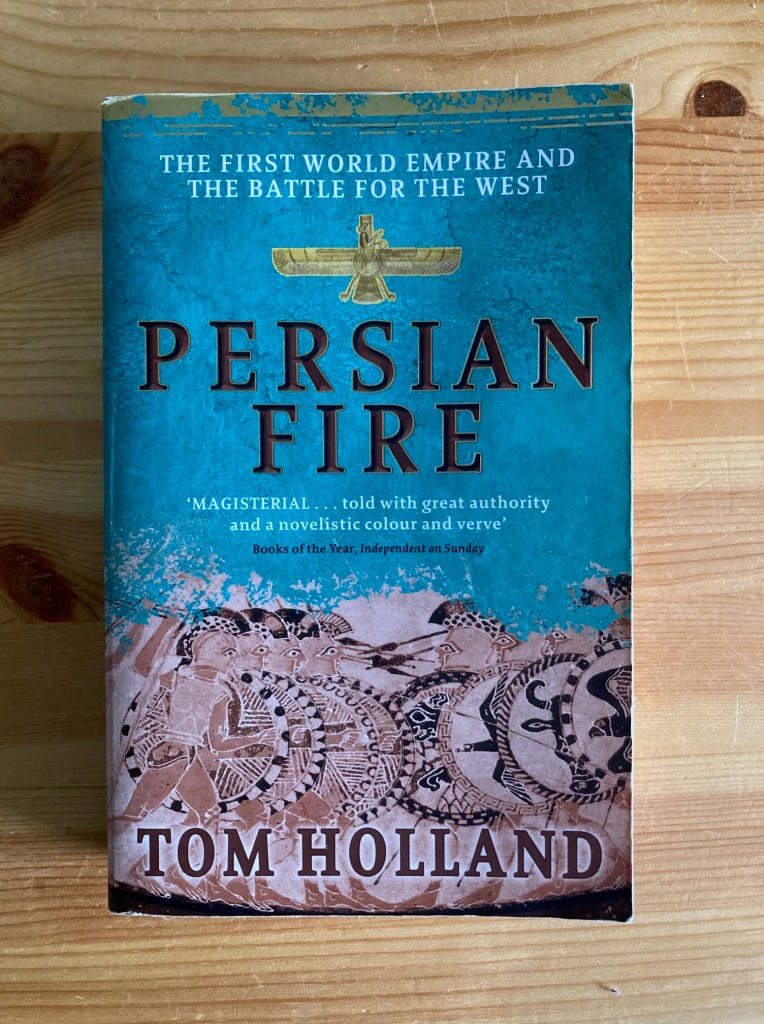
  • Persian Fire

    Tom Holland 

    Read: August 2025

    Edition read: 2005, Little Brown, 448 pages

    Non-fiction, history 

    Tom Holland’s Persian Fire details the attempted invasion of modern-day Greece by modern-day Iran, including the battle in which roughly 7,000 Greeks held the Thermopylae Pass against circa 100,000 soldiers of Emperor Xerxes’s invading army for 3(ish) days, in 480BC. 

    In providing the context of the Greco-Persian Wars, it challenged a somewhat unconscious preconception I had that eras start and end. Rather, they bleed into each other, passing on parts of culture and splitting along the way. It also provided a few rude corrections to the artistic liberties taken by Frank Miller in 300*, not least that the Persian army did not include divisions of ghouls and elephants. 

    It also altered my understand of what decides history: I was expecting more on the Battle of Thermopylae, but Holland outlines how this was only part of the Greco-Persian Wars, which were years in the making in themselves. Case in point, the Greek alliance – and not just the Spartan army – also made other decisive stands – these one successful, such as the Battle of Salamis and the Battle of Plataea, which ended the Persian attempt to conquer Athens and Sparta. Holland’s writing style is easy to follow, despite the plenitude of names, places and people and the vast scope of time that Persian Fire covers. The narrative is detailed yet well-paced and at points feels like an action story: Holland has a sense for what is engaging and what is the right amount of context. 

    Worth reading? Yes. 

    Worth re-reading? Yes. 

    *Review forthcoming. 

  • Black Spartacus: The Epic Life of Toussaint Louverture

    Sudhir Hazareesingh, 2020

    Read: 2020–24

    Edition read: Allen Lane, 2021, 464 pages

    Non-fiction, history

    Take #2 (or #3?)

    Toussaint Louverture (or, if you like, the slightly more dashing Toussaint LOuverture) led the only successful slave revolution since, well, the other Spartacus, freeing Haiti from French slavery. Nonetheless, he seems to have remained a generally unknown figure until this book came out in 2020 to much acclaim (I found out about him via a Swans song, which doesn’t exactly scream ‘well known’ either).

    I found this a hard read. There is a narrative, but it feels more like a loose structuring tool/device for details about Louverture and the ideas surrounding him, rather than a narrative-driven piece of history. 

    Although I appreciate that ideas and events can drive history as much, if not more so, than people, it ends up feeling academic.

    Louverture and the Haitian slave uprising is one hell of a story – it’s just how it is told. I am still interested in Louverture and the Haitian Revolution, but think I will try a different book next time. I even tried to read it via a set number of pages per day, but, ultimately…

    …DNF

    Worth reading: No

    Worth re-reading? No