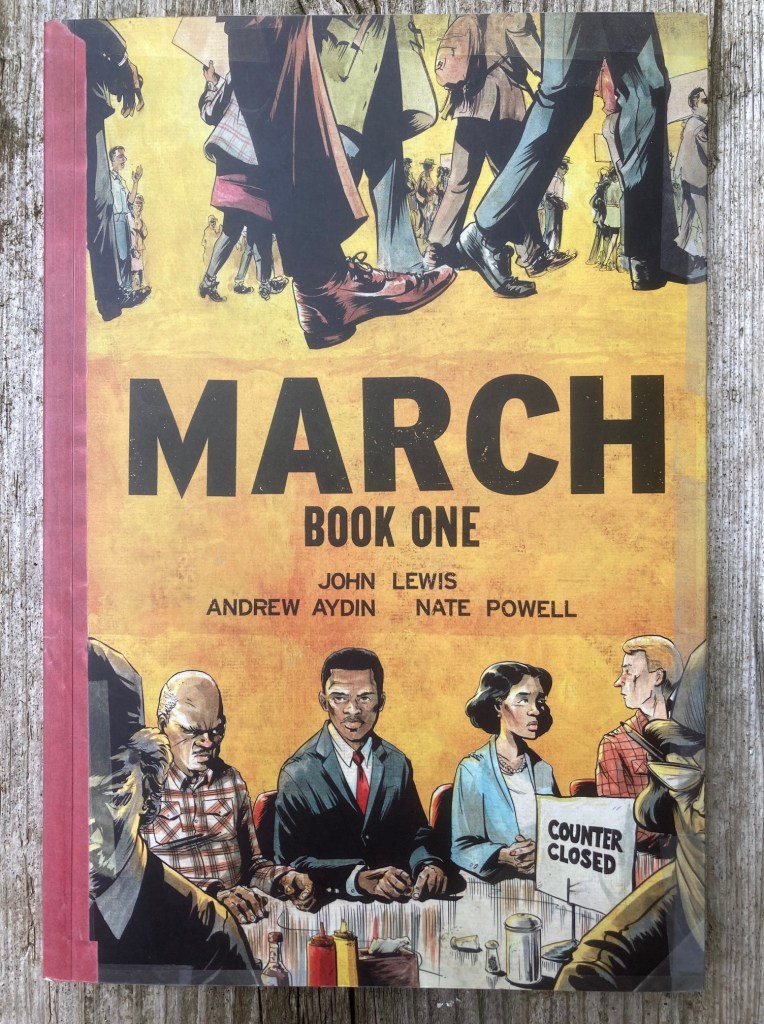
John Lewis, Andrew Aydin and Nate Powell, 2013
Read: March 2025
Edition read: Top Shelf Productions, 121 pages
Non-fiction graphic novel
Part 1 of 3
I read this – the opening volume of an autobiographical graphic novel of the American civil-rights activist John Lewis – a coincidental 60 years after the Selma to Montgomery march.
It moves between the two narratives of Lewis’s day on 20 January 2009, and his life as a child on a sharecropper farmer in Alabama, establishing how one man’s story transformed into history.
In a style best described as sober (although it is not without creativity – the panes change shape, with content often spilling over outside of them), it has the feel of a documentary (the black and white shading further adds to this), to tell Lewis’s story, including how the civil-rights movement largely worked not in rivers but in drops. The US civil-rights movement – at least in the UK – can sometimes be told in a reductive manner that is reduced to just Martin Luther King and Rosa Parks, with Lewis not a particularly well-known figure (‘Big Six’ was not a term I was familiar with), so this was an educational read. As much as March tells Lewis’s story, it’s also about the story of the civil-rights movement, combining the personal with history, making it as much a memoir as a history book. As volume one of three, it ends with the story and struggle still very much in motion.
So – why a graphic novel, especially given that Lewis already has a couple of published memoirs? The dramatic devices, such as the contrast between opening with the civil-rights activists beginning to cross the Edmund Pettus Bridge on 7 March 1965 and Lewis waking up in Washington D.C. on 20 January 2009, as well as the aforementioned black-and-white feel, are powerful, but the references by Lewis and his co-authors to the 1958 comic book Martin Luther King and the Montgomery Story are instructive; where we were, where we are, and where we might be in another 60 years.
Worth reading? Yes.
Worth re-reading? Yes.
 The Page Count