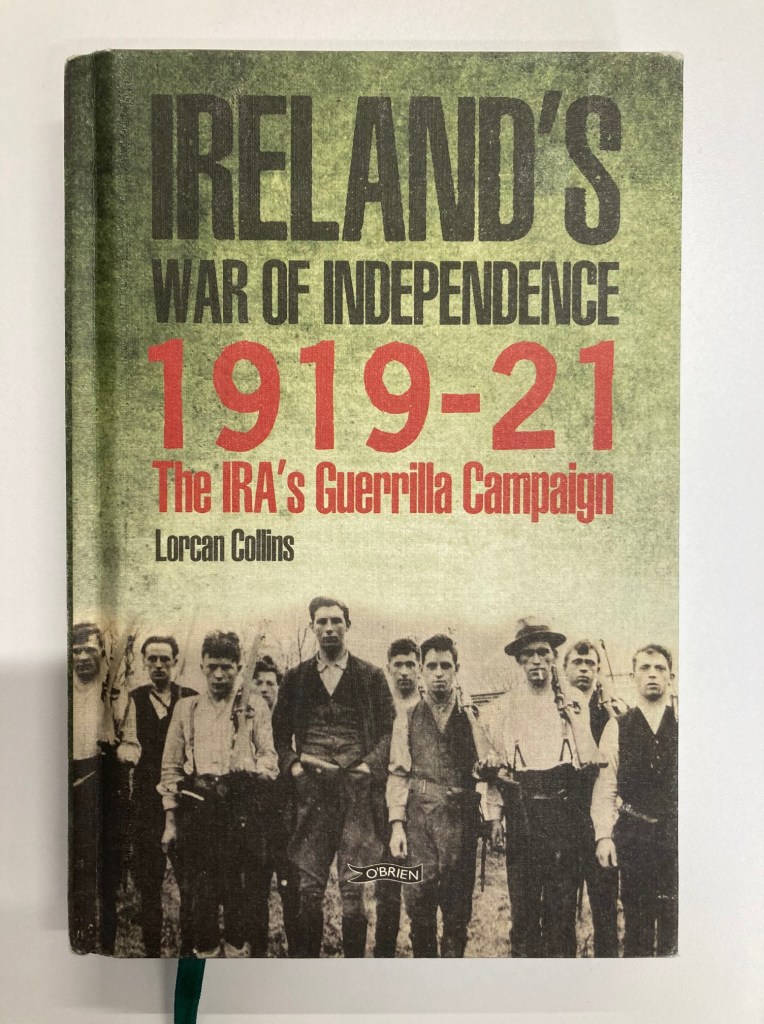
Lorcan Collins, 2019
O’Brien Press, 2024, 286 pages
Read August–September 2026
Non-fiction, Irish History, War, Politics
The Irish War of Independence, despite leading to the modern-day partition between Northern Ireland and the Republic of Ireland (initially called the Irish Free State), and then arguably to The Troubles, isn’t a particularly well-known conflict in Great Britain.
Perhaps overshadowed by World War One, it followed on from what the 1916 Easter Rising started and was one of the first successful wars that led to the shucking off the ties of the British Empire.1 The subtitle The IRA’s Guerrilla Campaign is indicative: this title emphasises the military operations of the Irish Republican Army (here meant in an older sense of the phrase, before its schism at the start of The Troubles), with Irish historian Lorcan Collins listing the events of the countryside-based guerrilla war and the assassinations that took place in Dublin in detail.
The names of the Irish combatants, including those who played a minor part, are listed meticulously, whereas the names of the British combatants – whether killed, wounded, unscathed – are generally not. However, the latter’s war crimes certainly are; with many (although, as Collins highlights, not all) of them having recently returned from World War One, they are depicted as lashing out in increasing frustration at civilian populations following hit-and-run attacks. The scenes of indiscriminate shooting and burning read like precursors to American forces in Vietnam. On the other hand, the IRA’s burning of the ‘Big Houses’, those of the land-owning, British-aligned, Protestant Anglo-Irish, is treated as fair game.2 Furthermore, in his conclusion, Collins doesn’t mince his words on the British Empire, referring to the Anglo-Irish Treaty as an ‘unfair imposition on Ireland’ and as the spark for the following Irish Civil War (which he concludes was far worse than the War of Independence). It’s not that this bias towards Irish nationalism/republicanism feels particularly unfair (assessing 800 years of English/British presence in Ireland, you’d be hard pushed to argue that it was of a net benefit); it’s just a sentiment worth being aware of. To generalise, this is an Irish perspective on what continues to be perceived on a national basis as a legitimate act of resistance against a brutal occupying force.
Although an engaging story with lots of action, during the course of the war (as opposed to beforehand and afterwards), the listing of names and slightly disjointed structure means that it can sometimes end up feeling a bit like reading a series of museum placards. While Collins does an admirable job in telling the stories of the untold, the focus on the day by day and on the military side of the war is sometimes at the expense of the big picture, as the broad scope is not always accompanied by depth. The shame of it is that Collins demonstrates great analysis of the war’s conclusion. A pre-existing interest in Irish history will help, but less initially engaged readers might find this hard work.
Worth reading? Yes
Worth re-reading? I would probably spend that time reading a supplementary title, such as Land Is All That Matters (review forthcoming).
Notes
- From a quick read around, it was pipped to the post by Afghanistan, and of course, the US.
- The names of British soldiers that Collins clearly feels were killed unfairly are listed. His inclusion of names seems to be more predicated on a sense of fairness than sectarianism.

