Tag: music

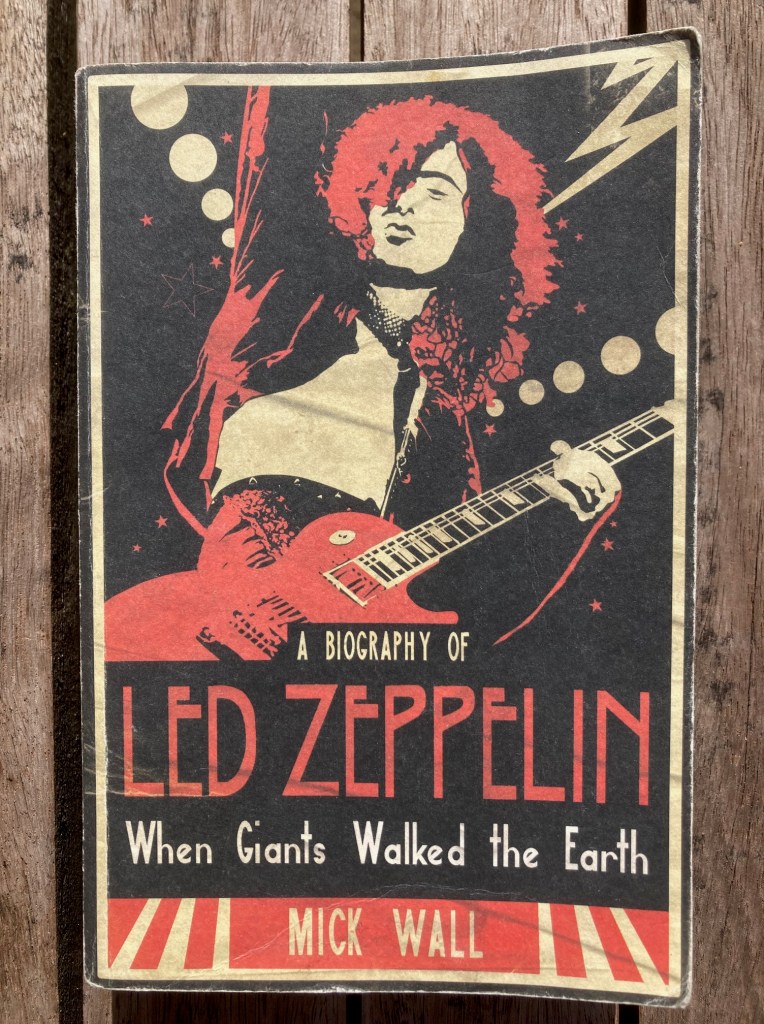
  • Led Zeppelin: When Giants Walked the Earth 

    Mick Wall, 2008

    Orion, 2009, 534 pages

    Read June–July 2026 

    Non-fiction, Music, Biography 

    A more journalistic, less bombastic biography of Led Zeppelin than the recently reviewed Hammer of the Gods. There is less of the latter’s ‘Apollian versus Dionysiac’ stuff, and although Hammer of the Gods possessed detail (with Mick Wall even crediting it here), where When Giants Walked the Earth distinguishes itself is in its better structured documentation of the rise and fall of the band. 

    Rock journalist Wall gives a good sense of how the giddy heights that they attained made it seem that they were a monolith which would never come off the rails – but also that the reality was that they were four highly talented, very well-guided musicians who ended up seduced by the power that they attained. 

    Manager Peter Grant is credited as enabling guitarist and band leader Jimmy Page’s vision, and Led Zep’s consequent success, through his refusal to accept industry norms (particularly when it came to splitting money) and his ability to harness them as workhorses (four North America tours in 1969 alone, slotted between UK and European dates). It’s made clear that Led Zeppelin was a carefully managed business set up, and that this was what allowed them to become the biggest band in the world – as well as their ability to combine light and dark, ‘synthesise’ (read: sometimes steal) ideas and work very quickly when they needed to (although the mixing and mastering of each album always ended up rushed). 

    Wall also makes it clear that this was aided and abetted, of course, by the singular luck of all great bands: the right musicians finding each other. This is complemented by fictional first-person interludes from the perspectives of the band members and Grant. Jumping from a narrative about the biggest band in the world to these assumed first-person perspectives, delving into the minds of five singular people, made for interesting counterpoints. Page, in particular, retained a great deal of control over their music (it was also interesting to read how there was always some distance between Page and vocalist Robert Plant).  

    Where these first-person interludes fall short is that even as their story progresses and Messrs. Page, Plant, Bonham and Jones develop from jobbing musicians to the biggest band in the world, they continue to take place in their pre- or initial Led Zep days. By the time it reaches the 1979 writing sessions for In Through the Out Door, it feels odd to jump back to moments like John Paul Jones’ perspective of his first meeting and practice with John Bonham in 1968. 

    Wall also arguably spends a bit too much time on Page’s Satanism, with a whole chapter (29 pages) on black magic(k) and Alastair Crowley, even entertaining the idea that Kenneth Anger placed a curse on Jimmy Page in 1976. 

    However, as stated, Wall maps out the rise and fall of the band clearly, and that the second half of their career went from disaster to disaster. They reached their pinnacle circa 1974: 

    If the first four years in the life of Led Zeppelin had been about empire-building, the next four – from 1972 to ‘75 – would find them overseeing their kingdom with all the splendid pomp and inherent arrogance of Pharaohs.

    He goes into the drugs problems that plagued the band towards the end – in particular, how Page’s heroin addiction caught up with his playing, Bonham’s behaviour made him dangerous to be around (‘La Bête Noire’), how their 1979 Knebworth shows, set up as their big UK comeback, were a disaster, with manager Peter Grant devolving from a sharp-elbowed, astute businessman into a paranoid bully. Wall also contends that the second of these two shows – which undersold to the point of financial disaster – signalled that rock music had moved on while Led Zep had been recuperating from various issues during the latter half of the 1970s. He even goes to the extent of arguing that the band was figuratively dying for a long time before Bonham literally did. Wall also makes it clearer than Davis that the band had their off nights, and has very little time for In Through the Out Door  in particular.

    He spends a fair bit of time on the 2007 reunion (verdict: good but safe) and why it didn’t last past that one show: post-1980, Led Zeppelin very much remained Page’s baby, with Plant having moved on into a solid solo career and Jonesy having become a friar. 

    In comparison to Hammer of the Gods, Wall is better at holding the band to account: he rightly goes into the ugly details of the Grant, Bonham, Bindon and Cole assault on a security guard, is critical of Led Zeppelin’s failure to credit the original songwriters (I particularly enjoyed the interview with Bert Jansch) and how the band let Bonham get away with his Jekyll and Hyde act (additional acts of assault and attempted rape) because it didn’t affect his drumming and allowed him to bear the commitments of touring and living away from his family. Whilst fittingly critical of Bonham’s errant behaviour, I would have appreciated Wall taking a more strident approach to Page’s relationship with a fourteen-year old. 

    Worth reading? Yes.

    Worth re-reading? Yes – a good story told well. 

    If you are interested, you might like…

    Hammer of the Gods –  Stephen Davis

    Led Zeppelin by Led Zeppelin

  • Last Rites

    Ozzy Osbourne with Chris Ayres, 2025 

    Sphere, 2025, 351 pages 

    Read July – August 2026 

    Non-fiction, Autobiography, Music 

    Black Sabbath’s (first) vocalist; the animal-chomping rock star; the ageing media personality: Ozzy Osbourne had several looks over the years.1 

    Last Rites is the ageing media personality looking back on his animal-chomping rock-star days, and bits of being a forming member of Sabbath, while dealing with a litany of concurrent health issues. The book hinges upon these maladies and moves back and forth from there. The tone is conversational and it certainly sounds like Ozzy.2 Besides the erraticism of the shifting chronology, it also jumps from subject matter to subject matter (often concluding with ‘Anyway, [proceeds to get back to the original point]), rather than forming a chronological account of his life. Initially this feels a bit haphazard and clunky (as does his phonetic spelling-out of riffs), especially if you aren’t familiar with Ozzy’s mannerisms. However, he was nothing if not entertaining, and this comes across in the writing style (on surviving consecutive surgeries and health scares: ‘I celebrated by getting pneumonia again’). Not only does this carry the non-sequiturs, but given Ozzy’s characterful manner, with time it even comes to feel fitting.3

    With that said, Last Rites is at its most interesting when covering Black Sabbath’s music, Ozzy’s upbringing and his post-Sabbath musical career. Fair enough, drink, drugs and the attendant mishaps are part of the Ozzy story, and he recounts them in an entertaining manner, but these are common to many a rockstar’s autobiography/biography, so these sections are OK, but nothing you won’t have read elsewhere about flights of self-destruction (‘Lemmy was the one guy I just could not keep up with’). 

    Although geriatric complaints don’t sound like particularly compelling reading, the health issues – Parkinsons, staph infections, a backbone seemingly consisting of apple crumble (there’s a lot of back surgery) – form an interesting counterpart to a lifetime of hard living – as well as a look into the more mundane, poignant reality of just getting old. The No More Tours II, er, tour, endlessly delayed because of these issues, becomes Ozzy’s white whale, and in his pursuit of this, what really comes across is his love of performing and singing. For all of the above set-up of Ozzy as a larger-than-life personality first and a musician second, he really comes alive when talking about music and his love of performing, as well as his love of the fans.4

    It is called Last Rites, and it does cover his last gig, only 17 days before his death. This must have left co-writer Chris Ayres with a careful decision to make – acknowledge this, or write as though he’s still alive and cursing away? In the end, the only acknowledgement, besides the title, is on the dust jacket. Otherwise, the tone (and that it’s told in the first person) means that, should you not know of Ozzy, you wouldn’t know that this is posthumous. While he often talks of having well and truly used up his nine lives and how he could head off to the great gig in the sky tomorrow, he also talks about all of the things he still wanted to do and the people he wanted to see. This makes for several poignant moments as the end approaches.

    I would have liked more on his time in Black Sabbath, album by album. He does remark upon Sabbath wanting to be heavier than anything that had come before, Geezer Butler’s lyrics, the influence of jazz on Bill’s Ward’s drumming, and the songwriting process, or lack thereof. He admits that Tony Iommi was the unofficial leader and does touch upon the sound of Black Sabbath and what they set out to create. There is some mention of Sabbath’s fractious nature, and how Bill Ward was left behind in the making of their reunion album 13, but again, I would have liked more detail on this – was it always the case; did it develop with time; did the mountains of cocaine have anything to do with it? Likewise, I would have liked more on songwriting post-Black Sabbath; he worked with an array of great guitarists, but the songwriting process isn’t covered in any detail.5

    However, the discursive nature of the writing does allow for many a digression into unrelated subjects – driving in the UK versus the US, modern dating, social media, how Birmingham has changed, modern recording techniques, addiction, the legalisation of weed, guns, the Blitz, the Concorde, Guinness (‘I dream about Guinness almost every night. I fucking love the stuff, it’s like drinking a glass of pudding.’) Normally this wouldn’t be that interesting, but as stated, Ozzy’s voice is inimitable and entertaining (on eating up to 12 apples a day: ‘It’s a wonder I didn’t wake up one day with an apple tree sprouting out of my arse’.)


    That first note of ‘Iron Man’ gets me every time, man. You feel it in your bowels. Your teeth. Our bones. It’s like the gates of hell grinding open. Like the groan of Heinkel bombers as they dipped below the clouds to try to take out the Castle Bromwich Spitfire factory, night after night. Like the thunder of the heavy machinery out fathers used to operate. And their fathers before them.

    Worth reading? If you are already interested in Ozzy, yes. 

    Worth re-reading? No. I think this time would be better spent reading a Black Sabbath biography or a more comprehensive Ozzy biography.

    If you are interested, also read listen to: 

    Black Sabbath – hear heavy metal being created. 

    Paranoid – their best album.  

    The Blizzard of Oz – Ozzy’s first solo album. It has a very different, more modern sound than Sabbath, arguably closer to rock than metal, aided and abetted by Randy Rhoads’ shredding. 


    1. Shortly after Lemmy died, I observed on my music blog that ‘Motörhead + past tense = strange’. Same here.

    2. I normally refer to authors and their characters by surname only upon subsequent mentions, but Ozzy has earned his demonym and will be referred to as such.

    3. A personal favourite is Ozzy recording a promo for the Radio 1 Rock Show, in which he mispronounces his own name as ‘Blozzy Osbourne’. Apparently, no one thought he had a better take in him and that’s how it stayed. 

    4. Lest we forget, he also helped to invent heavy metal.

    5. There are at least two Ozzy autobiographies: I’m not sure what the difference is between this and I Am Ozzy, published in 2010. Or maybe the latter covers the subject areas I thought lacking herein. Maybe they form a series?

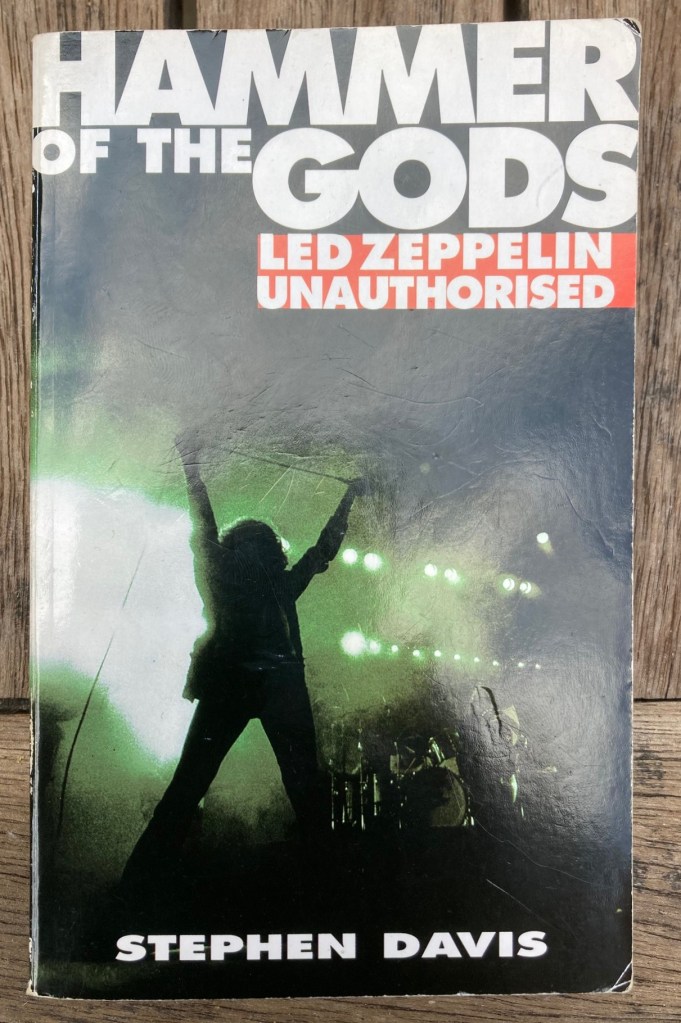
  • Hammer of the Gods

    Stephen Davis, 1985 

    Pan Books, 1995, 350 pages 

    Non-fiction, Music, Biography 

    Read: 2004, re-read April–May 2026 

    It is telling that the introduction (or ‘Overture’, as author Stephen Davis would have it) of Hammer of the Gods starts with allegations of the band’s sexual exploits, then moves straight onto Satanism. Circling back to Led Zeppelin’s bread and butter – y’know, music – the problem with this strong focus on their mythos is that, again, circling back to that primary means of assessing a band – y’know, listening to their music – some of their songs but certainly not all of them support this. This sets the over-the-top tone and an understanding that this is music fandom as much as music journalist (on one Led Zep concert: ‘Gradually Zeppelin’s avowed Apollian intent reverted to a Dionysiac bawdiness’). Hammer of the Gods is at its best when it does discuss their music, mythos-driven or not. 

    Starting with the four members’ backgrounds, and how half of the band were middle-class, experienced session musicians, and the other half labouring, working-class white bluesmen, with each album Davis provides a song-by-song breakdown. These are some of the best sections of the book and his observations are astute. 

    Besides Jimmy Page as the session guitarist, it also examines him as the producer and as the businessman. Davis also spends a good deal of time on the importance of Led Zep live: the details of their hectic touring schedules; how much they improvised live, particularly on their big US tours in the early ’70s; what the live experience was like; and how their early choice to focus on the US was driven by the hostile British press (and later on, the tax breaks).

    Hammer of the Gods is also strong when referring to quantifiable achievements – ticket sales, number of shows, records sold, records charted. What could have been just a list of numbers is written in a way that shows just how big they became and how they, with the help of manager Peter Grant, upended (disrupted?) the music industry. It also provides a good sense of how the band did most of their work in the first half of their 12-year career, and were less active after 1975, with fewer tours, and a decline to match their rise, somewhat of a squander fuelled by drink and drugs. 

    A bit more insight into the band hierarchy would have been interesting. Although it makes it clear that Page was the leader, internal power struggles within the band are referred to but not properly explored. Page is the visionary; Robert Plant is the coolest; John Bonham, when away from a drum kit, has to be carefully managed; bassist John Paul Jones remains in the background as the band’s the secret weapon.* We are left none the wiser as to whether there were there ever any creative differences. 

    The narrative does sometimes read as a list of events, mostly so when they are debauched tales from tours of the US. Sure, this is part of the Led Zeppelin story, but what does it all mean?  A bigger problem is that, although he mentions them, Davis doesn’t give the band’s most problematic aspects the insight that they merit. It would have been nice, for lack of a better word, if Davis expressed stronger feelings about the predatory behaviour that Page practised towards girls. Page’s alleged Satanism is brought up and discussed plenty enough, but the coverage of his relationship (read: grooming and kidnapping) of a fourteen year-old feel cursory. 

    Additionally, when drunk, John Bonham was truly awful. In separate incidents, he attempted to sexually assault the journalist Ellen Saunder (who states that another unspecified band associate was also involved), rape an air stewardess, punched a woman in the face for no reason, and assaulted (read: tortured) a security guard. Besides tour manager Richard Cole and Grant enabling great success, they also enabled some of this unforgivable behaviour. Frequently depicting them with pirate imagery, at one point Davis describes them as ‘gangsterish’, but otherwise leaves it there. 

    Also problematic is the band’s (which translates to Page’s and Plant’s) penchant, particularly in their early days, to lift vocal lines and other melodies from other artists, particularly blues artists, freely and without credit. Having listened to a lot of these originals, they are adaptions and launching points rather than covers, but the lifting of ideas is still clear (Davis also drops the n-word out of nowhere when discussing one of Zeppelin’s bluesy intros – there’s no other signs of racism, but whatever point he was trying to make, it’s highly jarring.) 

    Some of this book is just bullshit – such as the front row of a crowd headbanging against the edge of the stage – and more broadly has been reported to be an unreliable source. As the title states, this biography is unauthorised and the band have stated that Davis spent a very limited amount of time with them. Cole, who had his own disputes with the band and Grant, is a primary source. 

    Wow. This has been a bit of a negative review. Did I enjoy reading it? Well, Led Zeppelin were my favourite band growing up, and this was essential reading for me as I got into them. Re-reading Hammer of the Gods – and in particular, Davis’s great descriptions of their music and the power therein – did encourage me to relisten, rewatch (to The Song Remains the Same and the self-titled 2003 live DVD), but also to read around (the 2018 self-titled photo book) and to reappraise them. On the merit of his music and his drumming, Bonham’s death is a sad ending – a talent enabled by success to act without compunction. 

    So yes, I enjoyed it. It’s just that it read as a piece of musical fandom, rather than a piece of journalism upon music and musicians. 

    This review is a compare and contrast with Mick Wall’s When Giants Walked the Earth: A biography of Led Zeppelin, soon to be reviewed. 

    *Yes, I play bass. 

    If you liked this, you might like…

    When Giants Walked the Earth, Mick Wall

    Led Zeppelin (photo book), Led Zeppelin

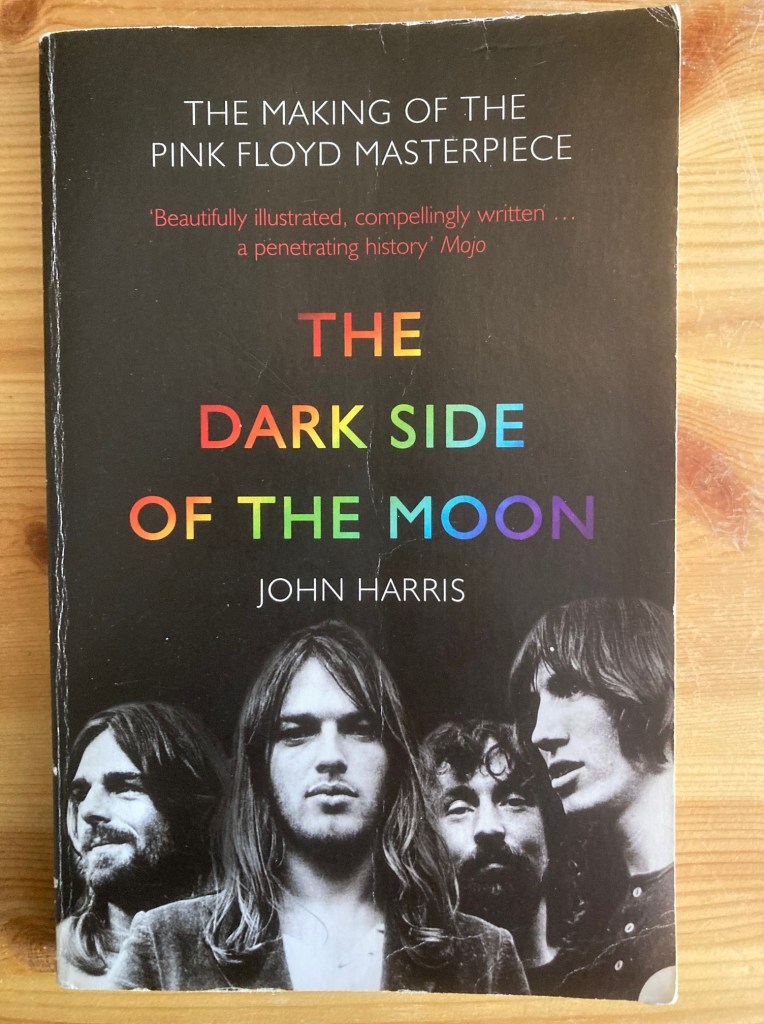
  • The Dark Side of the Moon: The Making of the Pink Floyd Masterpiece 

    John Harris, 2005 

    Harper Perennial, 2006 

    180 pages 

    Re-read March 2026 

    Memoir/Biography 

    A partial biography of Pink Floyd with a focus on The Dark Side of the Moon. Starting with their formative years and the importance of Syd Barrett, it covers the band from inception through to the writing and recording of The Dark Side of the Moon, touching upon their subsequent efforts, their ugly fracturing and eventual dissolution. 

    Widely considered to be one of the best albums ever, it could be easy for the cultural cache of The Dark Side of the Moon to be misattributed to any telling of its story. Coupled with this is that music journalists tend to be, at least in their nascent stage, fans. However, a free pass for Messrs. Water and Gilmour et al. this is not; although enthusiastic enough, Harris still applies critical insight, with the Syd Barrett era generally coming across as inessential (‘“Corporal Clegg”’ may have been a rather directionless burlesque about an English war hero who “had a wooden leg”, an impression only furthered by a deeply irritating passage played on kazoos’). 

    Given the cohesion and sophistication of The Dark Side of the Moon, it’s also interesting how much Pink Floyd were still learning by trial and error on their eighth album. Harris listens around a lot, not only placing this album in its context after the widely forgotten Obscured by Clouds, but also to live recordings, giving an idea of how this album developed. He digs into the details of the recording process without it becoming a full technical rundown. It’s also interesting to learn how much they gigged during the writing of the album, including on US tours. What’s less surprising is the personalities involved. Whilst making it clear that this album was very much the creation of four people, Harris inevitably focuses on Roger Waters, who comes across as a dominating, oft-cantankerous figure. 

    It’s inevitable that reading about a band or album will recontextualise it, even if only slightly, through the shedding of mystique. Whether you want to know about the nuts and bolts of this seamless, wonderfully creative album is up to you, but if you do (and if the band you’re in starts playing different tunes), this is a great read. 

    Worth reading? Yes. 

    Worth re-reading? If you are a particularly big fan of Pink Floyd, yes.