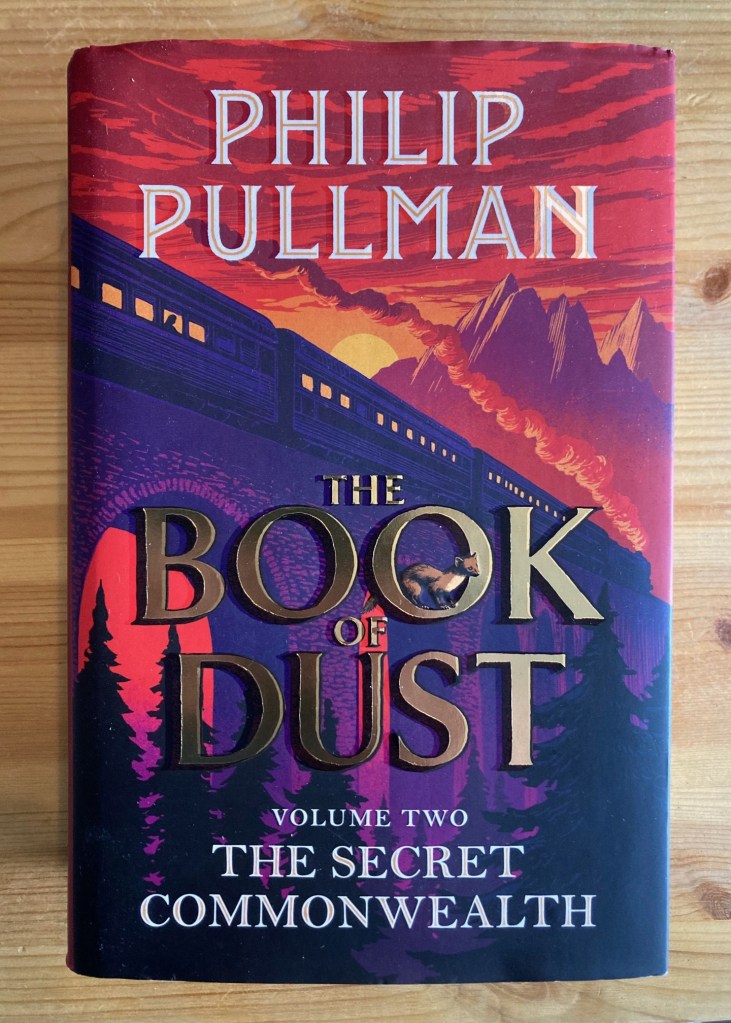
Philip Pullman
David Fickling Books, 2019, 687 pages
Read January 2020, re-read December 2025–May 2026
Fiction, adventure, steampunk
*Spoilers*
A return to the universe of His Dark Materials. Whereas La Belle Savage was a prequel to His Dark Materials, this – part two of The Book of Dust trilogy – is a sequel, continuing around ten years after the heartbreak of The Amber Spyglass.
Lyra is now a young adult, studying (and sinking pints) in her hometown of Oxford. The shadow of her past is not yet fully diminished, with her lost love, Roger, referred to a few times, and her and Pan now able to separate (in this universe, a huge taboo). Maybe as a way of coping with this, she’s really into the newly in-vogue philosophy of hyper-rationalism, which Pan – her manifested, pine marten-shaped soul – is understandably not too pleased about. This is against a backdrop of the Magisterium, an international religious institute, expanding and consolidating its powers.
From the inciting incident of Pan witnessing a murder, we have the elements of a mystery and the ingredients for a quest. There are two main driving factors, combining the global and the personal; Malcolm Polstead trying to find out why ‘men from the mountain’ are destroying vital rose fields in Central Asia; and the separation of Lyra and Pan, and Lyra’s subsequent hunt for Pan. The former is interesting, the latter is vital. Our Hero’s Path has been established.
The addition of new characters builds upon the existing universe, with established characters, beside Malcolm, returning, such as the gyptians and Hannah Relf.* There are a couple of difference perspectives – Lyra, Pan, Malcolm, Marcel Delamare (Lyra’s mental religious uncle), Olivier Bonneville (a fellow alethiometer** reader) – but it is Lyra who remains our (flawed) heroine.
However, in contrast to the preceding trilogy, this is not a story about or for children. Pantalaimon’s decision to separate from Lyra, partially due her being an insufferable student type, leaves her simultaneously untouchable and highly vulnerable. She finds herself having to travel through a world where she is constantly at risk, and is sexually assaulted and nearly raped at one point. Despite these adult concepts, the writing style reads as though for children at points, and this could be quite jarring; it sometimes moves from a very simple sentence to something very adult.
Whilst still critical of organised (and corrupt) religion, Pullman also rejects binary assessments. After the ‘God is dead’ schtick of His Dark Materials,*** he seems to be saying a) it’s OK to be supernatural (this is where the ‘secret commonwealth’ comes in) b) don’t be a hyper-rational dick who is so in thrall to sophists that even your manifested soul doesn’t want to hang out with you.
It’s long, and although it does have touches of the epic about it, it doesn’t quite justify its length. The plot is complex, with a lot of characters moving about geographically, and at times this made it feel like the transition piece in a series. While the finalé of the trilogy, The Rose Field, will determine whether this pays off, judged on its own merits, not everything in The Secret Commonwealth worked well, such as the sequence with the alchemist Agrippa, which felt a bit like a connecting device. Malcolm’s hitherto unmentioned feelings for Lyra seem unfounded, and the religious villains, while possessing a clear motivation (it’s power. It’s always power) are a bit flat, with Olivier reading as a bit of a plot device. It would have been tighter if a few perspectives or characters were dropped: what if Pan’s whereabouts were left a mystery, and Olivier’s perspective was not direct but instead reported by Malcolm where it added something?
Worth reading? Yes. Keep a character map.
Worth re-reading? No, unless you need to as a reminder.
You might like this if you enjoyed:
His Dark Materials, Philip Pullman
Duncton Wood, William Horwood
American Gods, Neil Gaiman
Neverwhere, Neil Gaiman
Kraken, China Miéville
*Unfortunately, the panserbjørne, the armoured, brawling polar bears, do not return to stare into souls and kick ass.
**Alethiometer: looks like a compass, acts like tarot cards.
*** In The Amber Spyglass, there is a scene where Lyra and Will do actually see God die. He seemed OK with it, all things considered.

