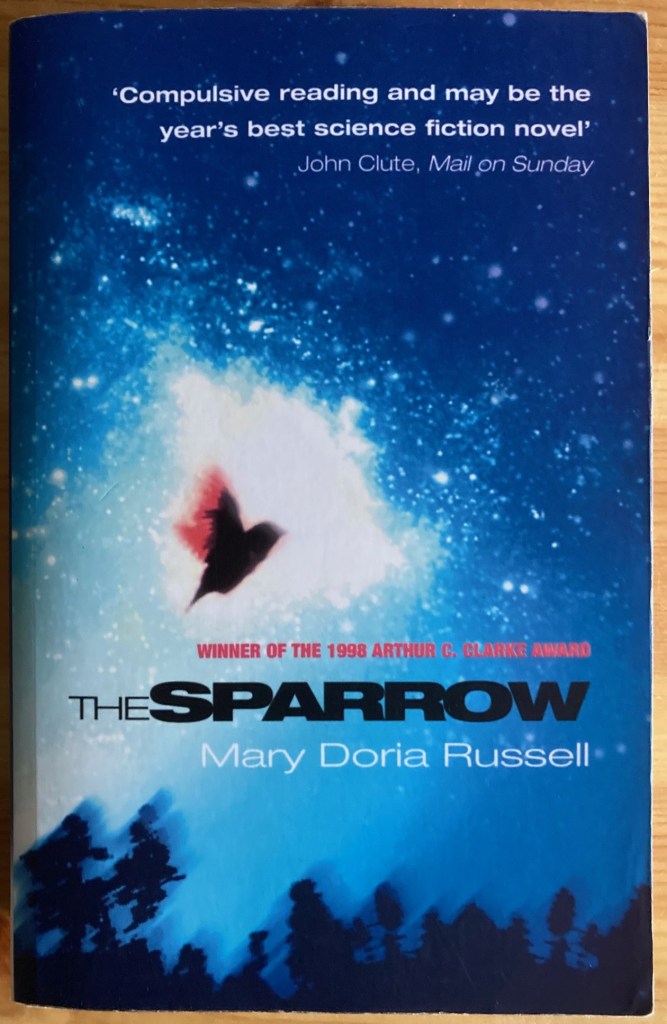
Mary Doria Russell, 1996
Edition read: Black Swan, 503 pages
Read: 2019
Sci-fi/philosophy
The Sparrow is ostensibly a sci-fi novel, but really, sci-fi is the point of departure. Outline: the planet of Rakhat makes contact with Earth in 2019. The Jesuit Order decide that they’ve got this one, so off they go into space. We follow the crew along on their adventure, but we have already been told that only one member of the crew returns in 2059. Despite the premise of going to and living on another planet, technicality is eschewed in favour of ‘why’? As such, it is more about religion and faith. Nor is it about some outlandish alien religion or faith – it’s mostly the Jesuit Order.
This sounds like an incongruous pairing (‘priests in space’ sounds only one step away from a stoner song) but a central theme is how God chooses to show himself.* The characters ponder over this a great deal; when we push the boundaries of existence, how do we maintain belief in old systems? (especially when God taketh away, which he does deign to do here). In this sense, the genre – or maybe the context – of sci-fi is fitting.
The chronology jumps around, with the interplay between the two periods cranking up the suspense – we know that something went wrong on the venture, but the details are trickled out. The characters are sometimes cheerful to the point of incredulity, but this is a minor criticism of characterisation in a genre which carries a reputation for sacrificing well-rounded characters in all of the excitement of world-building.
Worth reading? Yes
Worth re-reading? Yes – a re-read is due on my part.
*The books sticks to ‘him’ for God, so we’ll leave it at that here too.
 The Page Count