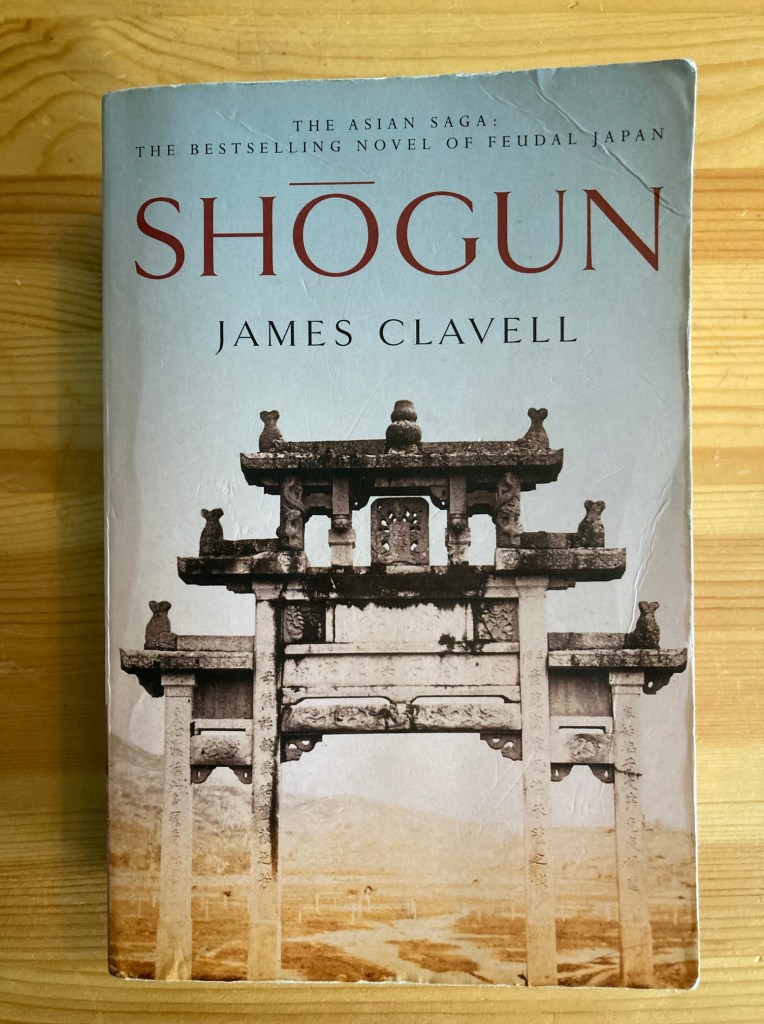
James Clavell, 1975
Read: January – June 2025
Edition read: Hodder & Stoughton 2017, 1125 pages
Historical fiction
*Spoilers*
In Down Under, Men at Work sing their way through a couple of culture clashes. These all turn out to be relatively benign; cars break down on hippie trails, people make Vegemite* sandwiches, beer flows and people chunder. There is an attempted drug deal, but the proud Australian tells the Bombayite that he comes from the land of plenty, and that Aussie rules is the best sport, so clear off mate.** In Shōgun, the learning curve is a bit steeper; the (Protestant) Elizabethan protagonist gets shipwrecked in ‘the Japans’, the only people who can translate to and from Japanese are pesky Catholic missionaries, people are either beheaded or expected to commit ritual suicide (‘seppuku’) for slight infractions, eating raw fish is a yes and daily baths are expected.
The Erasmus, a trading ship of Elizabethan-era Dutchmen and an Englishman (John Blackthorne, the navigator and our protagonist), arrives at a key moment in the history of feudal Japan; the Taiko (Japan’s main man) has died, leaving an infant son and five lord regents to rule for him as a council until he comes of age. These five regents all want to kill each other off, but manners dictate that no one can even openly show that they are mildly offended by obvious stingers, so they resort to a lot of scheming instead. Talking of scheming, the Portuguese Jesuits are already there, facilitating their monopoly of trade between Japan and China, as well as working on The Treaty of Tordesillas. They are not pleased about a bunch (in fact, the very first bunch) of Protestants appearing.
As such, Shōgun covers the build-up to war and the requisite manoeuvring, moving between the perspective of various characters, including Blackthorne, to do its world building. Although based on a true story, from a post-colonial perspective, that a story about feudal Japan had to involve an Englishman seems a bit questionable, although Clavell’s approach does make for an interesting premise. (This is also not to mention that feudal Japan did a fair bit of colonising of its own.) Upon first consideration, it just seems improbable that Blackthorne is the protagonist (and also gets the main lady.) However, he is very much used as an oft-unwitting chesspiece in a game of political chess; it ends with an soliloquy from Toranaga (who, indisputably, grows into being the Shōgun of this story), rather than from Blackthorne, wherein it is revealed that the latter’s plans of sailing off into the sunset back home to England may not quite work out. Emphasising this point, the rest of the crew of The Erasmus quickly become minor characters; their main purpose is to show the tension between what Blackthorne was and what he becomes. Fortunately, Clavell doesn’t try to place Blackthorne on a typical hero’s path and make him become a great warrior who comes to surpass his (many) enemies in combat; instead, Blackthorne quickly comes to understand that he is no match for any samurai.
Shōgun packs a lot of plot into its 1000+ pages, and my initial assumption that there was going to be a swordfight on every page was incorrect – it actually ends before the major warfaring begins, being very much about the preceding manoeuvering. The flipside to this is that what with the politics, plotting, spying and power struggles, the plot can be hard to keep up with and the sections focused on social propriety make for slower reading.
When it comes to show versus tell, it leans towards tell, wherein a lot of historical information about Japan, and the personal stories of characters, are set up, generally via free direct discourse. It is a nice touch that Toranaga disappears at times, not just from the events of the book but also from the narrative, with Clavell resisting the urge to jump into his perspective and instead let the reader get a taste of the other characters’ confusion.
Worth reading? Yes – it’s a long read, but stick with it.
Worth re-reading? Yes, and given the complexity of the plot, would be a fruitful read with the added comprehension that a second read invariably brings. However, to compare apples to orangutans, the 2024 TV series is better than the book, so if you don’t have time, do that.
Death is part of our air and sea and earth. You should know, Anjin-san, in this Land of Tears, death is our heritage.
* Don’t listen to the Aussies – Marmite’s better.
** They cut this line, more’s the shame.
 The Page Count