Tag: Spy fiction

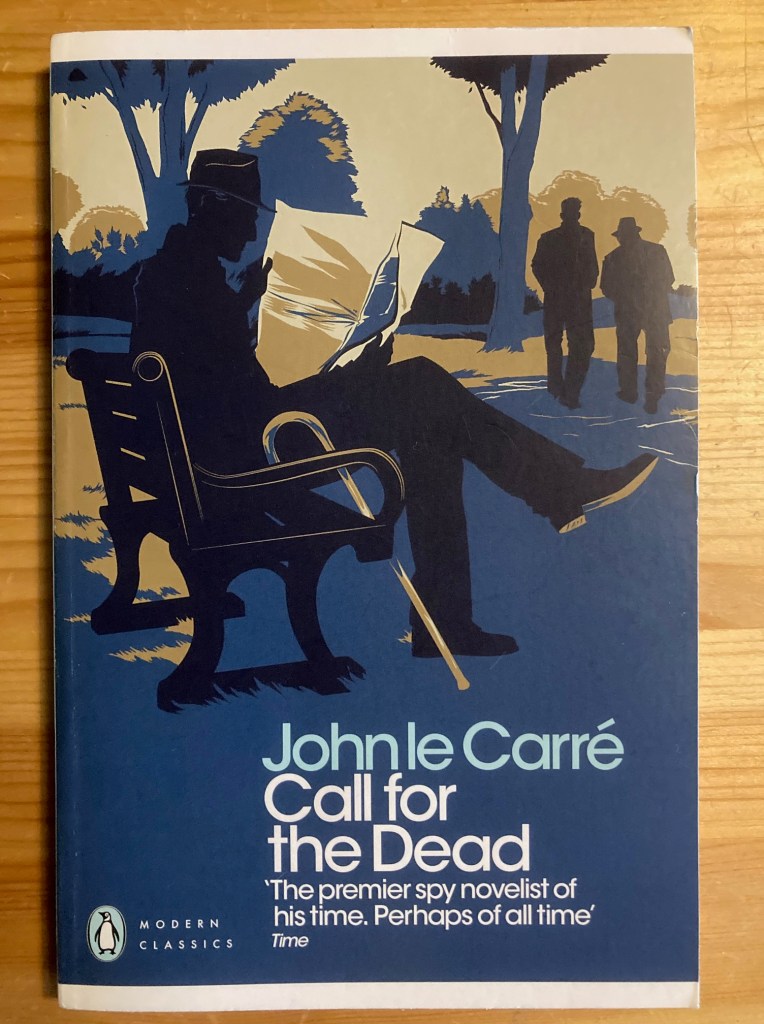
  • Call for the Dead

    John le Carré, 1961 

    Edition read: Penguin Modern Classics, 2012, 150 pages 

    Read: October⁠–November 2025 

    Spy fiction

    *Spoilers* 

    Here in le Carré’s first novel, we meet George Smiley, who, not for the last time, is set up as a cuckold who is about to be fired for someone else’s mistake,* but subsequently proceeds to kick clerical ass and take down possibly important names, dates and locations via diligent observation.  

    The premise is that a civil servant has committed suicide after a routine security check – only for said civil servant to receive a phone call during the subsequent investigation. With an atmosphere of betrayal set up from the outset, the characteristic cut-and-thrust dialogue of the Circus (the secret service) is present, as is the jargon of the trade. 

    This is a slightly more forgiving read than something like The Russia House or Tinker Tailor Soldier Spy, with a bit more exposition provided (one character even gives another one a written summary in the form of a case report at the end). It’s also a relatively light read compared to le Carré’s subsequent works, with a lower body count and fewer characters reduced to disaffected cynics. 

    While clever, complicated and characteristically morally ambiguous, this isn’t le Carré’s best novel – Dieter, although an interesting character, it is a little bit hard to appreciate as the great opponent he is set up to be. Partially this is because this is quite a short novel, partially it’s because it’s hard to square away some of his characterisation: ‘[…] to Guillam he was a living component of all out romantic dreams, he stood at the mast with Conrad, sought the lost Greece with Byron, and with Goethe visited the shades of classical and medieval hells. As he walked, thrusting his good leg forward, there was a defiance, a command, that could not go unheeded.’ Eh? Although Dieter embodies the human side of the enemy, for a spy runner, that sounds a bit conspicuous. It is interesting, however, to read him as a prototype of Karla – the fanatic, faceless antagonist who comes to be Smiley’s nemesis and counterpoint. Nonetheless, it’s an engaging read, and I enjoyed working the case out along with the protagonists.

    Worth reading? Yes. A good starting point for reading le Carré. 

    Worth re-reading? Yes…although I think there are better le Carré novels to re-read. 

    *To my knowledge, his forever cheating wife, Anne, never appears directly in any of the nine George Smiley novels. Having not read all of them, I ask you, dear reader, does she ever? Or is she always framed via Smiley? 
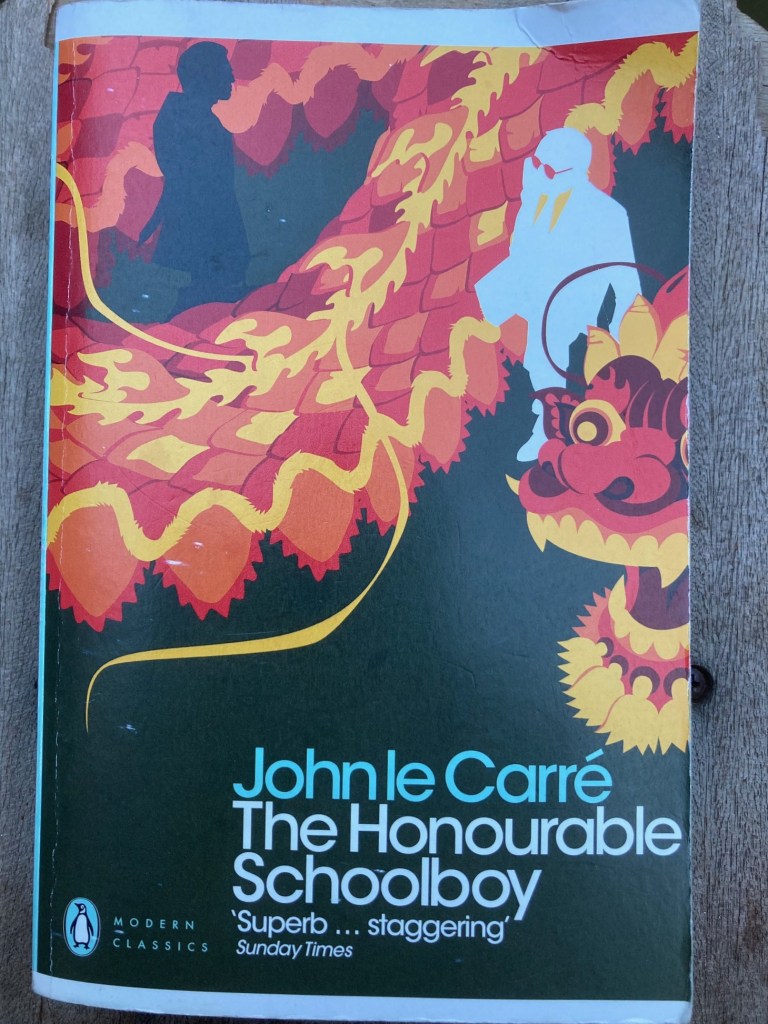
  • The Honourable Schoolboy

    John le Carré, 1977 

    Edition read: Penguin Modern Classics, 664 pages 

    Read: August – October 2025 

    Spy fiction 

    Part II of the Karla Trilogy.  

    *Spoilers* 

    The sequel to Tinker, Tailor, Soldier, Spy, the plot is set in motion by the dissemination of Bill Haydon’s act(s) of betrayal.* It’s now 1974 and George Smiley and Peter Guillam are rebuilding the secret service, here always referred to rather archly as The Circus. The reinstated intelligence analyst Connie Sachs revisits investigations that Haydon had suppressed and finds what looks to be a money-laundering operation centred in Hong Kong. 

    Jerry Westerby is called back to London from rural Italy (where he had bolted to when he found out that Haydon had possibly betrayed him to the Soviets), where he is writing a novel (‘me neither’), ostensibly on leave from his journalistic duties, in which capacity he is sent to Hong Kong to follow this lead. 

    And just this much of the plot, comprising just the set-up of the premise, is complicated enough. As with his characters, le Carré’s plotting and dialogue is sophisticated and worldly.** I will be honest and say that I couldn’t follow the plot through every single juncture; the amount of exposition is limited, people talk in jargon (or not at all), and the amount of trail covering and switching and deliberate wrongfooting by spies and their handlers is byzantine. Guillam’s perspective is the closest that there is to the reader’s, with Smiley even gently mocking him at one point for not being able to piece together just what the hell everyone is up to and what it all means. However, despite this density and length (I found it useful to keep a dramatis personae), it’s a page turner. Besides the human element (why do all of these clever, erudite people seem so wretched?), the reader has to find out the answers and to see where it’s all heading at the same pace (if not a bit behind) as the – oft highly resourceful – characters. It does wander into James Bond territory just a bit when it turns out that Westerby, besides being a journalist and spy, is an expert on racehorses.  Thankfully, Westerby – the titular honourable schoolboy – doesn’t turn out to be a winning jockey. By and large, instead of stunts, this is a world dominated by suspicion and sadness and full of fittingly distrustful and unhappy characters.   

    Worth reading? Yes. 

    Worth re-reading? Yes. Read the Smiley novels in sequence.** 

    ‘Not allowed a past in this game. Can’t have a future either.’


    *In an uncharacteristic bit of narrative leniency from le Carré, the first page provides all the exposition you need to bring you up to speed. However, I still recommend reading Tinker, Tailor, Soldier, Spy beforehand. 

    **‘“The case has firmed up a little, so perhaps it would be sensible to fix a date. Give us the batting order and we’ll circulate the document in advance.” 

    “A batting order? Firmed up? Where ever do you people learn your English?”’