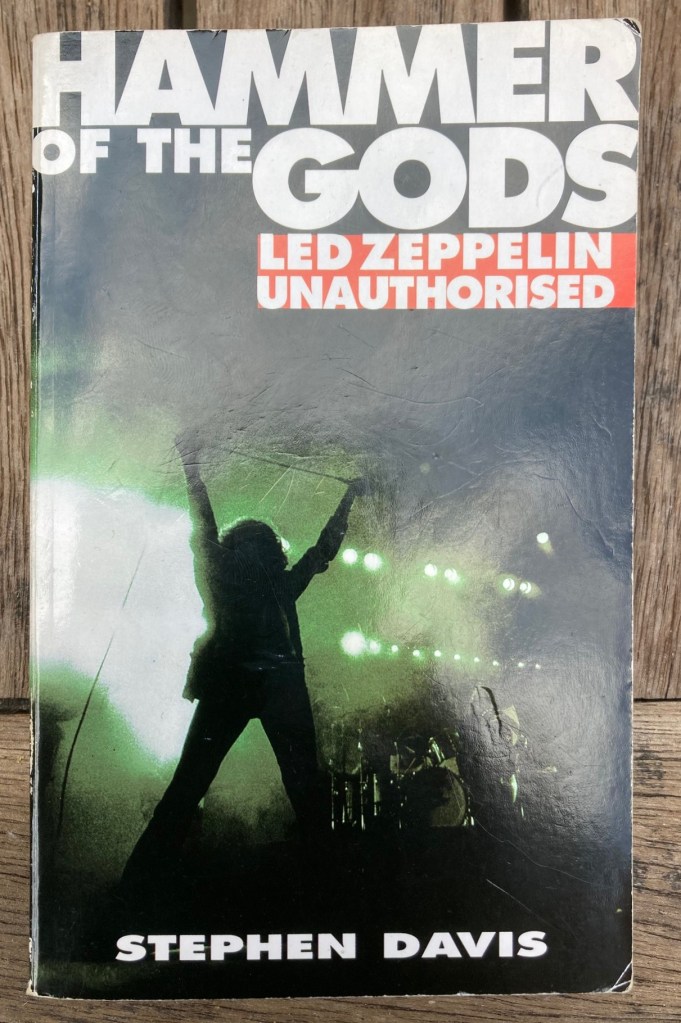
Stephen Davis, 1985
Pan Books, 1995, 350 pages
Non-fiction, Music, Biography
Read: 2004, re-read April–May 2026
It is telling that the introduction (or ‘Overture’, as author Stephen Davis would have it) of Hammer of the Gods starts with allegations of the band’s sexual exploits, then moves straight onto Satanism. Circling back to Led Zeppelin’s bread and butter – y’know, music – the problem with this strong focus on their mythos is that, again, circling back to that primary means of assessing a band – y’know, listening to their music – some of their songs but certainly not all of them support this. This sets the over-the-top tone and an understanding that this is music fandom as much as music journalist (on one Led Zep concert: ‘Gradually Zeppelin’s avowed Apollian intent reverted to a Dionysiac bawdiness’). Hammer of the Gods is at its best when it does discuss their music, mythos-driven or not.
Starting with the four members’ backgrounds, and how half of the band were middle-class, experienced session musicians, and the other half labouring, working-class white bluesmen, with each album Davis provides a song-by-song breakdown. These are some of the best sections of the book and his observations are astute.
Besides Jimmy Page as the session guitarist, it also examines him as the producer and as the businessman. Davis also spends a good deal of time on the importance of Led Zep live: the details of their hectic touring schedules; how much they improvised live, particularly on their big US tours in the early ’70s; what the live experience was like; and how their early choice to focus on the US was driven by the hostile British press (and later on, the tax breaks).
Hammer of the Gods is also strong when referring to quantifiable achievements – ticket sales, number of shows, records sold, records charted. What could have been just a list of numbers is written in a way that shows just how big they became and how they, with the help of manager Peter Grant, upended (disrupted?) the music industry. It also provides a good sense of how the band did most of their work in the first half of their 12-year career, and were less active after 1975, with fewer tours, and a decline to match their rise, somewhat of a squander fuelled by drink and drugs.
A bit more insight into the band hierarchy would have been interesting. Although it makes it clear that Page was the leader, internal power struggles within the band are referred to but not properly explored. Page is the visionary; Robert Plant is the coolest; John Bonham, when away from a drum kit, has to be carefully managed; bassist John Paul Jones remains in the background as the band’s the secret weapon.* We are left none the wiser as to whether there were there ever any creative differences.
The narrative does sometimes read as a list of events, mostly so when they are debauched tales from tours of the US. Sure, this is part of the Led Zeppelin story, but what does it all mean? A bigger problem is that, although he mentions them, Davis doesn’t give the band’s most problematic aspects the insight that they merit. It would have been nice, for lack of a better word, if Davis expressed stronger feelings about the predatory behaviour that Page practised towards girls. Page’s alleged Satanism is brought up and discussed plenty enough, but the coverage of his relationship (read: grooming and kidnapping) of a fourteen year-old feel cursory.
Additionally, when drunk, John Bonham was truly awful. In separate incidents, he attempted to sexually assault the journalist Ellen Saunder (who states that another unspecified band associate was also involved), rape an air stewardess, punched a woman in the face for no reason, and assaulted (read: tortured) a security guard. Besides tour manager Richard Cole and Grant enabling great success, they also enabled some of this unforgivable behaviour. Frequently depicting them with pirate imagery, at one point Davis describes them as ‘gangsterish’, but otherwise leaves it there.
Also problematic is the band’s (which translates to Page’s and Plant’s) penchant, particularly in their early days, to lift vocal lines and other melodies from other artists, particularly blues artists, freely and without credit. Having listened to a lot of these originals, they are adaptions and launching points rather than covers, but the lifting of ideas is still clear (Davis also drops the n-word out of nowhere when discussing one of Zeppelin’s bluesy intros – there’s no other signs of racism, but whatever point he was trying to make, it’s highly jarring.)
Some of this book is just bullshit – such as the front row of a crowd headbanging against the edge of the stage – and more broadly has been reported to be an unreliable source. As the title states, this biography is unauthorised and the band have stated that Davis spent a very limited amount of time with them. Cole, who had his own disputes with the band and Grant, is a primary source.
Wow. This has been a bit of a negative review. Did I enjoy reading it? Well, Led Zeppelin were my favourite band growing up, and this was essential reading for me as I got into them. Re-reading Hammer of the Gods – and in particular, Davis’s great descriptions of their music and the power therein – did encourage me to relisten, rewatch (to The Song Remains the Same and the self-titled 2003 live DVD), but also to read around (the 2018 self-titled photo book) and to reappraise them. On the merit of his music and his drumming, Bonham’s death is a sad ending – a talent enabled by success to act without compunction.
So yes, I enjoyed it. It’s just that it read as a piece of musical fandom, rather than a piece of journalism upon music and musicians.
This review is a compare and contrast with Mick Wall’s When Giants Walked the Earth: A biography of Led Zeppelin, soon to be reviewed.
*Yes, I play bass.
If you liked this, you might like…
When Giants Walked the Earth, Mick Wall
Led Zeppelin (photo book), Led Zeppelin

