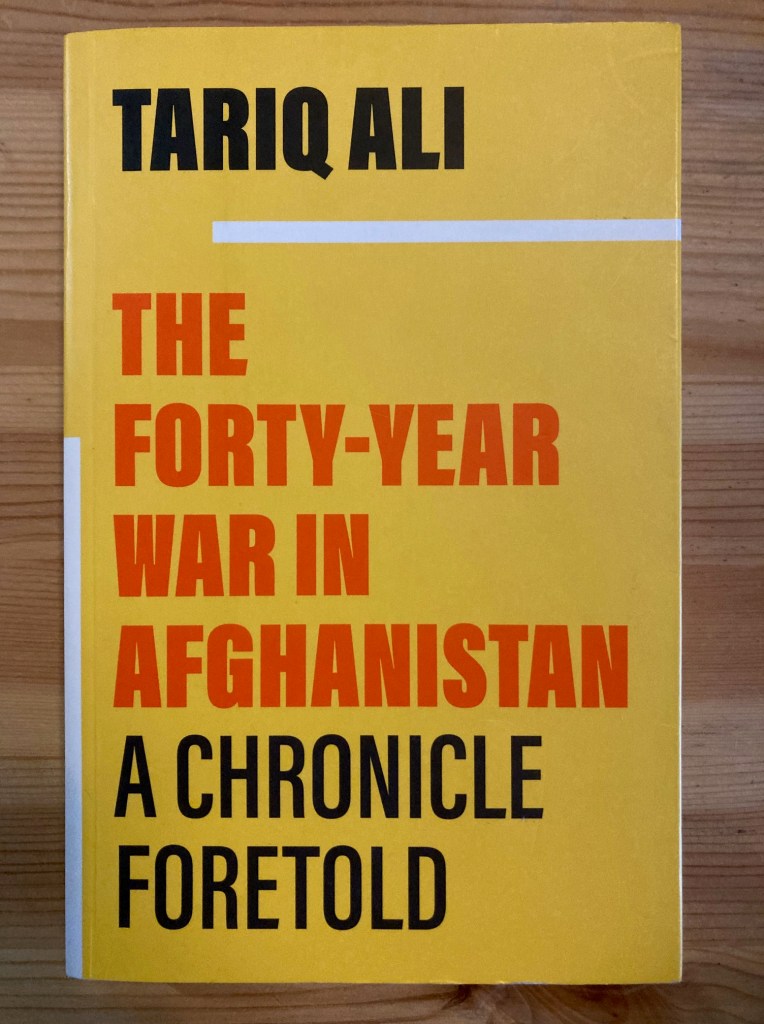
Tariq Ali, 2021
Edition read: Verso, 2021, 244 pages
Non-fiction
Read: October–November 2025
The Forty-Year War in Afghanistan is a collection of twenty-six essays (and one exchange of letters) on the various occupations of Afghanistan, penned by the left-wing journalist Tariq Ali. It dates from 1980–2021, critiquing the Soviet occupation, the Afghanistan–Pakistan–US relationship (as well as the involvement of China and Saudi Arabia), through to the NATO withdrawal and the fall of Kabul to the Taliban.
Despite its disastrous ending, the invasion and occupation of Afghanistan is widely considered to have been a justified war (certainly compared to the invasion of Iraq). Ali gives this outlook short shrift, arguing that the NATO occupation repeated the mistakes of the Soviet one, such as installing unpopular puppet rulers (indeed, the subtitle is A Chronicle Foretold).
Looking at the occupation of Afghanistan in retrospect, and how badly it was managed and ended (and what life is now like for Afghans), it’s somewhat hard to argue that Ali doesn’t have prescient points to make. With hindsight proving him accurate on several matters, he regularly refers to his detractors’ contemporaneous criticisms that he is a cynic with a dark sense of humour.
He writes eloquently and his arguments are sophisticated. Because sophistication necessitates complexity, I would advise reading these commentaries one at a time, rather than treating this as a whole book: they’re not always the easiest pieces to read and digest, and being a series of essays, it’s not as comprehensive as a history book. There is plenty to learn, just not always in a straightforward format, and the bias is obvious (although I’m sure Ali would argue that these are just the facts).
However, a lot of the strength of his argument is drawn from how badly the occupation was managed (which he primarily believes was due to the corruption of the United States’ choice of new Afghan leadership and the failure to address elements within Pakistan and Saudi Arabia that supported the Taliban). This is slightly different to whether Afghanistan should have been invaded post-9/11, and there is a distinction to be made between ‘Was it justified?’ and ‘Was it well handled?’. If the occupation of Afghanistan had been successful (i.e., led to a reconstructed nation), would the invasion of it have then been justified?
As such, I wasn’t fully convinced by Ali’s argument that Afghanistan shouldn’t have been invaded post-9/11. He argues that Bin Laden should have been arrested and that the Taliban were ready to hand him over to the US:
It need hardly be added that the bombardment and occupation of Afghanistan has been a disastrous – and predictable – failure in capturing the perpetrators of 9/11. This could only have been the result of effective police work; not of international war and military occupation […] According to the official 9/11 Commission report, Mullah Omar’s initial response to Washington’s demands that Osama bin Laden be handed over and al-Qaeda deprived of a safe haven was ‘not negative’ […] but while the Mullah was playing for time, the White House closed down negotiations. It required a swift war of revenge. Afghanistan had been dominated the first port of call in the ‘global war on terror’, with Iraq already the Administrations’ first target […] Predictably, it only gave al-Qaeda leader the change to vanish into the hills.
My doubts come down to whether the Taliban would have actually done so, on which there are a myriad of conflicting sources. In The 9/11 Wars, author Jason Burke states that this was never going to happen.
I was also dubious about his argument that ‘What is really required in the region is an American/NATO exit strategy from Afghanistan, which should entail a regional solution involving Pakistan, Iran, India and Russia. These four states could guarantee a national government and massive social reconstruction in the at country.’ Given his own criticisms of Pakistan’s vested interests in its neighbour, I doubt that this measure would have led to a successful reconstruction.
Ali did, however, make me challenge my assumption that if Iraq hadn’t been invaded, the invasion of Afghanistan would have been successful. He argues that this occupation was mismanaged from the outset, criticising NATO’s selection of new, incompetent, corrupt leaders for Afghanistan, Hamid Karzai in particular.
While reading this, I tried to keep in mind whether I was reviewing a book or reviewing the justification and success of the Afghan war. Although not taken in by all of its arguments, Ali does ultimately make a convincing argument that the invasion was a misadventure and that the quality of lives for Afghans – perhaps the most important metric of the success of the invasion – has only gotten worse. Reading this in 2025, it is a saddening fait accompli.
Worth reading? Yes. Ali has a fairly rare opinion on the matter and it is interesting to read his arguments, whether you ultimately agree with them or or not.
Worth re-reading? Yes, due to how detailed it is.
 The Page Count