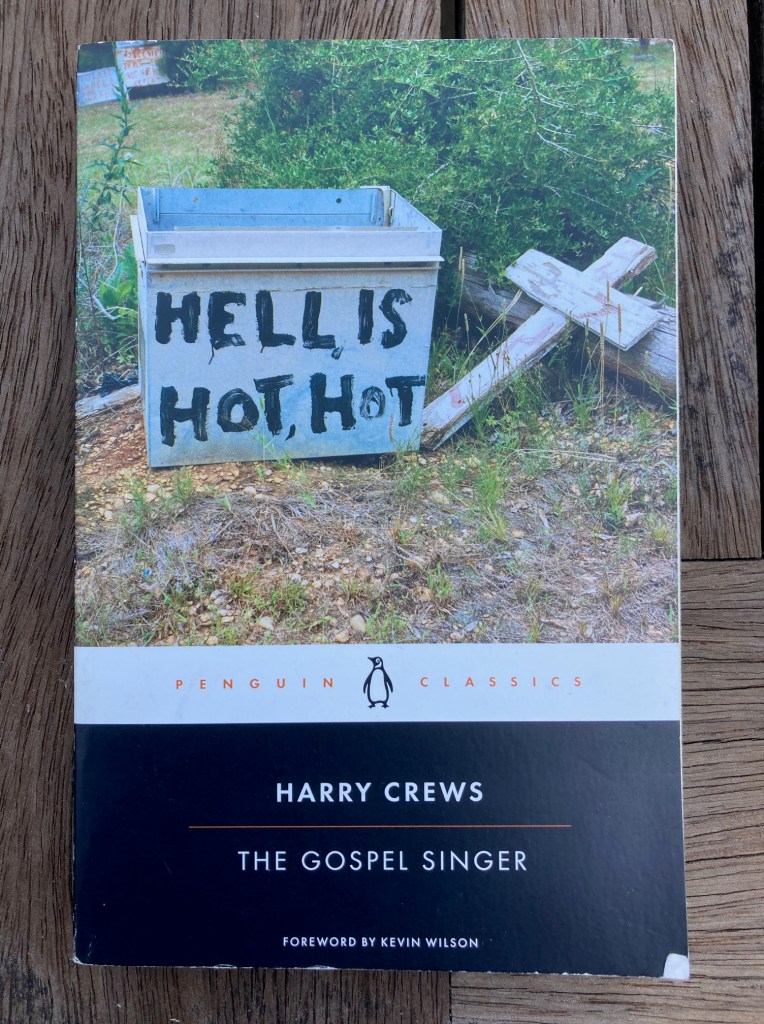
Harry Crews, 1968
Penguin Books, 2022, 210 pages
Read February 2024, re-read March 2026
Fiction, Southern Gothic
*Spoilers*
The eponymous Gospel Singer returns to his hometown of Enigma, Georgia, where his talent quickly proves to be a poisoned chalice in the company of some deeply flawed characters – including himself. The idolatry of the townspeople (and those from further afield) creates a twisted burden of expectation, elevating the Gospel Singer to healer status, when in fact, he just found that he was good at singing and used it to escape a life of hog farming in a swamp. Christianity is nothing more than a persistent black cloud to him: ‘[…] his superstition of God opened in him like an old wound […] What had God to do with him? Who was he, The Gospel Singer, anyway, for God to be concerned with?’ His followers project their hopes onto him, hoping that he can cure them of their various maladies, with the ‘Dark Man’ embodying the desires of the crowds for the Gospel Singer to be their panacea:
For the Gospel Singer, [the man] became, in that moment, the symbol not only of the rest of the audience but of every person who had ever heard him sing. The man was asking, as plainly as if he had shouted it at the top of his lungs, for an impossible benediction, for an intercession between the world and the flesh that the Gospel Singer could not make.
The only people who don’t want something from him are his mother (except for him to stop touring and come home) and Foot, the leader of a touring freakshow – who does, nonetheless, correctly identify him as a business opportunity, following the Gospel Singer’s act around the country with his own. Likewise, his manager, Didymus (a Biblical name meaning ‘twin’ and another name for Thomas the Apostle) has a twisted utilitarian vision, in which if an act of evil leads to an act of countering good, evil is therefore goodness. Faith, business and entertainment are presented as flipsides to each other here, the Evangelical businessman Woody Pea as nakedly representing this intertwining of religion and entertainment and money as anything or anyone else. Even when the Gospel Singer, who remains unnamed throughout, even by his friends and family, does do what he can to help – giving his family money to build a new house and buying them a new car – this is met with inconsideration, his family letting pigs live in the house and leaving the new car broken.
Compounding the Gospel Singer very much not being a healer is him very much being a sex addict (‘Lust rose in him like a live thing, and it swept everything before it: altars, lynchings, churches and revivals’), which develops into a love/hate relationship with his hometown sweetheart, MaryBell Carter. Enigma collectively assumes that they are a couple, but they have a loveless relationship driven only by physical lust – a basis which the Gospel Singer established and which she weaponised when he refused to commit to her. As such, neither the Gospel Singer nor MaryBell Carter are what Enigma thinks they are.
As with Crews’s A Feast of Snakes, mindless crowds are a recurring feature (‘The street was a jammed mass of faces turned up like masks with black open mouths sucking and expelling a collective breath’) and when he finally tells them the truth, a congregation, awash in one of the Bible’s most famous acts of destruction, a flood, turns into a lynch mob. Willalee Bookatee, the murderer with whom the story beings, kills MaryBell for the same reason – because she tells him that the basis of his faith is corrupted. Despite the town’s professed hatred for Bookatee, there’s not much difference between them in the end, both senselessly killing someone they love as they reveal their true nature.
As much as he is exploited, the Gospel Singer is complicit in that he, in turn, exploits people – specifically, young women – to feed his addiction. While it’s hard to feel much sympathy for him as the story progresses and the depth of this particular flaw become apparent, what also becomes clear is that he is never seen as a person in his own right, as the lack of a name would suggest. It is no coincidence on Crews’s part that the most well-adjusted person in the whole book is the leader of the freakshow, Foot (in contrast to Enigma, the ‘freak fair’ is neat and orderly), who tells the Gospel Singer that he is not as attractive in the flesh, a comment that the Gospel Singer actually seems to appreciate.
The plot’s simplicity emphasises its quick pace and character-driven nature. Crew’s first novel is often referred to as ‘Grit Lit’ or ‘Southern Grotesque’, but for my money, it’s just a Southern Gothic and a satire on evangelism, and a macabre, darkly humorous, excellent one at that. Despite the wonderfully freakish characters (the preacher who butchers a woman with an ice pick, a sheriff with one lung, a brother who has an aversion to the heat à la Anse Bundren in As I Lay Dying, his two other siblings’ awful musical act, Woody Pea the Evangelical businessman – not to forget the sex-addicted gospel singer), Crews has an ability to make them human.
Worth reading? Yes.
Worth re-reading? Yes.
‘“There’s work and there’s work,” said Didymus. “My work is souls.”
“Mine’s pigs,” said his father.’
If you liked this, you might like:
The Gospel Singer, Harry Crews
The Long Home, William Gay
Provinces of Night, William Gay
Child of God, Cormac McCarthy

