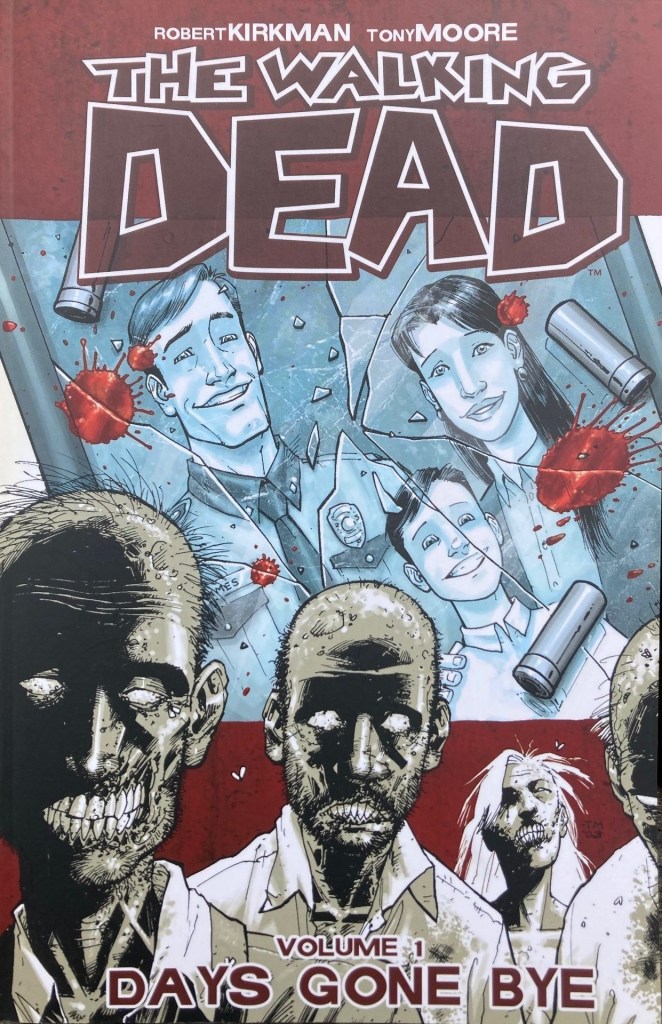
Robert Kirkman, Tony Moore and Charlie Adlard, published 2003–19
Image Comics, 2003–19, 32 volumes at around 156 pages each
Read from 2013 to June 2026
Fiction: graphic-novel series, horror, thriller
*Spoilers*
Much like the zombies that populate this apocalyptic franchise, we’ve shuffled a long way, and now after 13 years of reading and surviving, the end is nigh. As such, all 32 volumes are here reviewed together.
Starting with our protagonist – Sheriff Rick Grimes – waking from a coma in an abandoned hospital to a freshly arrived apocalypse, zombies are the primary antagonist, but other humans quickly take over as the main threat with the collapse of civilisation.* This is zombies as a backdrop to a social experiment. Initially, this keeps the premise interesting as multiple attempts to restart civilisation, which generally consists of our heroes trying to evolve from hunter-gatherers into a stationary society which has specialised classes, fall afoul of other people’s designs. Sometimes these antagonists are sinister; sometimes they’re just competing to survive. With the upending of the status quo comes a perpetual unease and danger. No explanation is given as to the ‘how’ or ‘why’ of this apocalypse – the dead now come back to life and the toothpaste won’t be going back into the tube as we are plunged into this new world alongside Rick and his family.
The main themes are leadership, power, justice, trust, betrayal, whether the enemy of my enemy is my friend and divided we fall. The old system versus new ones is a recurring theme; besides their own group dynamics and struggles (Rick is the reluctant leader), the other groups they encounter all have different social systems and they struggle with the quandary whether to push for change or to accept something good but flawed for what it is, with its undemocratic imperfections.
The biggest symbolic advantage of the zombie as a trope is sometimes used effectively, sometimes not so much. Zombies as a mirror of humans is really stressed early on, then they just become more of a background nuisance.** They end up forming herds, and the symbolism of this could have been exploited more so.
Besides the corruption of youth and innocence (via Rick’s son, Carl), as Rick (our everyman) battles the world, heroes stray into villainous territory and it becomes a cautionary tale of he who fights with monsters might take care. With that said, some of the characters – both our heroes and our antagonists – are flat, such as the Governor, who is depicted at a consistent level of wickedness. Such personalities would arguably flourish in an apocalyptic scenario, but a little more justification for some of the behaviour would have been appreciated. On this point, although it is packed in towards the end, Negan has a more interesting arc, developing from villain to enemy-of-my-enemy to distrusted ally, acting as a foil to Rick along the way. (The quality of his dialogue, defined by his constant imprecations, never improves, however.***) We are invited to consider what makes Rick different to Negan, but for too much of the story he remains too much of a shark for this point to really land. The diversity of the characters is also interesting.
As per the above comment about the symbolism, there’s also not too much in the way of subtext, and some of the dialogue can veer from a bit clunky to downright awful (two characters discussing zombies: ‘What happened to these people is a sad thing.’) There are lots of speeches in which either a new hope is established or all hope is lost, and the matters of the day tend to be stated quite baldly – ‘WE ARE THE WALKING DEAD!’, etc.
Despite the zombies being a bit plodding, the danger of this world and the horrors that it produces are not to be underestimated. There is some strong stuff here – murder (including of children and babies), rape, torture, dismemberment, cannibalism and people disguising themselves by wearing the skins of the dead (arguably the symbolism is just a tiny bit heavy-handed here). Reader beware – main characters will be killed off and mutilations abound.
After an enthusiastic start, that it took me 13 years to finish this series is indicative. Apparently, the writing of the series was wrapped up suddenly, but it’s still definitely too long (there are numerous declarations of ‘It’s time to end this’), and it became hard to care about (and thus subsequently keep up with) the proliferating secondary characters, even as the original cast were killed off and with a late injection of intrigue surrounding Michonne.
With all of this said, the relief of reaching the end was mingled with sadness – there is a flashforward to the world of the next generation, in which the world has changed once again and Carl must continue to adapt. At one point, in what I can only describe as a very Lynyrd Skynyrd gesture, a flock of birds flies overheard, signifying the rebirth of a nation. An interesting point is when a character disputes the legacy of Rick, but nothing is made further of this ‘founding-father’ revisionism. There is a weird bit where Michonne, now a judge, makes a speech in which she reads out the blurb of the book (which is the same for every issue). Besides suddenly going a bit meta, the blurb is actually quite misleading, positing a ‘now we are surrounded by death, we must learn to truly live’ premise, which is not the tone of the series (the only characters who seem pleased that the world has reverted to a Darwinist state are clearly those we are not invited to empathise with). What does work a bit better is the end, in which Carl’s bedtime story to his daughter, becomes an epilogue: ‘But this is not a scary story. This is a story about hope.’
In terms of the drawing style, this changes between volumes 1 and 2 and then 12 and 13, simplifying slightly. It’s in black and white, and I also wondered, given the abundant scenes of gore and rot, colour would have been better (although colourised editions have been produced since I started reading). It’s certainly not minimalist in any other way.
Worth reading? …up to around issue 21. I advise reading the compendiums rather than the individual issues.****
Worth re-reading? After issue 21, no; the storylines start to recycle.
You might like this if you enjoyed:
Watership Down by Richard Adams
Lord of the Flies by William Golding
The Road by Cormac McCarthy
*Not to be confused with Cillian Murphy’s misadventures
**They are of the old-school, George Romero mould – slow, grumbly, hostile in quite a sullen way.
***Much like in The Midnight Gospel, in a whimsical moment he considers whether maybe zombies are living their best lives.
****Also available at your local bookstore.

