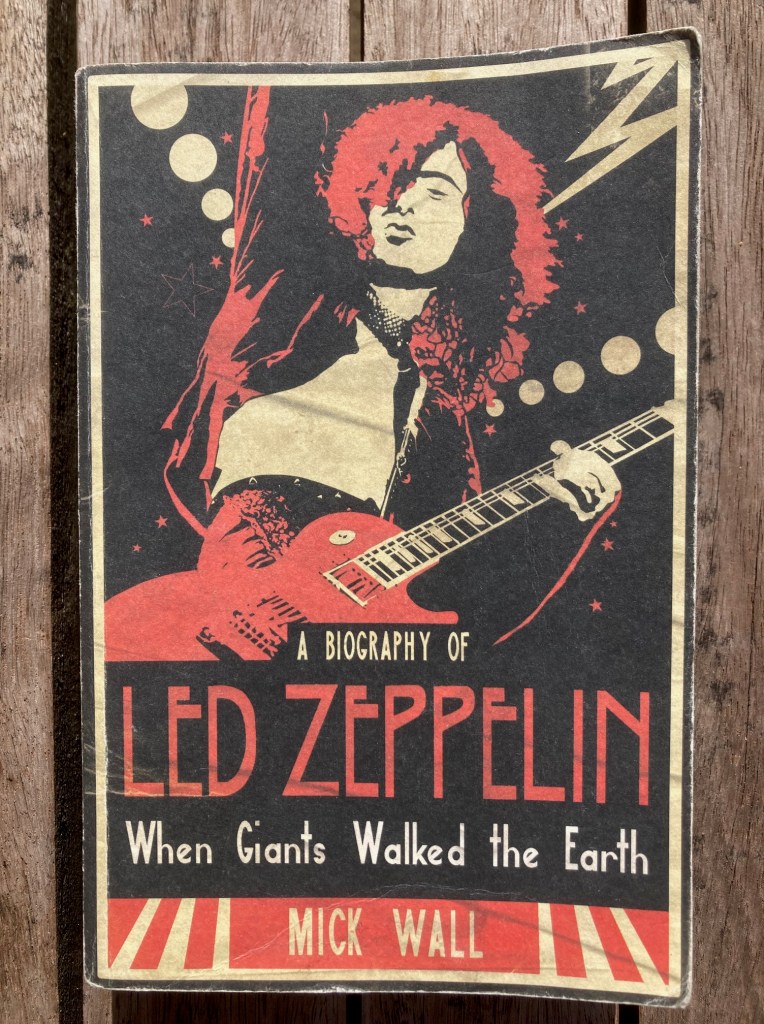
Mick Wall, 2008
Orion, 2009, 534 pages
Read June–July 2026
Non-fiction, Music, Biography
A more journalistic, less bombastic biography of Led Zeppelin than the recently reviewed Hammer of the Gods. There is less of the latter’s ‘Apollian versus Dionysiac’ stuff, and although Hammer of the Gods possessed detail (with Mick Wall even crediting it here), where When Giants Walked the Earth distinguishes itself is in its better structured documentation of the rise and fall of the band.
Rock journalist Wall gives a good sense of how the giddy heights that they attained made it seem that they were a monolith which would never come off the rails – but also that the reality was that they were four highly talented, very well-guided musicians who ended up seduced by the power that they attained.
Manager Peter Grant is credited as enabling guitarist and band leader Jimmy Page’s vision, and Led Zep’s consequent success, through his refusal to accept industry norms (particularly when it came to splitting money) and his ability to harness them as workhorses (four North America tours in 1969 alone, slotted between UK and European dates). It’s made clear that Led Zeppelin was a carefully managed business set up, and that this was what allowed them to become the biggest band in the world – as well as their ability to combine light and dark, ‘synthesise’ (read: sometimes steal) ideas and work very quickly when they needed to (although the mixing and mastering of each album always ended up rushed).
Wall also makes it clear that this was aided and abetted, of course, by the singular luck of all great bands: the right musicians finding each other. This is complemented by fictional first-person interludes from the perspectives of the band members and Grant. Jumping from a narrative about the biggest band in the world to these assumed first-person perspectives, delving into the minds of five singular people, made for interesting counterpoints. Page, in particular, retained a great deal of control over their music (it was also interesting to read how there was always some distance between Page and vocalist Robert Plant).
Where these first-person interludes fall short is that even as their story progresses and Messrs. Page, Plant, Bonham and Jones develop from jobbing musicians to the biggest band in the world, they continue to take place in their pre- or initial Led Zep days. By the time it reaches the 1979 writing sessions for In Through the Out Door, it feels odd to jump back to moments like John Paul Jones’ perspective of his first meeting and practice with John Bonham in 1968.
Wall also arguably spends a bit too much time on Page’s Satanism, with a whole chapter (29 pages) on black magic(k) and Alastair Crowley, even entertaining the idea that Kenneth Anger placed a curse on Jimmy Page in 1976.
However, as stated, Wall maps out the rise and fall of the band clearly, and that the second half of their career went from disaster to disaster. They reached their pinnacle circa 1974:
If the first four years in the life of Led Zeppelin had been about empire-building, the next four – from 1972 to ‘75 – would find them overseeing their kingdom with all the splendid pomp and inherent arrogance of Pharaohs.
He goes into the drugs problems that plagued the band towards the end – in particular, how Page’s heroin addiction caught up with his playing, Bonham’s behaviour made him dangerous to be around (‘La Bête Noire’), how their 1979 Knebworth shows, set up as their big UK comeback, were a disaster, with manager Peter Grant devolving from a sharp-elbowed, astute businessman into a paranoid bully. Wall also contends that the second of these two shows – which undersold to the point of financial disaster – signalled that rock music had moved on while Led Zep had been recuperating from various issues during the latter half of the 1970s. He even goes to the extent of arguing that the band was figuratively dying for a long time before Bonham literally did. Wall also makes it clearer than Davis that the band had their off nights, and has very little time for In Through the Out Door in particular.
He spends a fair bit of time on the 2007 reunion (verdict: good but safe) and why it didn’t last past that one show: post-1980, Led Zeppelin very much remained Page’s baby, with Plant having moved on into a solid solo career and Jonesy having become a friar.
In comparison to Hammer of the Gods, Wall is better at holding the band to account: he rightly goes into the ugly details of the Grant, Bonham, Bindon and Cole assault on a security guard, is critical of Led Zeppelin’s failure to credit the original songwriters (I particularly enjoyed the interview with Bert Jansch) and how the band let Bonham get away with his Jekyll and Hyde act (additional acts of assault and attempted rape) because it didn’t affect his drumming and allowed him to bear the commitments of touring and living away from his family. Whilst fittingly critical of Bonham’s errant behaviour, I would have appreciated Wall taking a more strident approach to Page’s relationship with a fourteen-year old.
Worth reading? Yes.
Worth re-reading? Yes – a good story told well.
If you are interested, you might like…
Hammer of the Gods – Stephen Davis

