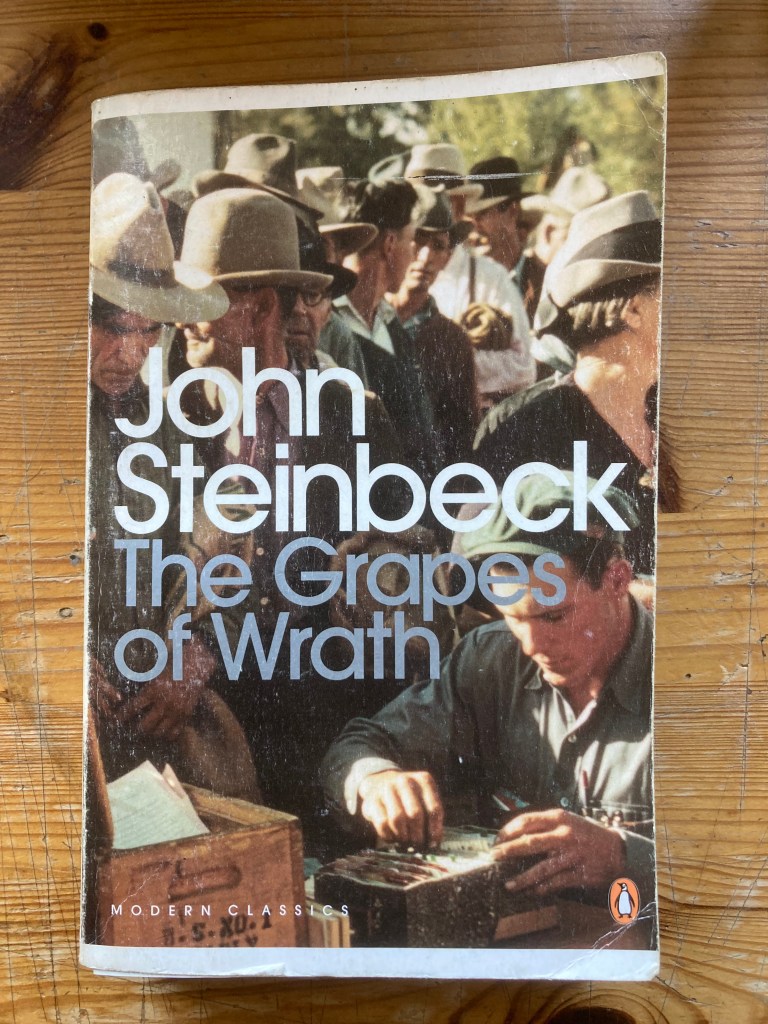
John Steinbeck, 1939
Read: November 2024 – January 2025
Edition read: Penguin Modern Classics 2000, 476 pages.
Literary realism
* Contains spoilers *
A realist novel about American tenant farmers (monikered more literally in the book as ‘sharecroppers’) whose crops failed in the dustbowl during The Great Depression. In the process of their subsequent eviction they are completely disenfranchised. It is a documentation of the shift from one way of life to another – a hallmark of the Great American Novel.
This road trip of the Joad family, as they are forced to become migrant works and drive from Oklahoma to California via Route 66, is defined not by a sense of adventure or a historical sensibility, but by a precariousness; they, alongside thousands of others, have to pack up their entire lives into a single truck and find a new home.
As opposed to, say, Cormac McCarthy or Virginia Woolf, Steinbeck’s straightforward writing style doesn’t initially draw attention to itself, but its clear, earnest manner brings a gravitas to the story being told. More complex yet still authentic, the speech is conversational and as spoken (‘just set and figured’; ‘don’t get ornery now’, etc.) Likewise, there is a strong layer of symbolism (I particularly liked the rising flood waters and downed tree towards the end), although it’s interesting ow rich the story remains even when read without these.
This declarative quality serves the depiction of life being harsh and people being poor; when Grampa dies, the family have no choice but to bury him in a field; even the tractor driver, who can do the work of dozens of sharecroppers, talks about having yet to buy shoes for his youngest child; and Rose of Sharon, self-centered, pregnant, abandoned by her husband and suffering from malnutrition (fried dough does not a well-rounded diet make), is shown little in the way of sympathy. The family unit is consistently depleted, with family members either dying or wandering off on a regular basis. The ties that bind are severed as misfortunes assail the Joads day by day.
This builds into the major theme of the individual versus the collective. Some of the people taking part in this exploitation hate themselves for it, as they know what they are doing, but are subject to the same downwards financial pressures. When the employees unionise, they are immediately denounced as ‘red’ and attacked, verbally and physically. There is no ignoring that this is more than just a story – this is a political book.
The longer chapters, which are directly about the Joads, are interspersed by short chapters of exposition, wherein the narrative point of view is anonymous and omnipotent; I read this as the voice of Steinbeck. Either way, these shape up as what the introduction refers to as ‘atemporal interchapters’, serving to show the scale of the suffering.
Worth reading? Yes.
Worth re-reading? Yes – this was a re-read from seven to ten years ago. Perhaps Steinbeck’s best book, combining the human struggles of Of Mice and Men with the scale of East of Eden.
Wherever they’s a fight so hungry people can eat, I’ll be there. Wherever they’s a cop beatin’ up a guy, I’ll be there […] I’ll be in the way guys yell when they’re mad an’ – I’ll be in the way kids laugh when they’re hungry n’they know supper’s read. An’ when our folks eat the stuff they raise an’ live in the houses they build – why, I’ll be there.
 The Page Count