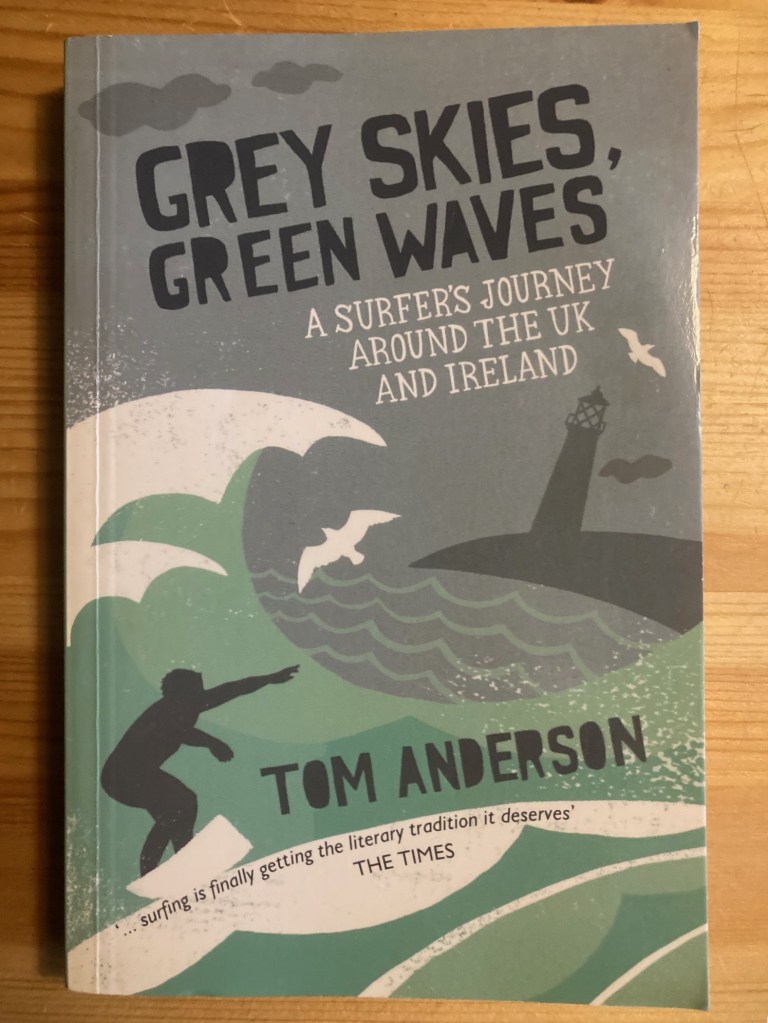
Tom Anderson
Read: October 2025, re-read December 2025–January 2026
Edition read: Summersdale Publishers, 2010, 270 pages
Travel writing
Living in southeast England, friends, family and well-wishers in general (you’d be surprised) are often alarmed when I mention that you can surf in the British Isles. Isn’t it cold? they ask. Yes, I say. Bring a wetsuit. Embrace the pain. The truth of the matter is that there is a lot of surf to be had; it’s just very much a geography-determined past-time. However, wherever you do go to catch a wave, they will be right about one thing: it will be cold.
As such – although only partially for this reason – surfing in the British Isles is sometimes seen as the poor cousin of what’s to be had internationally. And thus, the premise of Grey Skies, Green Waves is partially set up: our narrator and author, Tom Anderson, has come to realise that he doesn’t really like surfing in the British Isles anymore, given how much warmer, sunnier and, er, wavier, the rest of world is. He has fallen into a slump of surfing locally only half-heartedly.
The other part of the premise – and actually, given that Anderon grew up with the niche but all-consuming hobby of surfing, the more important part – is that he has hit a slump of entering surf competitions, only to drastically underperform. He sets out to remedy this case of ‘I don’t like the things I use to’ by taking more opportunities to surf in more domestic locales, and herein he accounts several surfing trips around the British Isles, extending from south to north Wales (including a secret spot in Cardiff), Devon, Cornwall, John O’Groats, the Outer Hebrides, the River Severn and County Claire.
Anderson is clearly a Good Surfer (surfing triple overheaders near John O’Groats is not for beginners, nor for improvers), and at points he captures the various sensations of being in the water vividly (‘A thick slop of heavy, cold, dark water is the surfing equivalent onto several feet of powder on a snowboard, or a big, smooth tarmac slope to a skater […] To bury your board onto its edge and then throw all your weight through an arcing turn, knowing the water below will bear everything you throw at it, it a feeling of at-oneness with the ocean that rivals any tube ride.’) As a surfer’s lexicon will attest, a wave is not just a wave: it has speed, height, depth, shape, direction and length. Anderson does this well, although certain passages merit a bit of secondary reading (for example, what is a ‘wedge’?). It is at its most engaging when describing being in the water in good conditions, and the more enthused about that particular session he is, the better that Anderson writes about it. As the book goes on, the stoke improves., and as such, the last quarter of the book is the best.
The other element of this book is back on dry (well, damp) land, capturing the ennui that accompanies not just surfing, but many outdoor pursuits, in the British Isles: early (cold) mornings, waiting in (cold) carparks for the right conditions to materialise (if they do), drinking away (cold) afternoons in pubs, disappointing competition results and late (cold) night drives home. Whilst overall I appreciate the inclusion of this other side of surfing, there were a few non-surfing sections that did not exactly make for compelling reading, such as the passage where he retells someone else’s story about accidentally trapping someone in an automatically cleaning French toilet.
It is written in the first person, which while fitting for a piece of travel writing, could have included fewer conversations recounted word for word via direct speech. Although sometimes this does place you in the moment, at other times it could have been a bit terser and not lost anything. Sharing the same past-time, it would be remiss not to mention William Finnegan’s Barbarian Days as a simultaneously accompanying and contrasting read, but given their different focus.
Worth reading? Yes – persevere through the discouraging sections.
Worth re-reading? Yes, for the passages in the water in particular.
 The Page Count
Leave a comment