Author: gregmbrooks

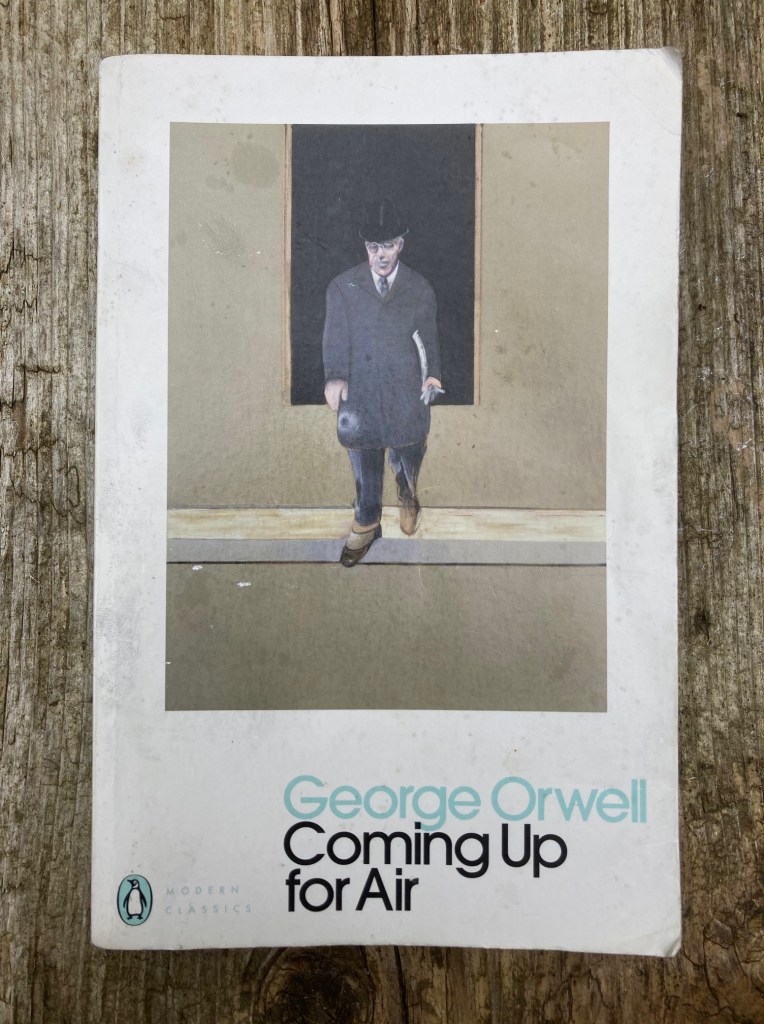
  • Coming Up For Air

    George Orwell, 1939 

    Read: September 2025 

    Edition read: Penguin Classics, 2020, 276 pages 

    Inter-war Literature

    *Spoilers* 

    Flashbacks from a lower-middle class, middle-aged Englishman, on the eve of World War Two, to his childhood, World War One, his marriage, his working life, working his way up to his present day and an impulsive return to his hometown of Lower Binfield, inspired by a trip down memory lane (thankfully, Orwell kept it to 270 pages. Take note, Proust.) 

    An inter-war novel, the main themes are concurrent nostalgia and anxiety about the threat of forthcoming war. Written in the first person, what drives protagonist George Bowling is his oft-self-centred pursuit of happiness; he shows – and openly describes – his life since childhood as having been a dreary trudge. While recovering from an injury in the trenches, he is sent to a redundant, absurdist job posting for the remainder of the war. He got married and had children very much out of a sense of that was just what people do. He sees his family and house as a chore at best, taking no satisfaction in them. He dreads what he sees as another forthcoming war – primarily due to the shortages it will impose. He is overweight, middle-aged, newly equipped with false teeth, has already cheated on his wife and very much intends to continue doing so. 

    Even in what could be more considered his principled moments, such as when he attends a local Left Book Club meeting, he leaves both utterly apathetic and lamenting what he perceives to be the violence of contemporary politics, before visiting a friend who is stuck in the past (and not even his own past – in the age of antiquity). He is scathing about his wife and her penny-pinching ways. He goes on holiday with gambling wins he hides from his family. 

    This leads Bowling to become nostalgic about elements of a childhood that he knows he is misremembering: ‘I don’t idealise my childhood, and unlike many people I’ve no wish to be young again […] in a manner of speaking I am sentimental about my childhood – not my own particular childhood, but the civilisation which I grew up in and which is now, I suppose, just about at its last kick.’ He has no qualms in detailing how he saw unfettered capitalism slowly kill off his father’s small businesses or how his ne’er-do-well brother suddenly disappeared. He constantly offsets his existence and his perception of society against his memories of fishing – one of those wonderful childhood memories which he knows he is misremembering (‘My best fishing-memory is about some fish that I never caught. That’s usual enough, I suppose’). As such, fishing comes to serve as a metaphor for either the promises of life – or, in a slightly different reading, for the age in general.

    Whilst he doesn’t think particularly kindly of anyone, women get a decidedly harsh treatment. Even taking his wider observations as largely true to life, this is a reflection of Bowling’s character more so than anything else. This is at its most evident when his ex-girlfriend doesn’t recognise him and, in his ensuing critique of her appearance, fails to realise that this might have something to do with his own condition. 

    Whilst I’m not sure if it’s possible for Orwell to have any obscure books, this is one of his lesser-known ones. As such, whilst not quite a sleeper hit, it is well worth reading in addition to his heavyweights. He is remembered for the ideas he expressed in his writing, but what seems to sometimes go forgotten is how quietly impressive his actual writing is; he makes the semi-nostalgic reflections of a middle-aged insurance salesman a page turner. 

    ‘[…] in this life we lead – I don’t mean human life in general, I mean life in this particular age and this particular country – we don’t do the things we want to do. It isn’t because we’re always working. Even a farm-hand or a Jew tailor isn’t always working. It’s because there’s some devil in us that drives us to and fro on everlasting idiocies. There’d time for everything except the things worth doing. Think of something you really care about […] calculate the fraction of your life that you’ve actually spent in doing it. And then calculate the time you’ve spent on things like shaving, riding to and fro on buses, waiting in railway junctions, swapping dirty stories and reading the newspapers.’ 

    Worth reading? Yes – big ideas expressed through deceptively good writing.

    Worth re-reading? Yes – and I suspect a second reading will reveal further riches.

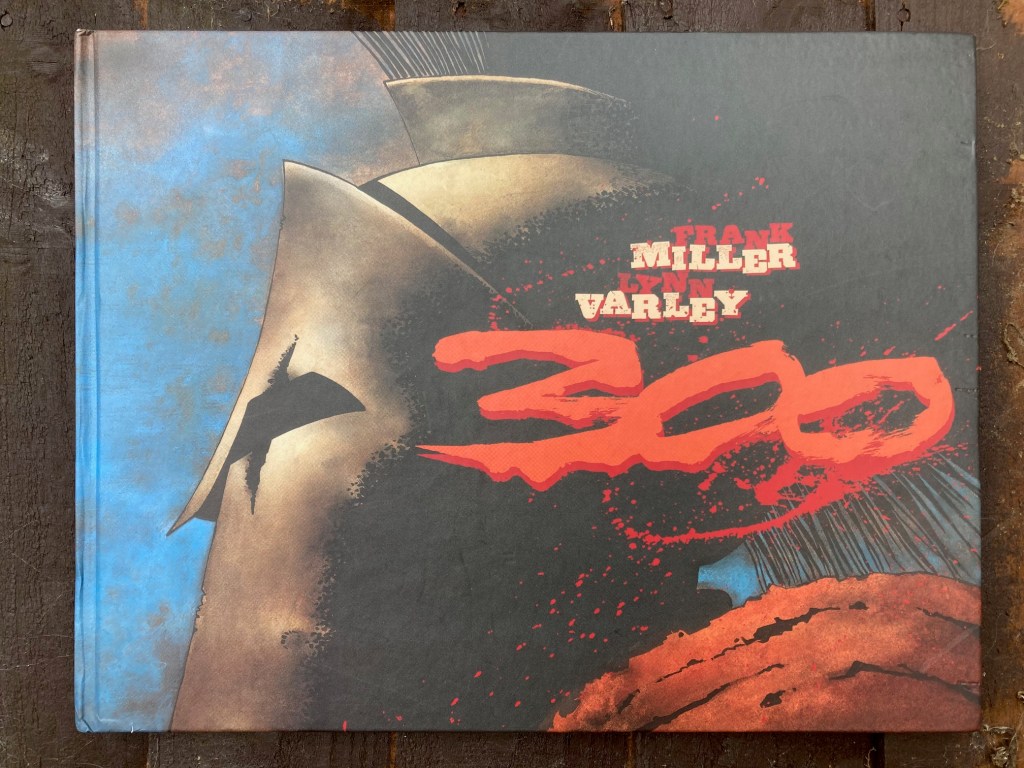
  • 300

    Frank Miller and Lynn Varley, 1999 

    Read March 2023 and re-read September 2025 

    Published by Dark Horse Books, 1999

    Page count: not sure. It’s around a one-hour read. 

    Graphic novel, historical fiction 

    The blood-and-guts film adaption of this inspired every 17 year-old boy circa 2006 to actually believe that they would have held the Hot Gates. Since then, however, I’ve had the chance to mend my ways and reapproach this historic event via Tom Holland’s Persian Fire. Combined with a now fuller, not quite so heroic-mythical, less mental worldview and actually quite glad I am not a Spartan Hoplite*, let’s just say, Miller took certain liberties. 

    A Greek alliance (not Sparta alone) consisting of 7,000 troops, held the pass for most of the battle – not the titular 300 (which 300 does partially acknowledge). The 300 were the holding force left behind when the Spartan king and commander, Leonidis, realised they were about to be outflanked – well, plus the 700 Thespians who were written out of the story by Herodotus, the primary source for this period.** The Greek army was betrayed, but more likely by a shepherd who wanted his fields back from the logjammed Persian army (what’s Greek for ‘get off my lawn?’), than by a deformed pariah of Sparta, jilted at birth for being the weak link in the phalanx. 

    Now that the question of revisionism has been answered – is this a good read? Spartans, what say you?***

    Well, citizen, the format of the book was well chosen, is the first thing they would say. Sized halfway between A4 and A3 landscape, it depicts the fighting and the landscapes of Greece in large scale. There is a lot of use of darkness, with features half-drawn with the other half blacked out – bodies, faces, cloaks, shields, rocks, piles of bodies – all the things you might expect to find at the Hot Gates. It’s a singular style and it’s easy to see Miller’s Sin City and The Dark Knight Returns in here and vice versa. It also gives an idea of the confusion of hand-to-hand fighting, with some panes take a couple of seconds to visually comprehend. 

    Starting in media res, the story moves along at a good pace and is well balanced, providing context about Sparta and why it was the way it was, complimenting the swords and sandals. The perspective is entirely Spartan – the Persians are given short shrift, depicted as the conscripted, decadent, undisciplined invading force of a foppish emperor, who ultimately can only win via underhand tactics. (The limited democracy of Sparta is underplayed and its subjugated neighbours go unmentioned.) 

    Read as a piece of fiction, it’s fine. Besides playing fast and loose with the facts of the event, it somewhat idealises Sparta, although any consideration that goes deeper than ‘those guys sure did kick ass’ should make it clear that it wasn’t a particularly fun place to live. The form of the hero’s journey is told in a way that feels like a story around a campfire, which, as a story drawn from the earliest history book, is fitting.**** It’s a bit short, at around an hours’ read, but this does serve to make it quite a punchy read. THIS WAS SPARTA (KINDA)!

    Worth reading? Yes.

    Worth re-reading? Yes – but now to hold the Hot Gates! 


    *Obviously Sparta of antiquity predates fascism as a philosophy, but there is a big overlap in ideas and practices between the two. 

    **Miller does include the Thespians in his telling, but rather than being part of the last stand, they surrender and are then immediately cut down. 

    ***Go on. Make the noise.  

    ****The Battle of Thermopylae was later set down in history by Herodotus (one of those ancient Greeks whose street cred eschews the need for a surname) in Histories, which is widely considered to be the first history book. 

  • The 39 Steps

    John Buchan, 1915 

    Read: August 2025

    Edition read: Penguin Classics, 2004, 149 pages  

    Thriller

    *Spoilers* 

    An early thriller novel full of decent chaps and rotten blighters. Whilst reading this I found myself trying to decide on the best semi-archaic synonym for ‘thrilling’, like ‘swashbuckler’, ‘humdinger’ or ‘snortripper’ (I may have invented that one). 

    The protagonist, Richard Hannay, bored with life in London, is framed for murder. Now a man on the run and not so bored, he proves to be a resourceful fellow, getting to try on lots of new disguises at a relentless pace. With a turn of pace, competence and luck which at times verge on the improbable, he MacGyver’s his way up and down the country, even getting to blow himself up and out of a jail cell at one point.   

    Hannay is also a fantastic judge of character and doesn’t mind letting you know. The predominance of rural folk and city bigwigs does result in a fair few flat characters, but the Scottish Highlands, however, are wonderfully described (‘Behind me was the road climbing though a long cleft in the hills, which was the upper glen of some notable river. In front was a fat space of maybe a mile. All pitted with bog-holes and rough with tussocks, and then beyond it the road fell steeply down another glen to a plain whose blue dimness melted into the distance.’) Circling back to the decent chaps and rotten blighters, the latter – what with this being set pre-WW1 and published in 1915 – are of course ruthless Germans, conspiring to bring about war (not to forget an unsolicited rant about Jews). 

    A fun read, the ten chapters set a rapid – although somewhat uniform – pace. 

    Worth reading? Yes. 

    Worth re-reading? No, just as there’s not much in the way of subtext. However, the descriptions of the Highlands are great. 

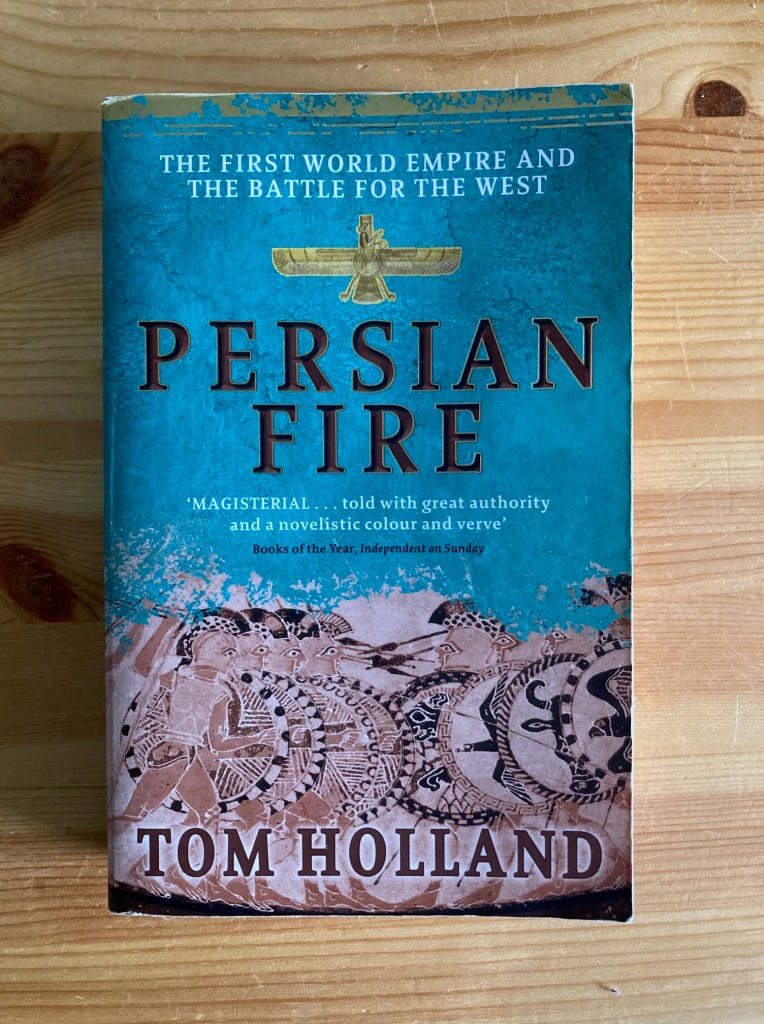
  • Persian Fire

    Tom Holland 

    Read: August 2025

    Edition read: 2005, Little Brown, 448 pages

    Non-fiction, history 

    Tom Holland’s Persian Fire details the attempted invasion of modern-day Greece by modern-day Iran, including the battle in which roughly 7,000 Greeks held the Thermopylae Pass against circa 100,000 soldiers of Emperor Xerxes’s invading army for 3(ish) days, in 480BC. 

    In providing the context of the Greco-Persian Wars, it challenged a somewhat unconscious preconception I had that eras start and end. Rather, they bleed into each other, passing on parts of culture and splitting along the way. It also provided a few rude corrections to the artistic liberties taken by Frank Miller in 300*, not least that the Persian army did not include divisions of ghouls and elephants. 

    It also altered my understand of what decides history: I was expecting more on the Battle of Thermopylae, but Holland outlines how this was only part of the Greco-Persian Wars, which were years in the making in themselves. Case in point, the Greek alliance – and not just the Spartan army – also made other decisive stands – these one successful, such as the Battle of Salamis and the Battle of Plataea, which ended the Persian attempt to conquer Athens and Sparta. Holland’s writing style is easy to follow, despite the plenitude of names, places and people and the vast scope of time that Persian Fire covers. The narrative is detailed yet well-paced and at points feels like an action story: Holland has a sense for what is engaging and what is the right amount of context. 

    Worth reading? Yes. 

    Worth re-reading? Yes. 

    *Review forthcoming. 

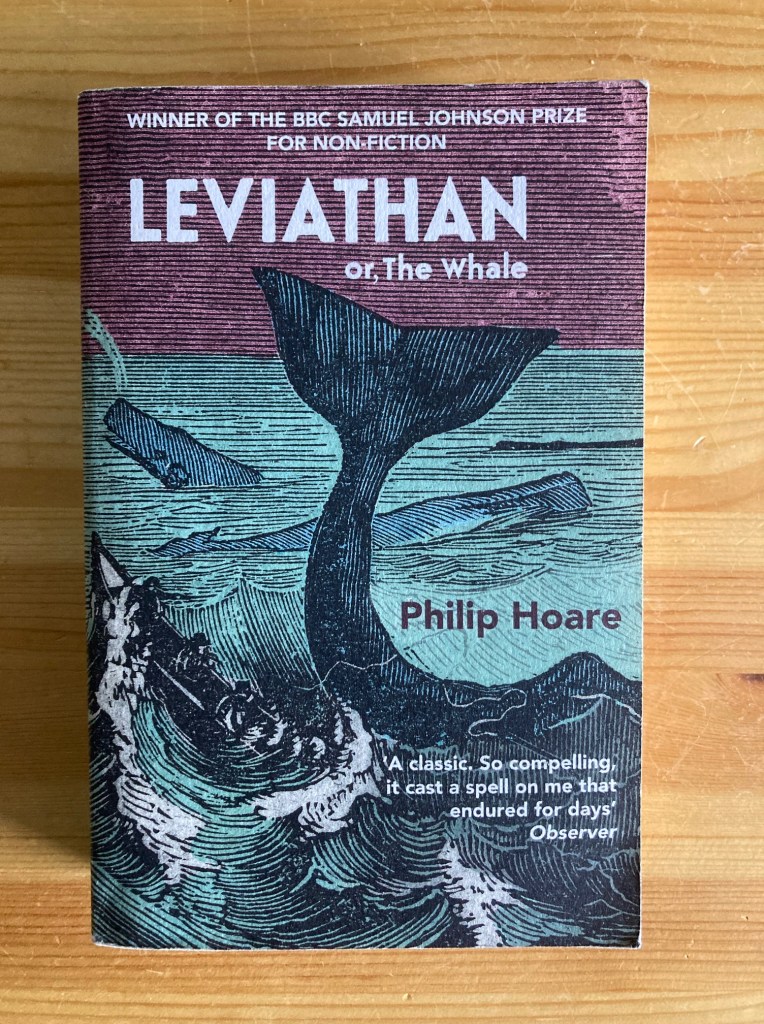
  • Leviathan or, The Whale

    Philip Hoare, 2008 

    Edition read: Fourth Estate, 2009, 421 pages 

    Read: August 2025 

    With a somewhat freeform approach, it is not immediately clear which category Leviathan falls into. At times possessing the discursiveness of a long essay, it reveals itself to be a mix of memoir and history, documenting both the relationship between humanity and whales and the author’s ambivalent perception of the sea. Besides being highly informative on the natural history of whales, the book takes on a confessional tone, with Hoare exploring universal themes such as loss and loneliness. It is poetic without losing grip of the subject at hand and in its broadness draws upon that lodestone of cetacean-related literature, Moby Dick*, as a cultural and literary reference point. As a book upon a naturalist interest projected outwards, it fits alongside titles like The Old Ways and H is for Hawk. As a book of obsession, it will certainly interest you in whales. 

    Worth reading? Yes 

    Worth re-reading? Yes 

    *I wouldn’t say a review is forthcoming per se, but I do intend to reread it at some point, with a particular focus on the chapter that is 100% about chum. 

  • Black Spartacus: The Epic Life of Toussaint Louverture

    Sudhir Hazareesingh, 2020

    Read: 2020–24

    Edition read: Allen Lane, 2021, 464 pages

    Non-fiction, history

    Take #2 (or #3?)

    Toussaint Louverture (or, if you like, the slightly more dashing Toussaint LOuverture) led the only successful slave revolution since, well, the other Spartacus, freeing Haiti from French slavery. Nonetheless, he seems to have remained a generally unknown figure until this book came out in 2020 to much acclaim (I found out about him via a Swans song, which doesn’t exactly scream ‘well known’ either).

    I found this a hard read. There is a narrative, but it feels more like a loose structuring tool/device for details about Louverture and the ideas surrounding him, rather than a narrative-driven piece of history. 

    Although I appreciate that ideas and events can drive history as much, if not more so, than people, it ends up feeling academic.

    Louverture and the Haitian slave uprising is one hell of a story – it’s just how it is told. I am still interested in Louverture and the Haitian Revolution, but think I will try a different book next time. I even tried to read it via a set number of pages per day, but, ultimately…

    …DNF

    Worth reading: No

    Worth re-reading? No

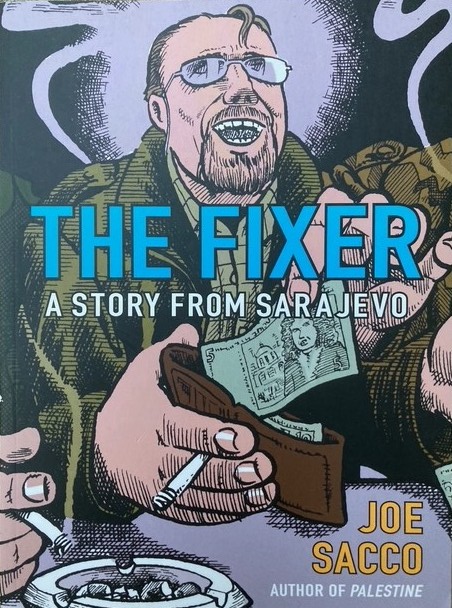
  • The Fixer

    Joe Sacco, 2004 

    Read: June 2025 (bought in Edinburgh) 

    Edition read: Jonathan Cape, 2004, 106 pages 

    Graphic Novel, black and white 

    *Spoilers* 

    The Fixer starts with Sacco’s return to Bosnia – specifically, Sarajevo – in 2001, having been there before during 1995 and 1996,* to continue his – now retrospective – reporting on the Bosnian War. 

    A major theme, constant across Sacco’s oeuvre, is conflicting narratives. Here, the narrative that receives (or demands?) the most (although not entirely uncritical) attention is that of the titular ‘fixer’, Neven. Sacco’s story morphs from that of the Bosnian War to that of Neven. He is a metonym for the whole of the Balkan conflict, as Sacco astutely identifies in his telling of this story, and his understanding of the value of Neven to him as a journalist. A Serb who fought on the side of the Bosnians, Neven is multi-faceted and contradictory. He makes his post-war living by helping journalists, with Sacco constantly unsure whether he is getting a deal or being fleeced, or if Neven is somehow a victim. 

    Sacco has a good sense of story and pace for what could be a morass of details and isn’t afraid to show himself as occasionally clueless and sweating over his own perceived amorality. His black and white crosshatching is as detailed as ever, eschewing exaggerated features in favour of a more restrained, serious style. 

    Worth reading? Yes. 

    Worth re-reading? Yes. 

    *Besides Sarajevo, Sacco also spend time reporting from the Bosnian enclave of Goražde, which resulted in Safe Area Goražde. 

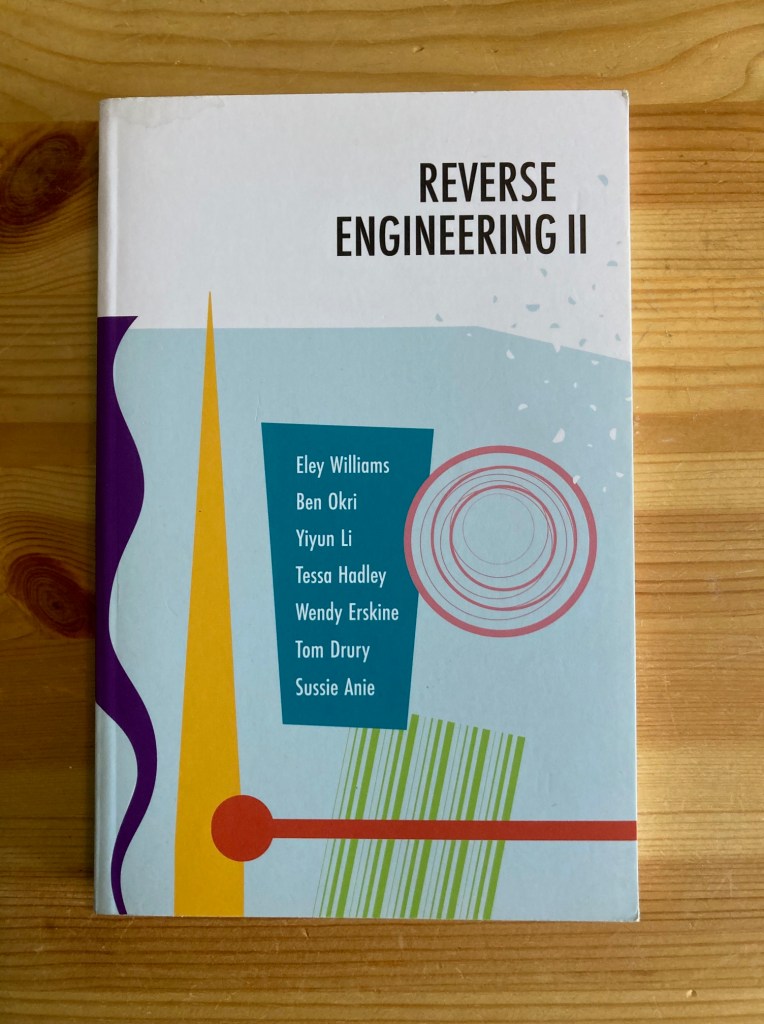
  • Reverse Engineering II

    Various authors, 2022

    Read: November 2023–April 2025 (stuck in the bookshelf traffic jam for a while)

    Edition read: Scratch Books, 2022, 173 pages

    Contemporary short-story anthology

    I read this alongside John Grisham’s The Firm whilst on holiday (St Ives, thanks for asking – yes, the surf was up). Let’s say these were contrasting reads.  

    This contemporary short-story anthology is made up of seven stories, each with an author interview at the end. I read the first collection* (also consisting of seven stories) in February 2023 and found a lot to pick apart in the interviews, which enhanced a second readthrough. 

    Whilst I didn’t enjoy this collection as much as the first, I was reminded of how interesting the form of the short story can be. Often, the form is, what is this story? What is it that’s actually happening? Some of these stories are quite hard to parse and further analyse, with a lot between the lines, such as in Bad Dreams, when the mother blames her husband for a nocturnal disarray – actually created by her child – in a kind of misunderstood epiphany. 

    However, by and large these stories avoid the mistake of having more between the lines than what is actually in them (a now-ceased subscription to Granta impressed upon me that something needs to happen in your stories, not just the idea of something). They are often slice-of-life accounts (All Will Be Well), and/or bring disparate elements brought together (Path Lights and Maintenance). 

    The interviews with the authors show as much; they are all very learned and sophisticated, combining clever and interesting concepts with carefully considered, sophisticated themes. So why didn’t I enjoy this collection as much as I did the first? A story can be clever, but something still needs to grab you – this was present in the closer, To All Their Dues, but sometimes I was left scratching my head (and not in the sense of being intrigued). 

    Worth reading? Yes. 

    Worth re-reading? Yes, although the first volume was better. 

    * I particularly enjoyed Theophrastus and the Dancing Plague by Jessie Greengrass. 


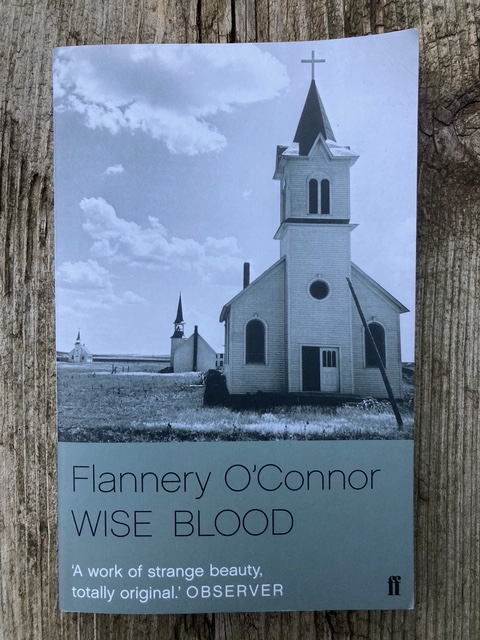
  • Wise Blood

    Flannery O’Connor, 1952 

    Read: June 2025

    Edition read: Faber and Faber, 2008, 160 pages 

    Southern Gothic 

    *Spoilers* 

    The demobbed Hazel Motes returns to the Deep South to set up his own church, ‘The Church Without Christ’ circa late 1940s, relocating to the big (fictional) city of Taulkinham from his now-abandoned rural hometown after finding that his family has all died or moved away.   

    Set on becoming a preacher until conscripted at 18, Mote set himself on becoming an atheist – or anti-religion – preacher, seemingly out of a sense of nihilism. However, it’s not the ordeal of war, and his resulting injury, cause this crisis of faith; he’s just told that he doesn’t have a soul by a fellow GI.  

    There is a certain class of purportedly ‘classic’ novels that I am not struck by, and the common factor behind my lack of comprehension seems to be, why are these people doing these things? 

    This was my first problem with Wise Blood; the protagonist is told that he doesn’t have a soul and he switches from knowing ‘by the time he was twelve years old that he was going to be a preacher’ to wanting to ‘be converted to nothing instead of to evil’. 

    It was this inscrutable nihilism which reminded me of The Outsider. I generally go in for Southern Gothics (William Gay, Harry Crews and Cormac McCarthy are favourites of mine), but I was underwhelmed in a way that reminded me of Albert Camus’s The Outsider, where the weight of expectations brought too much baggage. That’s not to say Wise Blood didn’t have both good and great scenes (in particular, the ending), just that there were elements and sections which didn’t land, such as when Enoch Emery, whose role as a character seems to be a metonym for the (religious) masses, finishes his part in the story out in the woods dressed up as an ape. Given that it is he who is of the ‘wise blood’, following it to make his decisions, is this just a critique of idolatry?  

    It’s certainly misanthropic, with few characters coming out of this looking good; the blind preacher Asa Hawkes turns out to be a fraud and as soon as Motes sets up his religion, the conman Hoover Shoats duplicates it in order to make money. Emery certainly introduces an element of the grotesque – dressing as an ape, stealing a preserved corpse – as well as comedy (such as his mispronunciation of ‘museum’). 

    Another element that I couldn’t work out was Asa Hawkes’s daughter, Sabbath Lily; I think she is supposed to be predatory, but Motes never seems particularly victimised by her. What was interesting was how it ended with Motes’ landlady trying to find meaning in his – now blind – eyes, at the moment of his death, searching hard and finding nothing – or maybe just whatever she wants to find. Overall, however, if this is a parable on organised religion, I’m not sure what the lesson is. 

    Worth reading? Yes, but I didn’t like it as much as I wanted to. 

    Worth re-reading? No – with the caveat that it is hard to fully understand on a first read. A short and quick read at 160 pages, I think a second read would bring more out of it. 

  • All Along the Echo

    Danny Denton, 2022

    Read: April–June

    Edition read: Atlantic Books 2022, 309 pages.

    Modern/Experimental fiction

    *Spoilers*

    DJ Tony and Producer Lou take a road trip across Ireland running a call-in competition for the Mazda 2 they are driving. In an inversion of the Troubles, London is under a swathe of terrorist attacks and Irish expats are returning home; the Mazda is to be given to whichever recently returned emigrant wins the competition.

    All Along the Echo takes an experimental form, with pages of radio static and graffiti, and there is a plenitude of voices, both over the radio and in person as it moves between perspectives. Despite the thought-provoking premise of the transposition of The Troubles, it all feels a bit low stakes: DJ Tony’s marriage is struggling (but it seems OK in the end?); Lou feels guilty about a time she cheated on her girlfriend (but this doesn’t come to anything?) and is worried about her missing cat (who her girlfriend eventually finds in – improbably – a sewer); there is teenage angst from a vulnerably housed graffiti artist (which feels a bit more real, but just ends when she makes some friends?); and there is a completely disconnected murder scene (everyone else is a recurring character – why not the ones in this?)

    I was sold on the blurb’s declaration that ‘All Along the Echo asks us whether our lives ever add up to more than the stories we tell ourselves’. I was left unconvinced of this; whilst it is skilfully written, for the most part the character arcs were flat and ultimately it all felt a bit scattered, leaving me unsure of what it was building towards.   

    Reading this review back, it feels a bit severe – the characters come across as real and the dialogue is convincing, and I was interested in seeing how the themes of a road trip, returning home and telling stories came together. It’s just that the story doesn’t add up to what it seems like it could have been. Whilst on a meta level that seems like it could be very clever – the narrative standing in for our lives – the execution has to match the ideas.  Given the interesting form, I am interested in seeing what else Denton has written.  

    Worth reading? No.

    Worth re-reading? No, but I am interested in Denton’s other books to see if the execution matches the ideas.