The Page Count

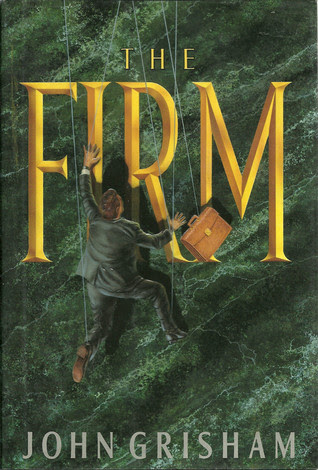
  • The Firm

    John Grisham, 1991 

    Read: April 2025 

    Edition read: Arrow 1991, 421 pages 

    Legal thriller

    Besides a nice view, slightly wonky drawers and Cornwall’s slowest TV, my holiday accommodation came with this book. It’s a legal thriller and using tell, don’t show (rather than the reverse), it succeeds in being a page turner. This keeps the pace up, a mark of success for a book about a law firm (and Grisham is not shy about the legal terminology). 

    Most of the story is told from the perspective of the protagonist Mitch McDeere. It switches to those of other characters to feed the reader information to smash that plotline out. This makes it a bit too easy a read; for example, there would have been more narrative tension if it wasn’t made explicit that McDeere’s house had been bugged. 

    It also reads as a certain amount of wish fulfilment, with Grisham accentuating the materialistic details; McDeere is a working-class boy (who was also quarterback!) who done good and now wants to drive a car that shows it. His wife, Abby, has great legs. His eventual accomplice, Tammy, has great breasts. The in-laws – who are the wrong type of materialistic – suck. This last point says a bit more than I think Grisham intended to; while masquerading as a takedown of these things – materialism, sexism and racism (on this last point, stereotypes abound), The Firm simultaneously accentuates them. 

    Returning to the issue of narrative tension, there a couple of things that left me scratching my head. The incriminating photos of McDeere with the prostitute never become of any significance. This would have made the story more dramatic in terms of Mitch’s and Abby’s relationship, but in the final paragraph this whole lapse of character – a moment of reckoning – is just dropped. Why does McDeere’s colleague, Lamar Quin, turn a blind eye when he spots his brother, Ray (ultimately allowing Mitch to incriminate him)? When Avery is killed off, it is reported via dialogue between two other characters, without the intimacy of being taken to the scene being granted. Given how much information The Firm does feed to the reader, it feels odd for this sense of distance to be deployed here. Only two of the five murders of former lawyers are delved into; is it realistic for a firm of brilliant, perceptive, high-flying lawyers to not look into the other three? Tammy also receives little in the way of resolution, although I felt that here, Grisham keeping her at arm’s length, rather than drawing her deeper into the narrative, did work, in that the theme of people cutting the ties that bind and reinventing themselves recurs. Likewise, when the stereotypes are left alone, The Firm does come across as a strong piece of Americana; motels, diners, roads, reinvention and losers abound. 

    There are a few other things that work better; the death of the third brother, Rusty, in Vietnam, is mentioned, as is Mitch’s and Ray’s mother, but both of these elements are kept peripheral. The closest the latter comes to entering the story is Mitch almost – but not quite – visiting her. This is one of the more interesting, literary aspects of the novel, with this relationship being shown rather than told, and this estrangement never being fully revealed. The end feels rushed, with the last third dropping the ‘legal’ from ‘legal thriller’. Little detail is given about the ultimate fate of the firm and the mob. Mitch gets his ending. Abby doesn’t (or rather, she gets Mitch’s ending and is apparently completely fine with it). They have loads of money, but it seems like they are limited in many other ways (they can never return home; McDeere, the dedicated lawyer, can never practise law again). Arguably this is more realistic and grittier than everything just working out and the hero getting to carry on as he was (the FBI aren’t depicted as angels, and in some ways, McDeere is their victim), but the closing line of ‘Let’s get drunk and make a baby’ reads like a somewhat Victorian idea of a happy ending. 

    Worth reading? It’s a tempting yes, because it’s a quick, easy read, but ultimately, no.  

    Worth re-reading? No. 
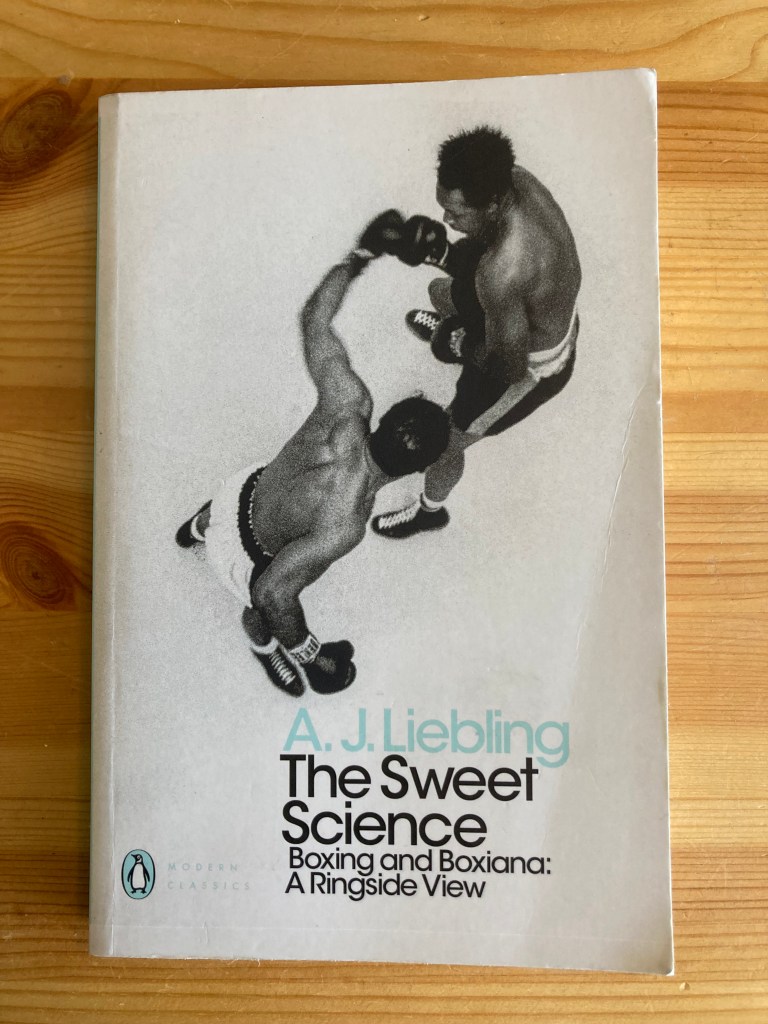
     

  • The Sweet Science: Boxing and Boxiana: A Ringside View

    AJ Liebling, 1956

    Read: January April 2025 

    Edition read: Penguin Modern Classics 2018, 232 pages

    Non-fiction 

    Liebling was a sports correspondent and this book was originally a series of articles for The New Yorker.

    Liebling covers a multitude of fights spanning – from what I could figure out – 1951 to 1955, over 18 articles (it’s hard to say how many fights exactly, because he refers to historic fights – some of which predate him – on a regular basis). These fights include boxers who are considered to be some of the best ever: Sugar Ray Robinson, Rocky Marciano, Joe Louis, Willie Pep, Sandy Saddler and Joe Walcott.  As such, this is widely considered to be a classic of boxing literature.

    The old-timey, black-and-white quality comes off the page; sometimes this is charming, sometimes it feels dated. Liebling, as befitting a writer for The New Yorker, has an elaborate vocabulary, which at times comes across as archaic (such as the use of ‘milling coves’) or stuffy (just because you can use a French phrase, doesn’t mean that you must*). He does also write with great sarcasm at moments. Largely set in New York, many of the figures read like a Looney Tune character; this is not necessarily a criticism of the writing, but at points some of the dialogue reminded me of Bugs Bunny (‘waidle you read the papers tomorrow’), which does make it hard to take seriously. 

    Nonetheless, The Sweet Science remains a valuable insight into a particular period and captures what Liebling accurately believed to be a vanishing world. By the fourth paragraph of the introduction, he has already raised his contention that TV was killing off boxing for the sake of advertising (hence his repeated references to beer and razor blades at any opportunity). With that said, he regularly goes to what he readily depicts as sold-out fights, such as Rocky Marciano versus Archie Moore – as captured in his many descriptions of crowded New York streets, bars, venues, restaurants and gyms. These pieces also show his obsession with boxing; no dilettante, he goes to sparsely attended fights as well as the sold-out ones (hence the subtitle). 

    Liebling takes on the unenviable task of describing different boxing styles, although he perhaps reads a bit too much into the physique of fighters. As with Norman Mailer’s The Fight, this always extends to covering the exact shade of black fighters’ skin. 

    Of course, Liebling didn’t know that he was writing in what is now considered one of boxing’s golden ages, and often seems somewhat underwhelmed. It is interesting that Liebling denounces aspects of this era.  

    Ultimately, its dated nature made it hard to read at points. If you stick with it, it is an interesting snapshot into boxing and where it sat within society. In this sense, because of these flaws, it is comparable to Mailer’s The Fight

    Worth reading? Yes, although it is dated. 

    Worth re-reading? No. 

    * Besides boxing, apparently Liebling loved eating and writing about French food. An improbable pairing.

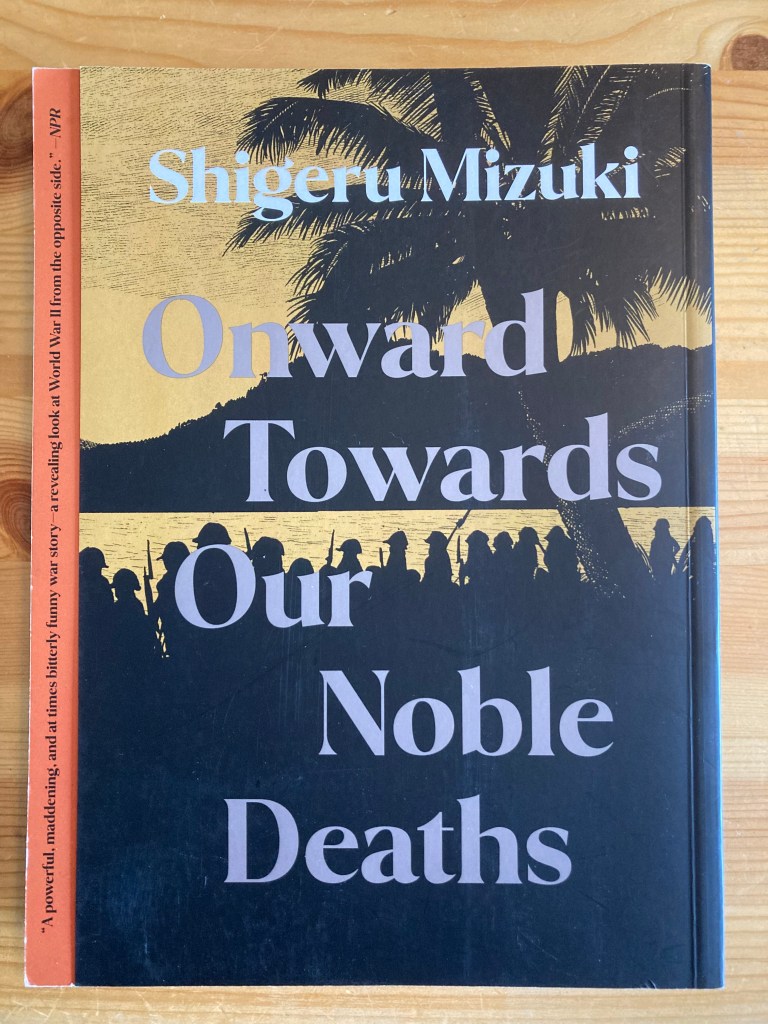
  • Onward Towards Our Noble Deaths

    Shigeru Mizuki, 1973 (translated by Drawn & Quarterly in 2011)

    February – May 2025

    Page count: 372

    Graphic novel

    Onward Towards Our Noble Deaths is a semi-autobiographical, black-and-white graphic novel about a battalion of Imperial Japanese infantry who were commanded to hold New Britain, an eastern island of Papua New Guinea, in 1943, against approaching US forces.

    It dissembles the image of the Imperial Japanese Army as being entirely made up of fanatics; the main characters are conscripts (‘rookies’), who are poorly trained, clumsy, grumble and are subject to abuse from their commanders, including physical beatings for no reason. Shigeru depicts these commanders with little sympathy; they are largely sadistic and inept, and refuse to recognise the strategic advantage that a guerrilla war – as opposed to the culminating banzai charge – would offer. The rank-and-file come across as most likely happy to surrender if they hadn’t been commanded to die fighting  and told by their ranking superiors that to live would be dishonourable.

    In the spirit of its original language and country of publication, it is printed in reverse, read right to left. The style combines somewhat quirky figures – heads and limbs fly from explosions and there are ‘BOOM’ onomatopoeias – with the naturalistic and textured backdrops of the rainforests of Papua New Guinea. This is, until the panels that depict the aftermath of conflict, where the death and destruction is no longer semi-comic and more like inked versions of war photos; prone bodies, trees shorn off, clouds of black smoke. The closing scenes switch exclusively to the photo-realistic drawing-style for these couple of pages, as if to say, what a waste.

    There are lots of characters – enough for a dramatis personae to be provided at the the beginning – who begin to die at a rapid rate as US planes, tanks and troops close in. The US soldiers, when they arrive, are depicted with so few details as to come across as Green Army Men, but as much of the Japanese soldiers’ fight is with malaria, rationing, clean water and sadistic officers. 

    It is hard keeping up with so many characters at times, and placing who is who on first read-through; the only character arc to speak of is of a doctor who ends up openly questioning his superiors’ morality. Fewer characters, with fuller characterisation, would have made this clearer. Likewise, the narrative direction is not always clear, and occasionally details are elided; one situation suddenly leads to the next with no transition presented. On second read-through, this does come to feel like part of the unclear, disorientating experience, but this could have still been delivered with a slightly more considered narrative.

    Obviously, depicting the perspective of Axis troops is to venture out onto thin ice, but this feels less like a justification than a exposé of the abundance of pointless death. One of the few humane officers feels compelled to commit suicide as he did not die in the first charge, and two others are ordered to commit seppuku – one of whom beforehand tears up a keepsake letter into the sea, which turns out not to even be from a girlfriend, but from his mum. On multiple occasions the infantry break into song; ‘Can’t hate the hateful enemy/forced to smile for smug soldiers/why am I stuck working this shitty job/no way out/all for my country’; as they sing this just before making their final charge, panel by panel they are shown simultaneously breaking down into tears.

    It’s not a comprehensive look at the Imperial Japanese Army during World War Two, instead focusing on the author’s experience in the Imperial Japanese Army. He writes himself in as one of the characters, with the key, unsparing difference that instead of just losing an arm and contracting malaria, as he did in real life, the character survives a mauling in the suicide charge, only to be shot by an American soldier. A noble death indeed.

    Worth reading? Yes.

    Worth re-reading? Yes – the added clarity allows the poignant moments to come across more clearly.

    I wonder if surviving the suicide charge wasn’t, rather than an act of cowardice, one final act of resistance as a human being.

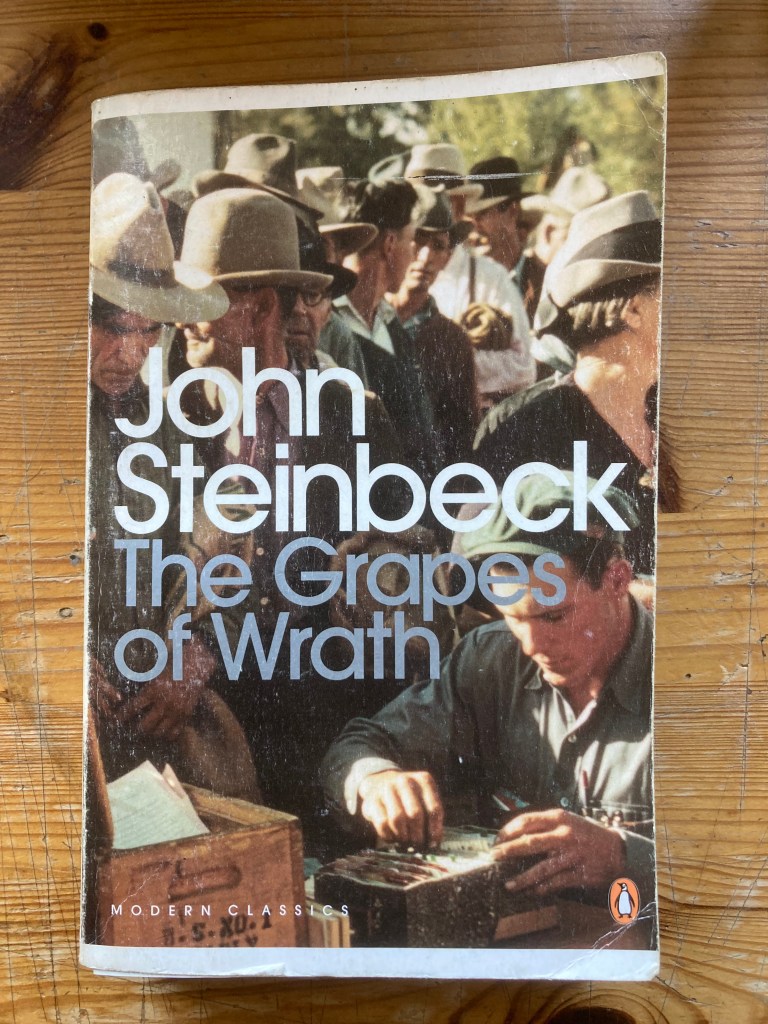
  • The Grapes of Wrath

    John Steinbeck, 1939

    Read: November 2024 – January 2025

    Edition read: Penguin Modern Classics 2000, 476 pages.

    Literary realism

    * Contains spoilers *

    A realist novel about American tenant farmers (monikered more literally in the book as ‘sharecroppers’) whose crops failed in the dustbowl during The Great Depression. In the process of their subsequent eviction they are completely disenfranchised. It is a documentation of the shift from one way of life to another – a hallmark of the Great American Novel.

    This road trip of the Joad family, as they are forced to become migrant works and drive from Oklahoma to California via Route 66, is defined not by a sense of adventure or a historical sensibility, but by a precariousness; they, alongside thousands of others, have to pack up their entire lives into a single truck and find a new home.

    As opposed to, say, Cormac McCarthy or Virginia Woolf, Steinbeck’s straightforward writing style doesn’t initially draw attention to itself, but its clear, earnest manner brings a gravitas to the story being told. More complex yet still authentic, the speech is conversational and as spoken (‘just set and figured’; ‘don’t get ornery now’, etc.) Likewise, there is a strong layer of symbolism (I particularly liked the rising flood waters and downed tree towards the end), although it’s interesting ow rich the story remains even when read without these.

    This declarative quality serves the depiction of life being harsh and people being poor; when Grampa dies, the family have no choice but to bury him in a field; even the tractor driver, who can do the work of dozens of sharecroppers, talks about having yet to buy shoes for his youngest child; and Rose of Sharon, self-centered, pregnant, abandoned by her husband and suffering from malnutrition (fried dough does not a well-rounded diet make), is shown little in the way of sympathy. The family unit is consistently depleted, with family members either dying or wandering off on a regular basis. The ties that bind are severed as misfortunes assail the Joads day by day.

    This builds into the major theme of the individual versus the collective. Some of the people taking part in this exploitation hate themselves for it, as they know what they are doing, but are subject to the same downwards financial pressures. When the employees unionise, they are immediately denounced as ‘red’ and attacked, verbally and physically. There is no ignoring that this is more than just a story – this is a political book.

    The longer chapters, which are directly about the Joads, are interspersed by short chapters of exposition, wherein the narrative point of view is anonymous and omnipotent; I read this as the voice of Steinbeck. Either way, these shape up as what the introduction refers to as ‘atemporal interchapters’, serving to show the scale of the suffering.

    Worth reading? Yes.

    Worth re-reading? Yes – this was a re-read from seven to ten years ago. Perhaps Steinbeck’s best book, combining the human struggles of Of Mice and Men with the scale of East of Eden.

    Wherever they’s a fight so hungry people can eat, I’ll be there. Wherever they’s a cop beatin’ up a guy, I’ll be there […] I’ll be in the way guys yell when they’re mad an’ – I’ll be in the way kids laugh when they’re hungry n’they know supper’s read. An’ when our folks eat the stuff they raise an’ live in the houses they build – why, I’ll be there.