The Page Count

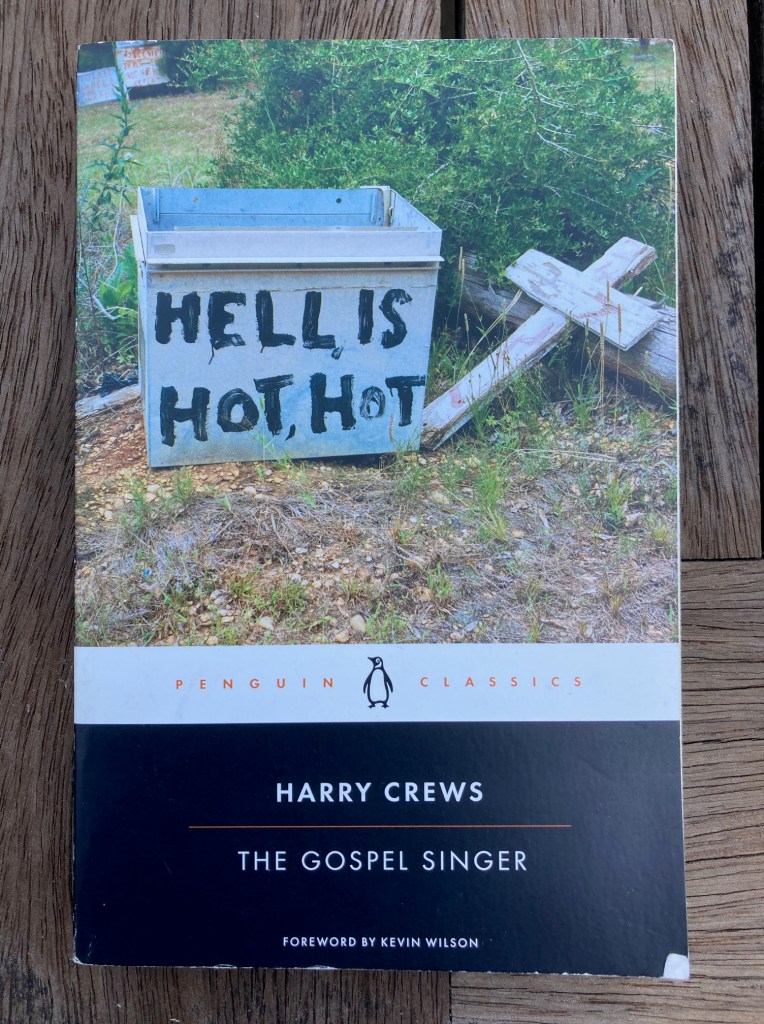
  • The Gospel Singer 

    Harry Crews, 1968 

    Penguin Books, 2022, 210 pages

    Read February 2024, re-read March 2026 

    Fiction, Southern Gothic

    *Spoilers* 

    The eponymous Gospel Singer returns to his hometown of Enigma, Georgia, where his talent quickly proves to be a poisoned chalice in the company of some deeply flawed characters – including himself. The idolatry of the townspeople (and those from further afield) creates a twisted burden of expectation, elevating the Gospel Singer to healer status, when in fact, he just found that he was good at singing and used it to escape a life of hog farming in a swamp. Christianity is nothing more than a persistent black cloud to him: ‘[…] his superstition of God opened in him like an old wound […] What had God to do with him? Who was he, The Gospel Singer, anyway, for God to be concerned with?’ His followers project their hopes onto him, hoping that he can cure them of their various maladies, with the ‘Dark Man’ embodying the desires of the crowds for the Gospel Singer to be their panacea: 

    For the Gospel Singer, [the man] became, in that moment, the symbol not only of the rest of the audience but of every person who had ever heard him sing. The man was asking, as plainly as if he had shouted it at the top of his lungs, for an impossible benediction, for an intercession between the world and the flesh that the Gospel Singer could not make.

    The only people who don’t want something from him are his mother (except for him to stop touring and come home) and Foot, the leader of a touring freakshow – who does, nonetheless, correctly identify him as a business opportunity, following the Gospel Singer’s act around the country with his own. Likewise, his manager, Didymus (a Biblical name meaning ‘twin’ and another name for Thomas the Apostle) has a twisted utilitarian vision, in which if an act of evil leads to an act of countering good, evil is therefore goodness. Faith, business and entertainment are presented as flipsides to each other here, the Evangelical businessman Woody Pea as nakedly representing this intertwining of religion and entertainment and money as anything or anyone else. Even when the Gospel Singer, who remains unnamed throughout, even by his friends and family, does do what he can to help – giving his family money to build a new house and buying them a new car – this is met with inconsideration, his family letting pigs live in the house and leaving the new car broken.

    Compounding the Gospel Singer very much not being a healer is him very much being a sex addict (‘Lust rose in him like a live thing, and it swept everything before it: altars, lynchings, churches and revivals’), which develops into a love/hate relationship with his hometown sweetheart, MaryBell Carter. Enigma collectively assumes that they are a couple, but they have a loveless relationship driven only by physical lust – a basis which the Gospel Singer established and which she weaponised when he refused to commit to her. As such, neither the Gospel Singer nor MaryBell Carter are what Enigma thinks they are.

    As with Crews’s A Feast of Snakes, mindless crowds are a recurring feature (‘The street was a jammed mass of faces turned up like masks with black open mouths sucking and expelling a collective breath’) and when he finally tells them the truth, a congregation, awash in one of the Bible’s most famous acts of destruction, a flood, turns into a lynch mob. Willalee Bookatee, the murderer with whom the story beings, kills MaryBell for the same reason – because she tells him that the basis of his faith is corrupted. Despite the town’s professed hatred for Bookatee, there’s not much difference between them in the end, both senselessly killing someone they love as they reveal their true nature.  

    As much as he is exploited, the Gospel Singer is complicit in that he, in turn, exploits people – specifically, young women – to feed his addiction. While it’s hard to feel much sympathy for him as the story progresses and the depth of this particular flaw become apparent, what also becomes clear is that he is never seen as a person in his own right, as the lack of a name would suggest. It is no coincidence on Crews’s part that the most well-adjusted person in the whole book is the leader of the freakshow, Foot (in contrast to Enigma, the ‘freak fair’ is neat and orderly), who tells the Gospel Singer that he is not as attractive in the flesh, a comment that the Gospel Singer actually seems to appreciate.

    The plot’s simplicity emphasises its quick pace and character-driven nature. Crew’s first novel is often referred to as ‘Grit Lit’ or ‘Southern Grotesque’, but for my money, it’s just a Southern Gothic and a satire on evangelism, and a macabre, darkly humorous, excellent one at that. Despite the wonderfully freakish characters (the preacher who butchers a woman with an ice pick, a sheriff with one lung, a brother who has an aversion to the heat à la Anse Bundren in As I Lay Dying, his two other siblings’ awful musical act, Woody Pea the Evangelical businessman – not to forget the sex-addicted gospel singer), Crews has an ability to make them human.

    Worth reading? Yes. 

    Worth re-reading? Yes.

    ‘“There’s work and there’s work,” said Didymus. “My work is souls.” 

    “Mine’s pigs,” said his father.’ 

    If you liked this, you might like:

    The Gospel Singer, Harry Crews

    The Long Home, William Gay

    Provinces of Night, William Gay

    Child of God, Cormac McCarthy

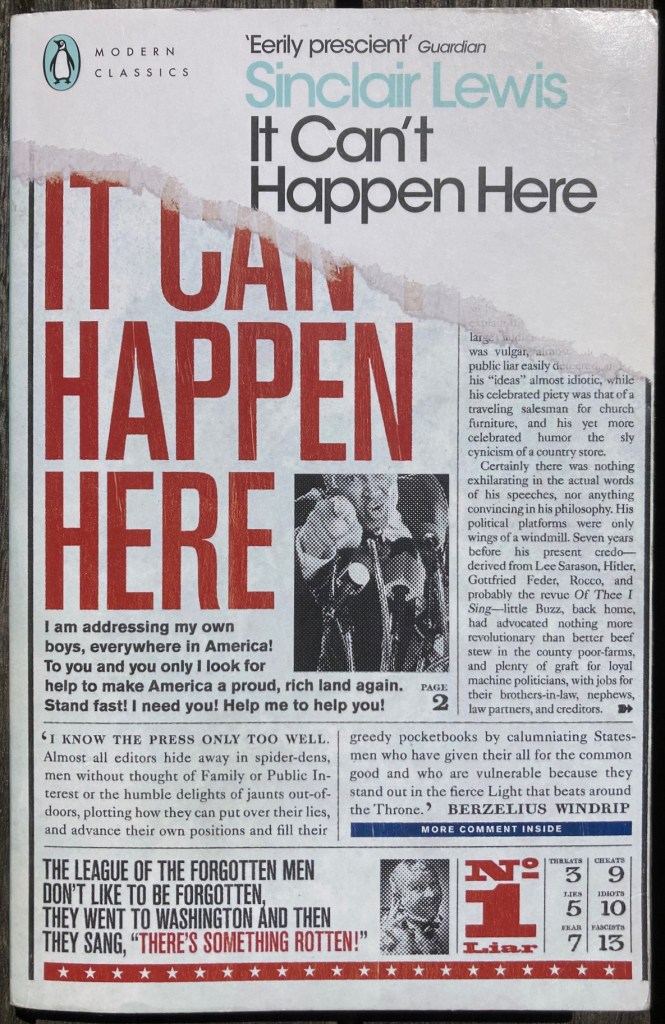
  • It Can’t Happen Here

    Sinclair Lewis, 1935 

    Edition read: Penguin Classics, 2017, 376 pages 

    Read April–May 2026

    Fiction: Literary fiction, dystopian fiction 

    *Spoilers* 

    The rise and rule of a populist leader in 1930s America. As a candidate, Berzelius ‘Buzz’ Windrip promises everything to everyone (‘he was all against the banks but all for the bankers’). Upon victory, he tacks hard to starboard, establishes a vice-like grip on the country and proceeds to deliver for cronies new and old while immiserating everyone else. Contemporaneously written with the rise of dictatorships in Europe, this initially very much comes across as a cautionary tale for American readers. However, despite the folksy setting (Vermont) and language, this is a universal warning: it can’t happen here (page 142) – until it does (page 241). 

    Starting at a small-town Rotary Club, the self-appointed local movers and shakers are risible – the portentous language, the names (‘Roscoe Conkling Crowley’ was a favourite), the self-important attitudes – but the things that they call for, and the cognitive dissonance that they couch them in, foreshadows the nature of the forthcoming regime. 

    Given that dictatorships of this exact nature were a new phenomenon* when this was written, Lewis depicts a lot of their defining elements accurately: the importance of propaganda (chapters are prefaced by passages from Windrip’s polemic novel, Zero Hour), the removal of checks and balances, the morphing of economic redistribution into a corporatism (the grassroots ‘League of Forgotten Man’ movement is forcibly disbanded once Buzz is in power), the persecution of intellectuals, the state assuming complete control of education, the onset of (eventually open) corruption, the intertwining of fascism with Christianity (until the former no longer needs the latter), demagogues’ use of militias, economic mismanagement, the weaponisation of courts, the censoring of news, purges, the formation of labour and concentration camps: it’s all here.  

    Initially, the basic premise is liberalism versus fascism. Our protagonist is the avowedly liberal everyman, Doremus Jessup, who sees Buzz for what he is. Fascism is the means of the antagonist here, but socialism (here represented by John Pollikop) and communism (by Karl Pascal) also receive regular criticism and mocking from the narrative perspective.  

    Given that it is liberalism that precedes the tyranny, this initial smugness comes to be seen as misplaced. However, as much as the communists are not represented as the antidote to Windrip’s fascist government, as the story progresses, liberalism is also becomes subject to criticism; Lewis deftly shows what happens when people think they can stay below the storm. However, there is valid criticism of left-wing infighting and its inability to form a united form. As much as this story ends with a message of hope and resilience, this seam of cynicism remains. 

    Both despite and because of its complexity, the writing style is enjoyable. Sometimes it’s old-timey to the point of amusement: 


    ‘“Say, boss, you don’t honest t’God think we’re going to set this up, do you?’ 

    ‘I certainly do!’ 

    ‘Well, I don’t! Rattlesnake poison! It’s alright your getting thrown in the hoosegow and probably shot at dawn, if you like that kind of sport, but we’ve held a meeting of this chapel, and we all say, damned if we’ll risk our necks too!’”

    The tone is decorous even as events increasingly take a turn towards the uncivilised, creating a dissonance which works on a symbolic level: Buzz speaks in one way, but acts in another. The sentences and paragraphs are oft long and complex, the clauses (and subclauses) are many, and it presupposes an understanding of American archetypes circa 1930, a cultural shorthand that inevitably doesn’t always carry through to 90 years later. As such, it sometimes reads as though written by Mr Burns.  

    However, what does successfully transmit is the warning against the exceptionalist belief that it – i.e., fascism – couldn’t happen in America – and in a continuation of this logic, anywhere else. It was interesting that our antagonist, Buzz, is built up and made bigger than life, despite (or perhaps because of) never making an in-person appearance (except for at a distance, at a stadium rally). Arguably, Lewis misses a trick by having Buzz eventually removed from power (as is also the case with his successor, Lee Sarason, the Steve Bannon of his cabinet).** This felt like a missed opportunity to examine the cult of personality which underwrites so many dictatorships, without really either leaning the other way to examine the concept of ideas outlasting their founder.  

    It’s not subtle, and arguably, the steps towards dictatorship happen a little too soon: as soon as he is elected into power, Buzz bears fruit on his threats of fascism and fully dismantles democracy. Furthermore, for a book that presents liberalism as perhaps the best thing that we have, women and ethnic minorities don’t get much of a look in (although the persecution of Jews does). Despite its work as a vehicle for ideas being perhaps a bit heavy when compared to the human element, it remains a compelling story, partially because of how prophetic it has proven to be. 

    Worth reading? Yes. 

    Worth re-reading? Yes and yes. 

    ‘“More and more, as I think about history,” [Doremus] pondered, ‘I am convinced that everything that is worthwhile in the world has been accomplished by the free, inquiring, critical spirit, and that the preservation of this spirit is more important than any social system whatsoever. But the men of ritual and the men of barbarism are capable of shutting up the men of science and of silencing them forever.”’ 

    * Were there any precursors to the dictatorships seen in Italy, Russia, Germany, Spain that were similar in nature? Sparta, perhaps? (I think Imperial Japan had been going for a while?) 

    ** Sales of It Can’t Happen Here spiked in the months following November 2016. 

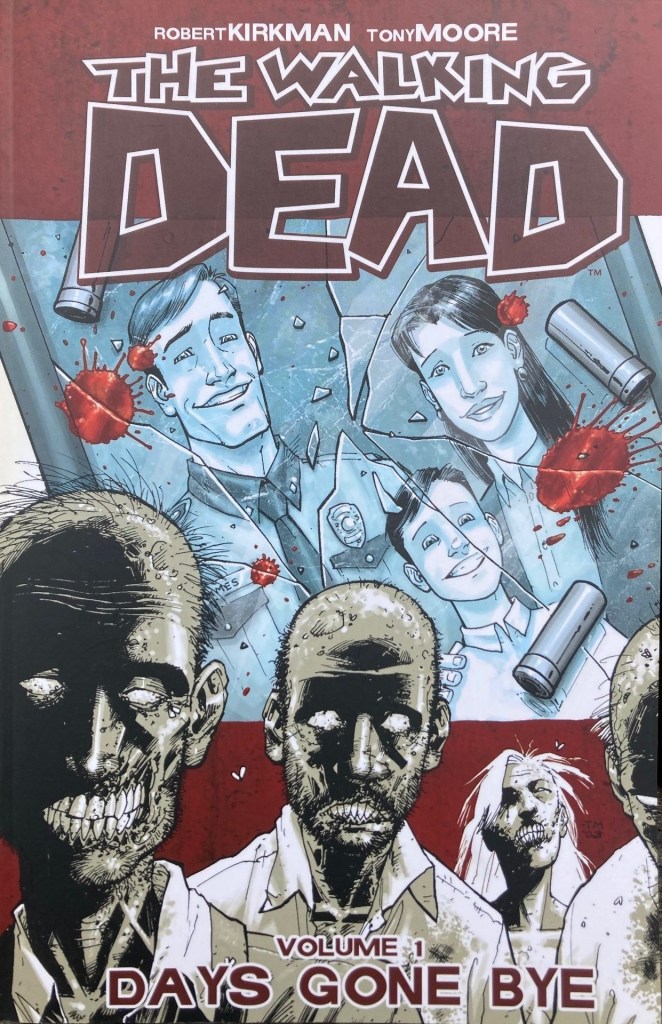
  • The Walking Dead

    Robert Kirkman, Tony Moore and Charlie Adlard, published 2003–19 

    Image Comics, 2003–19, 32 volumes at around 156 pages each 

    Read from 2013 to June 2026 

    Fiction: graphic-novel series, horror, thriller

    *Spoilers* 

    Much like the zombies that populate this apocalyptic franchise, we’ve shuffled a long way, and now after 13 years of reading and surviving, the end is nigh. As such, all 32 volumes are here reviewed together. 

    Starting with our protagonist – Sheriff Rick Grimes – waking from a coma in an abandoned hospital to a freshly arrived apocalypse, zombies are the primary antagonist, but other humans quickly take over as the main threat with the collapse of civilisation.* This is zombies as a backdrop to a social experiment. Initially, this keeps the premise interesting as multiple attempts to restart civilisation, which generally consists of our heroes trying to evolve from hunter-gatherers into a stationary society which has specialised classes, fall afoul of other people’s designs. Sometimes these antagonists are sinister; sometimes they’re just competing to survive. With the upending of the status quo comes a perpetual unease and danger. No explanation is given as to the ‘how’ or ‘why’ of this apocalypse – the dead now come back to life and the toothpaste won’t be going back into the tube as we are plunged into this new world alongside Rick and his family.  

    The main themes are leadership, power, justice, trust, betrayal, whether the enemy of my enemy is my friend and divided we fall. The old system versus new ones is a recurring theme; besides their own group dynamics and struggles (Rick is the reluctant leader), the other groups they encounter all have different social systems and they struggle with the quandary whether to push for change or to accept something good but flawed for what it is, with its undemocratic imperfections.

    The biggest symbolic advantage of the zombie as a trope is sometimes used effectively, sometimes not so much. Zombies as a mirror of humans is really stressed early on, then they just become more of a background nuisance.** They end up forming herds, and the symbolism of this could have been exploited more so. 

    Besides the corruption of youth and innocence (via Rick’s son, Carl), as Rick (our everyman) battles the world, heroes stray into villainous territory and it becomes a cautionary tale of he who fights with monsters might take care. With that said, some of the characters – both our heroes and our antagonists – are flat, such as the Governor, who is depicted at a consistent level of wickedness. Such personalities would arguably flourish in an apocalyptic scenario, but a little more justification for some of the behaviour would have been appreciated. On this point, although it is packed in towards the end, Negan has a more interesting arc, developing from villain to enemy-of-my-enemy to distrusted ally, acting as a foil to Rick along the way. (The quality of his dialogue, defined by his constant imprecations, never improves, however.***) We are invited to consider what makes Rick different to Negan, but for too much of the story he remains too much of a shark for this point to really land.  The diversity of the characters is also interesting.

    As per the above comment about the symbolism, there’s also not too much in the way of subtext, and some of the dialogue can veer from a bit clunky to downright awful (two characters discussing zombies: ‘What happened to these people is a sad thing.’) There are lots of speeches in which either a new hope is established or all hope is lost, and the matters of the day tend to be stated quite baldly – ‘WE ARE THE WALKING DEAD!’, etc. 

    Despite the zombies being a bit plodding, the danger of this world and the horrors that it produces are not to be underestimated. There is some strong stuff here – murder (including of children and babies), rape, torture, dismemberment, cannibalism and people disguising themselves by wearing the skins of the dead (arguably the symbolism is just a tiny bit heavy-handed here). Reader beware – main characters will be killed off and mutilations abound.  

    After an enthusiastic start, that it took me 13 years to finish this series is indicative. Apparently, the writing of the series was wrapped up suddenly, but it’s still definitely too long (there are numerous declarations of ‘It’s time to end this’), and it became hard to care about (and thus subsequently keep up with) the proliferating secondary characters, even as the original cast were killed off and with a late injection of intrigue surrounding Michonne. 

    With all of this said, the relief of reaching the end was mingled with sadness – there is a flashforward to the world of the next generation, in which the world has changed once again and Carl must continue to adapt. At one point, in what I can only describe as a very Lynyrd Skynyrd gesture, a flock of birds flies overheard, signifying the rebirth of a nation. An interesting point is when a character disputes the legacy of Rick, but nothing is made further of this ‘founding-father’ revisionism. There is a weird bit where Michonne, now a judge, makes a speech in which she reads out the blurb of the book (which is the same for every issue). Besides suddenly going a bit meta, the blurb is actually quite misleading, positing a ‘now we are surrounded by death, we must learn to truly live’ premise, which is not the tone of the series (the only characters who seem pleased that the world has reverted to a Darwinist state are clearly those we are not invited to empathise with). What does work a bit better is the end, in which Carl’s bedtime story to his daughter, becomes an epilogue: ‘But this is not a scary story. This is a story about hope.’ 

    In terms of the drawing style, this changes between volumes 1 and 2 and then 12 and 13, simplifying slightly.  It’s in black and white, and I also wondered, given the abundant scenes of gore and rot, colour would have been better (although colourised editions have been produced since I started reading). It’s certainly not minimalist in any other way. 

    Worth reading? …up to around issue 21. I advise reading the compendiums rather than the individual issues.****  

    Worth re-reading? After issue 21, no; the storylines start to recycle.  

    You might like this if you enjoyed:    

    Watership Down by Richard Adams 

    Lord of the Flies by William Golding 

    The Road by Cormac McCarthy 

    *Not to be confused with Cillian Murphy’s misadventures 

    **They are of the old-school, George Romero mould – slow, grumbly, hostile in quite a sullen way. 

    ***Much like in The Midnight Gospel, in a whimsical moment he considers whether maybe zombies are living their best lives.   

    ****Also available at your local bookstore. 

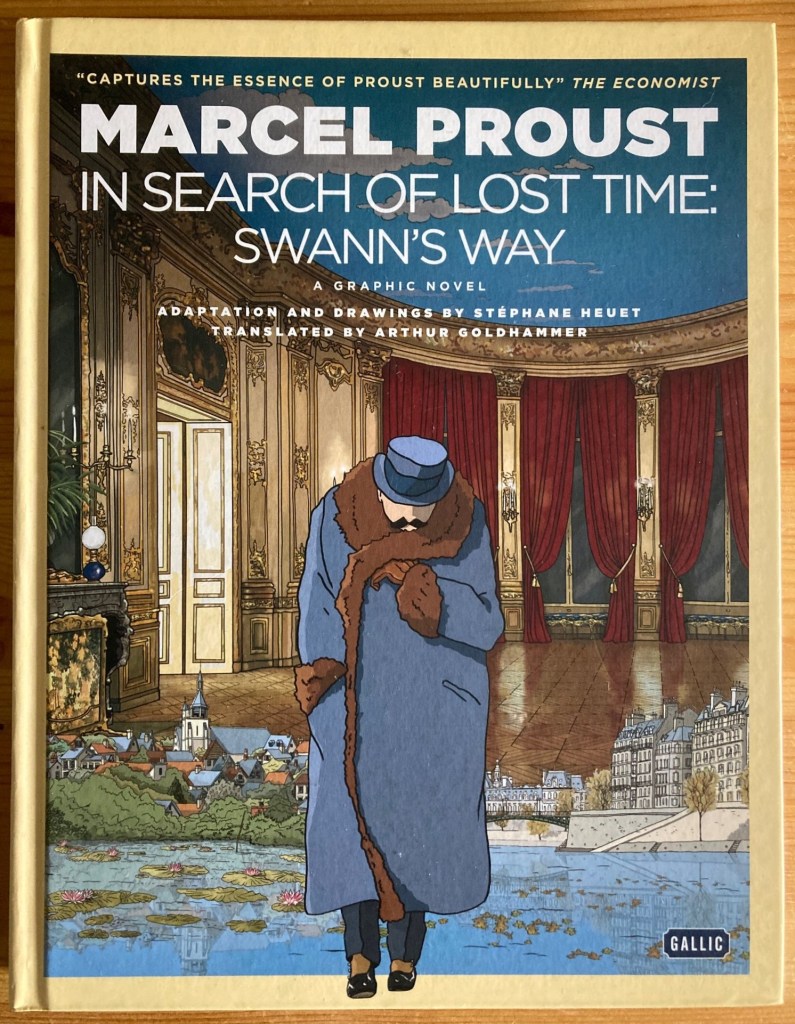
  • In Search of Lost Time: Swann’s Way – A Graphic Novel 

    Marcel Proust, adapted by Stéphane Heuet, 2013, translated by Arthur Goldhammer, 2015  

    Gallic Books, 2016, 224 pages 

    Re-read: December 2025 – May 2026 

    Fiction: graphic novel, modernism

    *Spoilers*

    The original is a canonical piece of modernist literature, a masterpiece focusing on the themes of memory and experience, an idiosyncratic tour de force. The plot, revolving around fin de siècle upper-class French society, complex enough in its own right before the ornate writing style is even taken into consideration, is only as important as the lengthy discursions into experience and memory. The sentences are long, the descriptions are rich and the digressions often. It’s also very long. In fact, it’s the longest book ever; In Search of Lost Time consists of 1.3 million words (novels are typically 70–100,000 words). Compounding this, as mentioned, like much modernist literature (Virginia Woolf, James Joyce, T.S. Eliot, etc.), it’s an intricate, dense read. So I’ve not actually read it.*  

    Can I review an adaptation with knowing the original? Partially and partially only. Obviously, I can merely review this adaptation on its own merits rather than against those of the original or on those of it as a success as an adaptation. However, I do think that reading this graphic-novel adaptation is a pragmatic alternative, and having opted for this choice, I am a younger (or just less old?) reader for it. It’s also worth noting that Swann’s Way is actually just part one of the original seven.** As such, even without having read it, I know that this is must have been a challenging book to adapt. 

    Although it starts off with the surreal vision of a pair of giant eyes drifting across the nighttime waking vision of Proust the narrator, Stéphane Heuet quickly curtails this in favour of a generally more true-to-life, subdued approach. It is drawn in ‘Ligne claire’, which translates to clean lines and little hatching. Think of as a slightly softer, more pastel-ly version of TinTin

    In contrast to this psychedelic opening, the drawing style doesn’t draw attention to itself, but this suits the text. Rather than pushing at the boundaries of consciousness, such as Charles Burns’ Black Hole and Last Look, it’s about memory. 

    Despite Proust starting this story as the narrator, a precociously observant young boy (and later on, a precociously observant middle-aged man), this is a framing device for the story of Charles Swann, a rakehell, albeit quite a mild one. I initially found the section about the narrator more interesting than the sections focusing on Swann, the former being more sensory and the latter being more about people (and in particular, some very self-absorbed people), but Swann becomes more interesting when he becomes more melancholic as he comes to understand the role of sensations and memories – fleeting in nature – in determining his perception of love. I don’t know if Proust intended this to be a satire, but after a while, the fripperies of upper-class life come to be a bit tedious. Regardless, Proust is astute at showing rampant pettiness. 

    As with how the famous*** dipping of the madeleine into tea triggers the story, a passage of music takes Swann back to his lost love and the small details of their courtship, with  Proust connecting memory to epiphany. Besides memory, this also touches upon the theme of pain begetting art, with Vinteuil, the composer of that particular piece of music, drawing from his suffering. 

    Even in graphic-novel form, it’s still text-heavy: it is still a read that demands attention, with short sections of the novel text lifted directly into captions and speech bubbles. No doubt this is an easier read than the original, but there is a lot of dialogue and it is easy to miss details. Proust focused on complex themes and ideas and, as such, every word and panel matters. 

    It’s also a melancholic read. The themes of memory and experience most often translate into disappointment, regret and a disassociated sense of having ossified via living through memories. Swann realises that he has wasted years of his life, too late, and the narrator realises that there is no recreating the feelings conjured by memories. Proust expresses an understanding of how there is often a tension between how we remember things – most poignantly, our zeniths – and how that moment actually was, and how we felt at that time, rather than how we came to feel about it. 

    Initially, I was going to contrast this against Blood Meridian, which I started re-reading around the same time. In Search of Lost Time felt petty when compared to the latter and its strong focus on human nature and death. Upon further reflection, this contrast should instead be a comparison: this is also about life and death, but from a non-violent perspective (body count: one).**** In Search of Lost Time is too complex to be reduced, but my main takeaway is that it is about what we do with our lives, with an understanding that time only ever moves forward, creating an ever-moving canvas upon which create memories both good and bad, and that one day we will die. It’s not a wild ride, but it is true to the life that most people will live. 

    Worth reading? I would read this before attempting the original. 

    Worth re-reading? Given its complexity, with time, yes. 

    If you liked this, you might like: 

    Kingdom, Jon McNaught 

    The Unconsoled, Kazuo Ishiguro 

    The Remains of the Day, Kazuo Ishiguro. 

    *For a while I tried to read a page a day at breakfast (tea, but no madeleines). 

    **Normally, I review serialised graphic novels altogether (The Walking Dead coming soon), but as far as I can tell, only parts one and two (In the Shadow of Young Girls in Flower) have been adapted into graphic novels. 

    ***More so in some circles than others, I suppose.

    ****An old lady who dies of natural causes. 

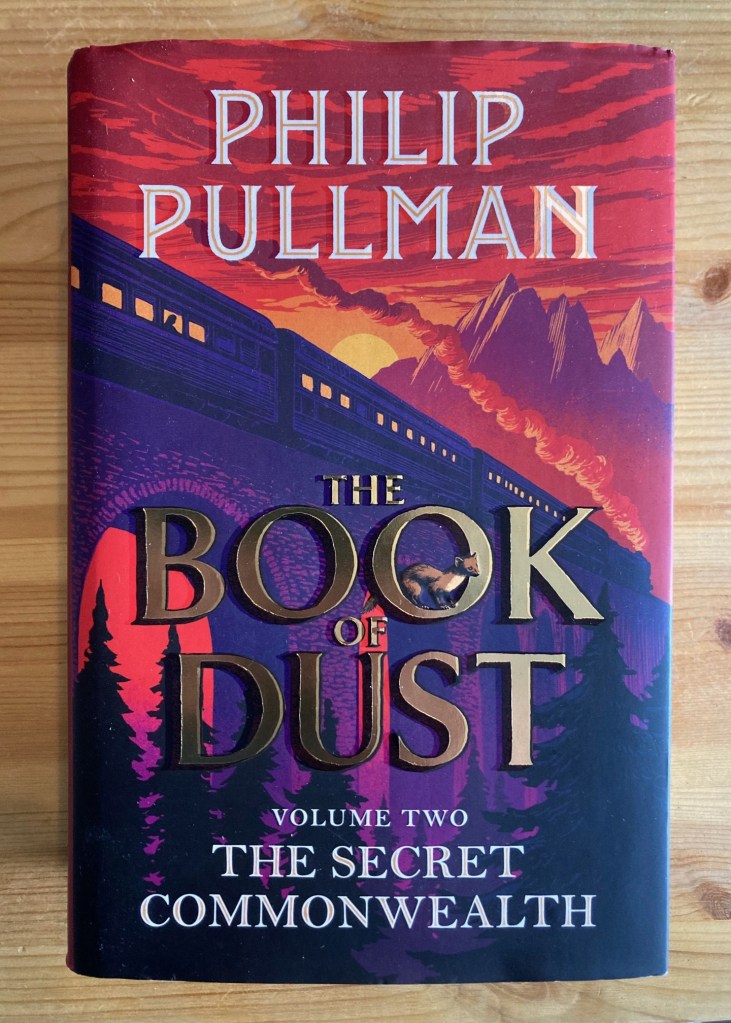
  • The Secret Commonwealth 

    Philip Pullman 

    David Fickling Books, 2019, 687 pages 

    Read January 2020, re-read December 2025–May 2026 

    Fiction, adventure, steampunk 

    *Spoilers* 

    A return to the universe of His Dark Materials. Whereas La Belle Savage was a prequel to His Dark Materials, this – part two of The Book of Dust trilogy – is a sequel, continuing around ten years after the heartbreak of The Amber Spyglass. 

    Lyra is now a young adult, studying (and sinking pints) in her hometown of Oxford. The shadow of her past is not yet fully diminished, with her lost love, Roger, referred to a few times, and her and Pan now able to separate (in this universe, a huge taboo). Maybe as a way of coping with this, she’s really into the newly in-vogue philosophy of hyper-rationalism, which Pan – her manifested, pine marten-shaped soul – is understandably not too pleased about. This is against a backdrop of the Magisterium, an international religious institute, expanding and consolidating its powers. 

    From the inciting incident of Pan witnessing a murder, we have the elements of a mystery and the ingredients for a quest. There are two main driving factors, combining the global and the personal; Malcolm Polstead trying to find out why ‘men from the mountain’ are destroying vital rose fields in Central Asia; and the separation of Lyra and Pan, and Lyra’s subsequent hunt for Pan. The former is interesting, the latter is vital. Our Hero’s Path has been established. 

    The addition of new characters builds upon the existing universe, with established characters, beside Malcolm, returning, such as the gyptians and Hannah Relf.* There are a couple of difference perspectives – Lyra, Pan, Malcolm, Marcel Delamare (Lyra’s mental religious uncle), Olivier Bonneville (a fellow alethiometer** reader) – but it is Lyra who remains our (flawed) heroine. 

    However, in contrast to the preceding trilogy, this is not a story about or for children. Pantalaimon’s decision to separate from Lyra, partially due her being an insufferable student type, leaves her simultaneously untouchable and highly vulnerable. She finds herself having to travel through a world where she is constantly at risk, and is sexually assaulted and nearly raped at one point. Despite these adult concepts, the writing style reads as though for children at points, and this could be quite jarring; it sometimes moves from a very simple sentence to something very adult. 

    Whilst still critical of organised (and corrupt) religion, Pullman also rejects binary assessments. After the ‘God is dead’ schtick of His Dark Materials,*** he seems to be saying a) it’s OK to be supernatural (this is where the ‘secret commonwealth’ comes in) b) don’t be a hyper-rational dick who is so in thrall to sophists that even your manifested soul doesn’t want to hang out with you. 

    It’s long, and although it does have touches of the epic about it, it doesn’t quite justify its length. The plot is complex, with a lot of characters moving about geographically, and at times this made it feel like the transition piece in a series. While the finalé of the trilogy, The Rose Field, will determine whether this pays off, judged on its own merits, not everything in The Secret Commonwealth worked well, such as the sequence with the alchemist Agrippa, which felt a bit like a connecting device. Malcolm’s hitherto unmentioned feelings for Lyra seem unfounded, and the religious villains, while possessing a clear motivation (it’s power. It’s always power) are a bit flat, with Olivier reading as a bit of a plot device. It would have been tighter if a few perspectives or characters were dropped: what if Pan’s whereabouts were left a mystery, and Olivier’s perspective was not direct but instead reported by Malcolm where it added something?  

    Worth reading? Yes. Keep a character map. 

    Worth re-reading? No, unless you need to as a reminder.  

    You might like this if you enjoyed:  

    His Dark Materials, Philip Pullman 

    Duncton Wood, William Horwood 

    American Gods, Neil Gaiman 

    Neverwhere, Neil Gaiman 

    Kraken, China Miéville 


    *Unfortunately, the panserbjørne, the armoured, brawling polar bears, do not return to stare into souls and kick ass. 

    **Alethiometer: looks like a compass, acts like tarot cards. 

    *** In The Amber Spyglass, there is a scene where Lyra and Will do actually see God die. He seemed OK with it, all things considered. 

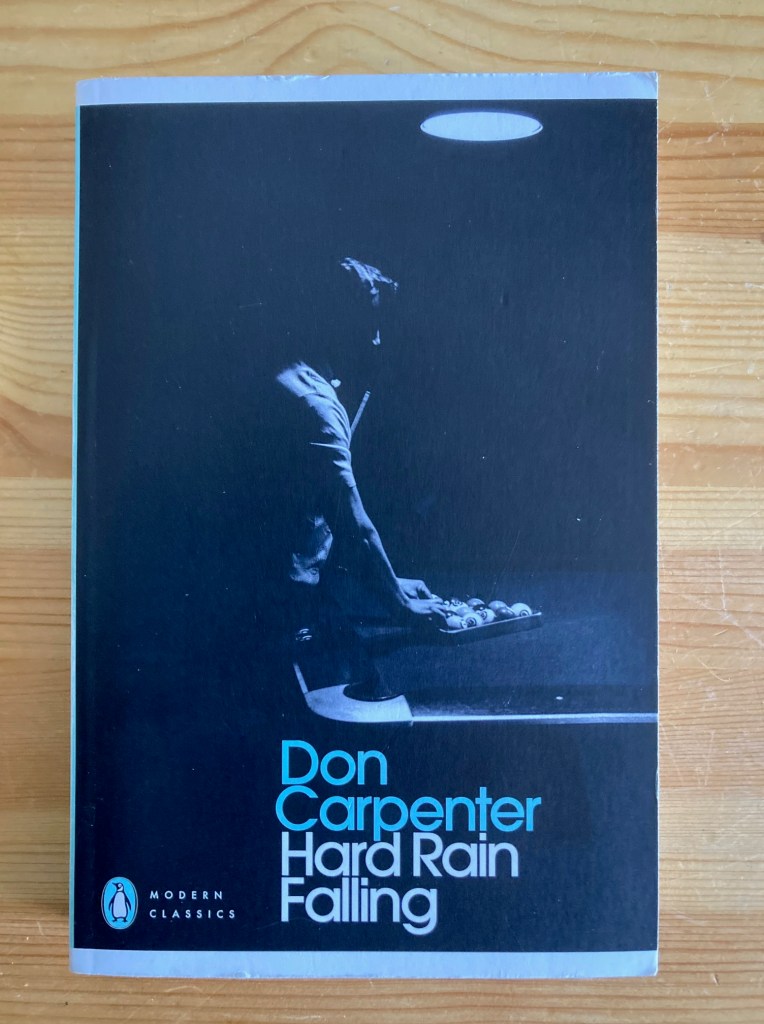
  • Hard Rain Falling

    Don Carpenter, 1966 

    Penguin Modern Classics, 346 pages 

    Read April 2026, re-read May 2026

    Fiction, Noir, Crime 

    *Spoilers* 

    I picked this up because of the Bob Dylan song and assumed, both being products of the 1960s, one must have been named after the other. However, whereas Dylan’s A Hard Rain’s A-Gonna Fall feels broadly prophetic, in Don Carpenter’s first novel, Hard Rain Falling, the hard rain in question isn’t prophetic – it is already happening, and the hard rain is life itself. 

    The lives of two men – one white, one black – become intertwined in post-Second World War America.* Jack and Billy, both from poor backgrounds, one shaped by the orphanage system and the other by racism, meet both each other and various highs and lows in poolhalls and prisons. 

    Jack has no sense of a future, making choices without consideration for their consequences. Raised in the Darwinian environment of an orphanage, he fights, drinks and steals his way into his first stint in prison. Billy, in contrast, is talented and does have a sense of a future that he wants, but is also black in 1940s and 1950s America. They go on to endeavour to escape their poor origins, but only with partial success, reuniting in a prison cell. 

    There’s social commentary: Jack hates the lack of humanity applied to the marginalised; as an orphan, he learns that the struggle is against a system, not an individual; he despises those who assume authority while also understanding that he would be the same should he be in charge; and he is shrewd enough to see through the prevalent racism. When an authority figure finally does ask Jack what he wants, he is stunned into silence. And from Billy’s perspective, even at the novel’s instigation he is already so ground down that he rarely allows himself to be anything other than pragmatic, bitterly reflecting later on in the book that one day his children will have to learn what racism is and sarcastically asking another black man when racial injustice will end. 

    Nonetheless, this is less a novel of social protest than one of the human condition, framed through the perspective of the marginalised. Jack and Billy live on the edge of society, but their struggle is against themselves as well as against the system. If they had more normal childhoods – i.e., if they were born as the rich character Bronson, rather than as themselves – they would still have a lot of the same questions (as Bronson does at the end, ‘sometimes wak[ing] up at night and feel[ing] it all [slip] through his fingers.’) 

    This is where Hard Rain Falling becomes something more than poolhalls, fighting and pulling; an idiosyncratic combination of the big ideas and a streetwise sensibility emerges over the course of the book, elevating it above being just a walk on the wrong side of the tracks. With a re-read, this seemed more like a book about everything: society, isolation, money, racism, love, parenthood, a sense of purpose. It’s all in there – except for the answers. 

    Even with the inclusion of these big ideas, it is still narrative-driven and a quick read. Initially, the structure, consisting of a couple of acts, seems slightly unusual, but this book is better understood as really being Jack’s story, rather than that of Jack and Billy. Although the story is set up to represent them as joint protagonists, as the story goes on, Billy becomes a kind of deuteragonist. 

    Although Jack is never an unintelligent character, he very much starts his character arc as an insensitive soul leading a dissolute life. When we are introduced to him, all he wants are temporary things – food, drink, a woman, clothes, a fast car. Likewise, when we meet Billy, he is already street – or rather, poolhall – smart. These dubious origins develop into Jack and Billy’s search for meaning. Billy starts off the story as the more naturally philosophical soul, already full of existential dreads and fears of insignificance, whereas Jack’s story involves him becoming more feeling, more aware, in large part due to Billy. The scene on the beach marks this change, with the last third of the book consisting of Jack having enough freedom to realise his constraints and that he is still missing something. 

    Carpenter’s fantastic insights into the human condition are aided and abetted some great writing: ‘How do you wake up? It was one thing to know that you had been asleep all your life, but something else to wake up from it, to find out you were really alive and it wasn’t anybody’s fault but your own. Of course that was the problem.’ He pulls off the unenviable task of being both expansive and insightful while making it believable that two guys from the street would think and talk this way. A weakness is that he pens better male than female characters, with the women written in a far less sympathetic manner; Sally is impatient, patronising, easily bored, inconsiderate and self-centred. Given that Jack is not supposed to be a great guy, a better-rounded character would have been more sympathetic here. 

    Worth reading? Yes. 

    Worth re-reading? Yes – the depth of the novel really emerges on a second read. 

    You might like this if you enjoyed: 

    Suttree by Cormac McCarthy 

    On the Road  by Jack Kerouac 

    The Dharma Bums by Jack Kerouac

    *It was interesting to compare these characters and settings to Jack Kerouac’s, with their very different perspectives on post-war America. Whereas Kerouac’s search generated writing (initially) full of life, Jack struggles to enjoy anything on his path to meaning. 

  • The Bloody Chamber

    Angela Carter, 1979 

    Vintage, 2006, 149 pages 

    Read 2011, re-read February–March 2026 

    Fiction, short stories, feminist literature, literary fiction 

    *Spoilers*

    I was going to introduce this collection of ten short stories as feminist rewritings of fairy tales. However, Helen Simpson’s introduction instantly states ‘The Bloody Chamber is often – wrongly – described as a group of traditional fairy tales given a subversive feminist twist.’ 

    Fine, I thought. Suit yourself. I won’t.  

    (Whispers) But actually, I will. Just a little bit.

    In The Bloody Chamber, fairy tales generally of the more macabre variety become the points of departure in Angela Carter’s process of writing new ones. In the eponymous first tale, a young French woman gets married to a murderous member of the nobility, only to be rescued by her mother. In The Tiger’s Bride, the protagonist is gambled away by her father to a man disguised as a big cat, in the end becoming a tiger herself. Puss-in-Boots is the story of a rake and his feline companion, who are only ever rewarded for their ways. The Erl-King is a sylvian story of possession and revenge. The Company of Wolves is a young girl taking on a wolf in a universe akin to The Northman, in which ‘Children do not stay young for long in this savage country.’ Wolf-Alice combines a vampire with a protagonist reared by wolves. Simpson is partially right in that these tales are evolutions rather than adaptations, but you can see the overlaps, as brief as they are. 

    Despite an almost-universal familiarity* with the stories that are used as launchpads (in respect to their providence, maybe they should be referred to as ‘tales’ rather than stories), it’s not always immediately apparent where these tales are going and what each element signifies. However, this sense of mystery, combined with Carter’s creativity, makes for compelling reading. This is a multilayered, densely symbolic and, despite its complexity, fun collection of short tales. Sometimes set in days of yore, sometimes rewritten into the twentieth century, most stories are from a female perspective, and that preserve of the short story, the ambiguous ending, recurs. Analysing all of them, and what I think they mean, would make this review 1) very long 2) something closer to academia (such as the Lacanian psychology in Wolf-Alice), but Carter creates the option of a close, deep read (and re-reads), or just marvelling at them in a less analytical, although not necessarily less appreciative, manner. Indeed, Carter really plumbs the content of these tales, with some of them based on the same origin story, two drawing from Beauty and the Beast and two (arguably three) from Little Red Riding Hood

    And if the ideas are bold, the writing matches it. Ian McEwan’s frontpage pull quote describes these as ‘Magnificent set pieces of fastidious sensuality’.** Ian, I just so happen to agree. Check this out: 

    And each stroke of his tongue ripped off skin after successive skin, all the skins of a life in the world, and left behind a nascent patina of shining hairs. My earrings turned back to water and trickled down my shoulders; I shrugged the drops off my beautiful fur. 

    Besides beauty, Carter’s continuation of these tales retains their darkness, with brutality present within each of the worlds created. However, here, the conservative bent of the traditional fairy tale is subverted into an embracing of danger. Yes, the protagonists must be vigilant, but also bold; they possess agency and learn to take action. 

    Worth reading? Yes. 

    Worth re-reading? Yes, particularly if you want to get into the subtext(s). 

    * At least in Europe. 

    **While studying this as a student, at some point I ended up just circling a single word of this front-cover quote: ‘sensuality’ (see the above photo). 

    You might like this if you enjoyed: 

    The Ocean at the End of the Lane, Neil Gaiman 

    American Gods, Neil Gaiman 

  • The Unconsoled

    Kazuo Ishiguro, 1995 

    Read: March–April 2026 

    Edition read: Faber and Faber, 2013, 535 pages 

    Fiction, Literary fiction, Post-modernism, Surrealism 

    *Spoilers* 

    A classical piano player, only ever referred to by his surname of ‘Ryder’, arrives in an unspecified, somewhat Germanic city, to give a performance. Between arrival and said performance, errands unfold one after the other into a chain of Kafka-esque side-missions, with the kind of incongruous logic only found in dreams. Time stretches, locations move about (the copy-editor must have had their own nightmares over this one), and otherwise repressed people bring their various crises and make unsolicited confessions to Ryder, in which they assume he is up to speed with whatever they are divulging. This assumed information – which we share Ryder’s ignorance and sometimes bemusement of – remains unexplained to both him and us as readers (for example, Ryder having his picture taken in front of The Sattler Building is hugely controversial – we just never get to know why).  

    This air of mystery is coupled with nearly every character’s excessively polite and precise and utterly verbose dialogue, which occasionally results in paragraphs several pages long. As such, the action and the plot unfold slowly. Although tense, it’s nowhere near ominous enough to be considered a thriller or horror novel (nor does it have the pay-off).   

    Rather, the novel lends itself to interpretation rather than explanation. Mine is that, in this dream-like state, the city is Ryder; maybe his self-perception, maybe his unconsciousness, and that he is trying to resolve some traumatic event – or maybe just overwhelming disappointment (one of the major themes) – with this trauma/disappointment simultaneously embodied and split into multiple characters, with each of these representing something that Ryder feels about himself. 

    A few examples: Stephan believes that his childhood inability to commit to his piano lessons caused his parents’ marriage to break down. And much as how Stephan’s parents ultimately never do watch him perform, nor do Ryder’s parents visit. Brodsky, once a conductor and now an alcoholic, is psychologically hung up on his wound (the nature of which is hinted at but never specified), with both of these issues estranging his wife. Despite a late resurgence, his conducting of the orchestra goes badly askew. Miss Collins, the said estranged wife, finally loses her patience, telling him ‘You’ll always go back to your one true love. To that wound!’ We are repeatedly told that the whole city – i.e., Ryder – and its reputation is dependent upon its ability to produce a genius musician, for which it turns to an outsider, Ryder, for help (unsuccessfully). Ryder, although clearly talented, is displaced even in his own dream/mind/sense of selfhood/sense of being, staying in a hotel (rather than at home) as he struggles to fulfil these expectations. 

    The variation upon this a couple of characters who it slowly becomes apparent are drawn from Ryder’s life and not just his mind, but his memory of which has been repressed. The most tragic of these are Sophie and Boris, to whom he appears respectively to be a husband and father figure. 

    Despite their symbolic prevalence, these characters are well-rounded and relatable. Taken together, the nature of these characters, with their combination of deep-seated unhappiness and repression, has a clear significance as symbolic elements. Despite the many unsolicited, detailed divulgences that Ryder is exposed to, nearly every character has an otherwise subdued, inhibited personality. Little in the way of obvious resolution is delivered and whatever has placed our protagonist in this position – or mental state – remains concealed. As such, The Unconsoled is a melancholic read; how we thwart the promises and expectations of our talent without even realising it, until only hindsight is left (‘Oh dear, Mr Ryder, I’m much too old to be standing at any crossroad […] If this had all happened even just seven or eight years ago […]This is hardly the time to be starting out with a whole new set of hopes and fears and dream.’) Ryder’s parents never arrive; Stephan recites his piece as support act, but the whole point, that his parents witness his talent, is thwarted; Brodsky’s conducting of the orchestra falls apart; Ryder’s performance never happens. Yes, this is a Kazuo Ishiguro novel. 

    If you enjoyed, or rather, enjoyed how sad Never Let Me GoThe Remains of The Day or Nocturnes made you, you’ll like remaining unconsoled to this one too. 

    Worth reading? Yes. Don’t be daunted by its length or its deliberate wordiness, it’s a compelling read. 

     Worth re-reading? Yes. This could even illuminate some interesting foreshadowing. 

    You might like this if you enjoyed: 

    The Third Policeman, Flann O’Brien 

    A New Name: Septology VI-VII, Jon Fosse

    Never Let Me Go, Kazuo Ishiguro 

    The Remains of The Day, Kazuo Ishiguro

    NocturnesKazuo Ishiguro

  • The Second World War 

    Antony Beevor 

    950 pages  

    Published 2012 

    Weidenfeld & Nicolson 

    Read from October 2025 – March 2026 

    History 

    Some historians focus on the minutiae of history: what is the history of the dice? Why did the shape of ringpulls on tinned food change? What role did shoelaces play in the Mongol Empire? Not Antony Beevor.  

    ‘Antony, what are you writing about next?’ 

    ‘The Second World War.’ 

    ‘Which bit-?’ 

     ‘ALL OF IT.’ 

    In reviewing non-fiction, and history books in particular, it can be tempting to list all of the information gleaned, and it is testament to the quality of this book that in writing this review it was tempting to list many, many things. Initially daunted by its length, once I got going the 950 pages were a pleasure to read. Narrative-driven but analytically insightful, The Second World War is well-paced and conveys the overall story of World War Two in a balanced manner. Despite being so long, there is a slight trade-off between scope and depth, with scope winning out. This isn’t to say that Beevor doesn’t have an eye for detail; he knows what to include while keeping the story moving, and given how long it would have been otherwise, this is a minor and sensible compromise and remains a highly educational read.* Beevor also makes just the right amount of space for the human element of the war and the interest that this generates is a good starting point for further, more specific, reading.   

    The national stories of the Second World War obviously vary, but Beevor – a British historian – makes efforts to cover all theatres. Besides the well-known events (from a British perspective) – the Blitzkrieg (which Beevor contends was improvised in the moment and on the ground rather than premeditated), the Battle of Britain, the Blitz, the North Africa campaign, the Eastern Front, D-Day – it covers lesser-known domains, such as the Winter War, the Italian invasion of Greece and the German invasion of the Balkans, and in particular, the Sino-Japanese theatre. 

    Beevor shows a particular focus, unsurprisingly, on military matters – particularly the distribution and movement of forces by commanders – and analysis of leaders, which in this war featured a lot of big personalities. Beevor doesn’t delve into the great man of history theory directly, but he does make it clear how important these particular people were, from Hitler’s uncompromising vision and interfering manner, to Stalin’s paranoia and ruthless obstinacy. I was also surprised at how badly world leaders, leaders-in-exile, military commanders and resistance-movement leaders, ostensibly on the same side, seemed to get along most of the time and how much politicking they engaged in. Many had post-war visions of their country or empire in mind and wanted to make sure that, come the cessation of hostilities, they would either be in charge or be able to pre-empt any civil war. 

    As with his analysis of citizens being caught between systems, Beevor also dispels the ‘good solider’ myth, and how it was more a case of people trying to survive the commanded action (whether combatant or civilian). His criticism is also balanced without producing any false equivalences. In particular, he looks at how British and American ‘targeted’ bombing was so inaccurate that it was more fitting to think of it as area bombing, and criticises this as morally indefensible. 

    Besides Beevor’s own analysis, his insights enable self-made analysis. One example, I already had some understanding of how poor Hitler was as a war-time leader, but didn’t appreciate the extent to which he interfered in command, believed in his own propaganda and refused to even consider strategic withdrawals. Both he and Stalin maintained hold of their subordinates through divide and rule in order to have direct control over all parts of their armed forces. 

    There are a couple of minor niggles: the front cover states that the war left no life untouched, but Latin America is barely mentioned and Sub-Saharan Africa is similarly limited. It would have been nice to have more on the end of the fighting in Italy, and overall, although it includes some post-war analysis, it ends a bit suddenly, although it’s fair to counter that a line had to be drawn somewhere as World War Two became the Cold War (‘Greece was another example of the Second World War merging into a latent third world war’). One point I would have liked Beevor to share his thoughts upon was if Hitler hadn’t believed in labensraum and the triumph of the will so stubbornly, and had been a more pragmatic military commander, would the Axis powers have won? There are several maps, but even so, a few more would have made it much easier to understand the progress of battles and how frontlines moved. Likewise, it would be useful to know what a division, battalion, army etc. consisted of, given that these varied from country to country. 

    However, befitting the title, Beevor does a good job of tying it all together, stating:  

    The Second World War, with its global ramifications, was the greatest man-made disaster in history. 

    Worth reading? Yes.

    Worth re-reading? Yes, although an alternative would be to read around the subjects that you find particularly interesting.

    *Winston Churchill’s history of the Second World War consists of six volumes if you really want what I assume to be a particularly splenetic account of the conflict. 

    ** It was interesting to contrast Beevor’s hyper-detailed Stalingrad with The Second World War and how Germany’s Russia campaign fitted into the wider story of the Second World War, particularly how it influenced the fighting in China and North Africa. 

  • The Dark Side of the Moon: The Making of the Pink Floyd Masterpiece 

    John Harris, 2005 

    Harper Perennial, 2006 

    180 pages 

    Re-read March 2026 

    Memoir/Biography 

    A partial biography of Pink Floyd with a focus on The Dark Side of the Moon. Starting with their formative years and the importance of Syd Barrett, it covers the band from inception through to the writing and recording of The Dark Side of the Moon, touching upon their subsequent efforts, their ugly fracturing and eventual dissolution. 

    Widely considered to be one of the best albums ever, it could be easy for the cultural cache of The Dark Side of the Moon to be misattributed to any telling of its story. Coupled with this is that music journalists tend to be, at least in their nascent stage, fans. However, a free pass for Messrs. Water and Gilmour et al. this is not; although enthusiastic enough, Harris still applies critical insight, with the Syd Barrett era generally coming across as inessential (‘“Corporal Clegg”’ may have been a rather directionless burlesque about an English war hero who “had a wooden leg”, an impression only furthered by a deeply irritating passage played on kazoos’). 

    Given the cohesion and sophistication of The Dark Side of the Moon, it’s also interesting how much Pink Floyd were still learning by trial and error on their eighth album. Harris listens around a lot, not only placing this album in its context after the widely forgotten Obscured by Clouds, but also to live recordings, giving an idea of how this album developed. He digs into the details of the recording process without it becoming a full technical rundown. It’s also interesting to learn how much they gigged during the writing of the album, including on US tours. What’s less surprising is the personalities involved. Whilst making it clear that this album was very much the creation of four people, Harris inevitably focuses on Roger Waters, who comes across as a dominating, oft-cantankerous figure. 

    It’s inevitable that reading about a band or album will recontextualise it, even if only slightly, through the shedding of mystique. Whether you want to know about the nuts and bolts of this seamless, wonderfully creative album is up to you, but if you do (and if the band you’re in starts playing different tunes), this is a great read. 

    Worth reading? Yes. 

    Worth re-reading? If you are a particularly big fan of Pink Floyd, yes.