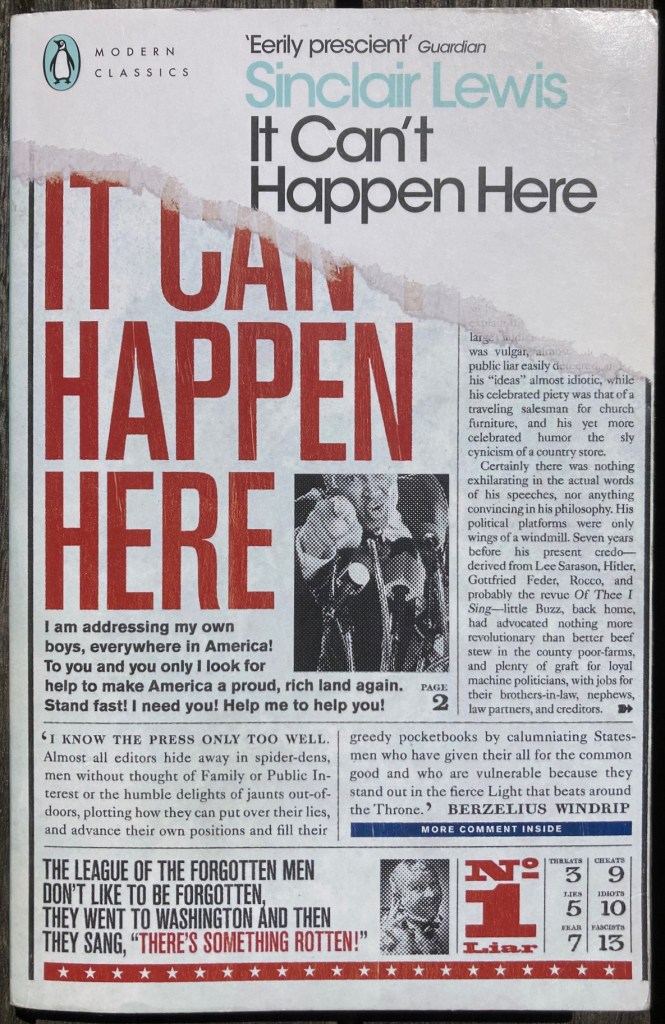
Sinclair Lewis, 1935
Edition read: Penguin Classics, 2017, 376 pages
Read April–May 2026
Fiction: Literary fiction, dystopian fiction
*Spoilers*
The rise and rule of a populist leader in 1930s America. As a candidate, Berzelius ‘Buzz’ Windrip promises everything to everyone (‘he was all against the banks but all for the bankers’). Upon victory, he tacks hard to starboard, establishes a vice-like grip on the country and proceeds to deliver for cronies new and old while immiserating everyone else. Contemporaneously written with the rise of dictatorships in Europe, this initially very much comes across as a cautionary tale for American readers. However, despite the folksy setting (Vermont) and language, this is a universal warning: it can’t happen here (page 142) – until it does (page 241).
Starting at a small-town Rotary Club, the self-appointed local movers and shakers are risible – the portentous language, the names (‘Roscoe Conkling Crowley’ was a favourite), the self-important attitudes – but the things that they call for, and the cognitive dissonance that they couch them in, foreshadows the nature of the forthcoming regime.
Given that dictatorships of this exact nature were a new phenomenon* when this was written, Lewis depicts a lot of their defining elements accurately: the importance of propaganda (chapters are prefaced by passages from Windrip’s polemic novel, Zero Hour), the removal of checks and balances, the morphing of economic redistribution into a corporatism (the grassroots ‘League of Forgotten Man’ movement is forcibly disbanded once Buzz is in power), the persecution of intellectuals, the state assuming complete control of education, the onset of (eventually open) corruption, the intertwining of fascism with Christianity (until the former no longer needs the latter), demagogues’ use of militias, economic mismanagement, the weaponisation of courts, the censoring of news, purges, the formation of labour and concentration camps: it’s all here.
Initially, the basic premise is liberalism versus fascism. Our protagonist is the avowedly liberal everyman, Doremus Jessup, who sees Buzz for what he is. Fascism is the means of the antagonist here, but socialism (here represented by John Pollikop) and communism (by Karl Pascal) also receive regular criticism and mocking from the narrative perspective.
Given that it is liberalism that precedes the tyranny, this initial smugness comes to be seen as misplaced. However, as much as the communists are not represented as the antidote to Windrip’s fascist government, as the story progresses, liberalism is also becomes subject to criticism; Lewis deftly shows what happens when people think they can stay below the storm. However, there is valid criticism of left-wing infighting and its inability to form a united form. As much as this story ends with a message of hope and resilience, this seam of cynicism remains.
Both despite and because of its complexity, the writing style is enjoyable. Sometimes it’s old-timey to the point of amusement:
‘“Say, boss, you don’t honest t’God think we’re going to set this up, do you?’
‘I certainly do!’
‘Well, I don’t! Rattlesnake poison! It’s alright your getting thrown in the hoosegow and probably shot at dawn, if you like that kind of sport, but we’ve held a meeting of this chapel, and we all say, damned if we’ll risk our necks too!’”
The tone is decorous even as events increasingly take a turn towards the uncivilised, creating a dissonance which works on a symbolic level: Buzz speaks in one way, but acts in another. The sentences and paragraphs are oft long and complex, the clauses (and subclauses) are many, and it presupposes an understanding of American archetypes circa 1930, a cultural shorthand that inevitably doesn’t always carry through to 90 years later. As such, it sometimes reads as though written by Mr Burns.
However, what does successfully transmit is the warning against the exceptionalist belief that it – i.e., fascism – couldn’t happen in America – and in a continuation of this logic, anywhere else. It was interesting that our antagonist, Buzz, is built up and made bigger than life, despite (or perhaps because of) never making an in-person appearance (except for at a distance, at a stadium rally). Arguably, Lewis misses a trick by having Buzz eventually removed from power (as is also the case with his successor, Lee Sarason, the Steve Bannon of his cabinet).** This felt like a missed opportunity to examine the cult of personality which underwrites so many dictatorships, without really either leaning the other way to examine the concept of ideas outlasting their founder.
It’s not subtle, and arguably, the steps towards dictatorship happen a little too soon: as soon as he is elected into power, Buzz bears fruit on his threats of fascism and fully dismantles democracy. Furthermore, for a book that presents liberalism as perhaps the best thing that we have, women and ethnic minorities don’t get much of a look in (although the persecution of Jews does). Despite its work as a vehicle for ideas being perhaps a bit heavy when compared to the human element, it remains a compelling story, partially because of how prophetic it has proven to be.
Worth reading? Yes.
Worth re-reading? Yes and yes.
‘“More and more, as I think about history,” [Doremus] pondered, ‘I am convinced that everything that is worthwhile in the world has been accomplished by the free, inquiring, critical spirit, and that the preservation of this spirit is more important than any social system whatsoever. But the men of ritual and the men of barbarism are capable of shutting up the men of science and of silencing them forever.”’
* Were there any precursors to the dictatorships seen in Italy, Russia, Germany, Spain that were similar in nature? Sparta, perhaps? (I think Imperial Japan had been going for a while?)
** Sales of It Can’t Happen Here spiked in the months following November 2016.


Leave a Reply