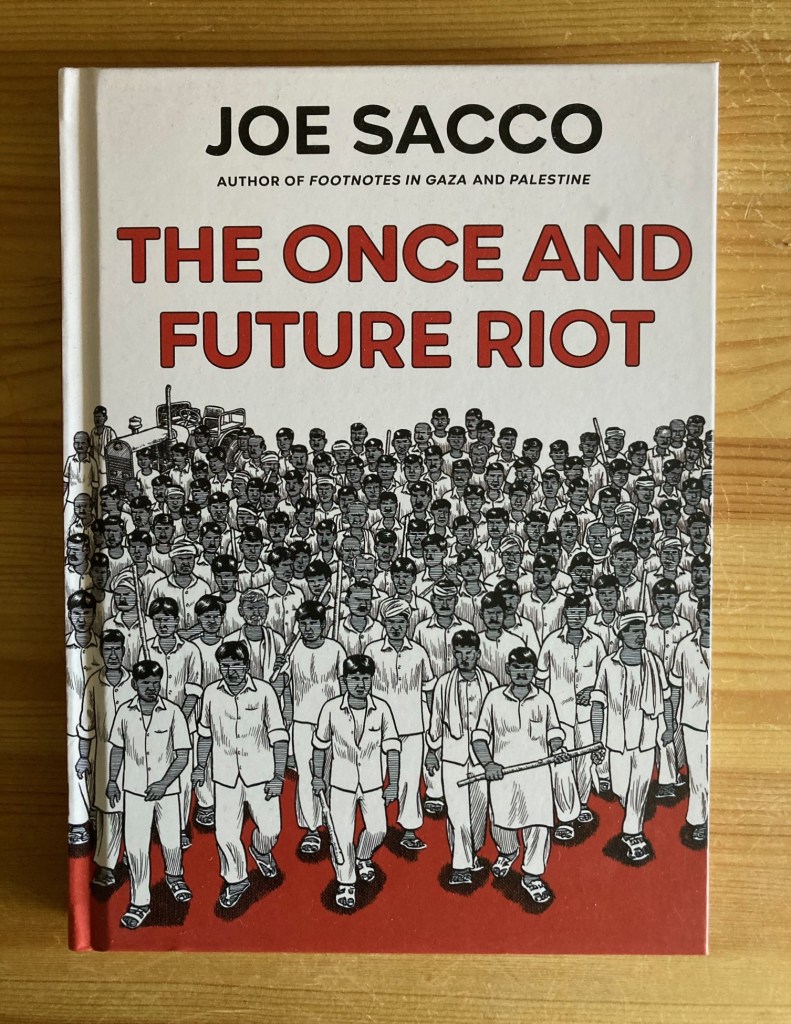
Joe Sacco, 2025
Vintage, 2025, 137 pages
Read June–July 2026
Non-fiction, Graphic novel, Journalism
Here we are, in Uttar Pradesh, northern India, trying to unpick how Muslim–Hindu sectarianism led to a 2013 riot in which ‘some scores’ of people were killed. Early on, conflict journalist Joe Sacco makes it clear that this is small fry compared to other acts of sectarian violence in India, but makes a compelling argument that its nature is indicative of a wider trend of the exploitation of religious affiliation as a sectarian faultline.
Sacco starts by covering what would normally be a series of tit-for-tat murders in rural India, rewinds to the bigger picture – that here being the 1947 partition – and then details his on-the-ground attempts to divine how that led to displacement, destruction and said murders. However, this isn’t so much a history of India as it is a reportage of a modern-day situation.
As with Sacco’s other books, this graphic novel simultaneously tells a complex story and the process of getting at said story. We are along for the ride with Sacco as an abundance of half-truths and lies slowly emerges and it becomes clearer and clearer that the story is partially Sacco trying to figure out what the truth really is, whether that be singular, localised events (a car crash, a rape, double-standard policing) and of the bigger picture (how these events incite the tensions within or between communities and led to riots).
Sacco talks to lots of people and gathers a myriad of conflicting opinions. From this, a few truths emerge: Muslims and Hindus simultaneously claim to be the group discriminated against; the sectarianism is so polarising that each side has dehumanised the other; and ambitious politicians, eager for power, opportunistically play one group off against another to secure a voting bloc.
Sacco looks at this latter point in particular. Although present-day Indian Prime Minister Narendra Modi may be the first person who comes to mind, in 2013 he was actually only the chief minister of Gujarat, and in this story he is only one of many who exploit sectarianism as an opportunity. Sacco discovers how the local leaders riled up the mobs, lying before the riots and then lying after the resulting destruction – but also how crowds, built up to a kind of critical mass, began to determine the words and actions of their ‘leaders’, rather than the other way around.
Due to the multiplicity of ‘truths’, it’s a slower read than something like Palestine, with many talking heads and less action. There is a lot of Sacco travelling from interviewee to interviewee (often consisting of groups of male village elders) and, especially as the story builds, the subsequent picking through of their contradictory accounts. The drawing style is also less exaggerated than 1995’s Palestine and Sacco’s other earlier works (except for when depicting what it’s like to drive in India) and closer to the more sober style of 2020’s Paying the Land. The drawing style, as ever with Sacco, is black and white and detailed, shaded with lots of horizontal lines rather than hatching.
This isn’t really a book that explains the India–Pakistan conflict – for example, the only mention of colonialism and Partition is brief and towards the beginning. It’s more about a country, which happens to be ‘the world’s largest democracy’, in which religion has morphed into identity and in which leaders take their people to the point where the crowds end up becoming the leaders. This is a picture that builds gradually – Sacco’s back and forth between this person and that person is painstakingly slow in the way that journalism can be when self-documenting, but it pays off by revealing this bigger picture without grasping for some kind of solution. Sacco doesn’t try to reduce the complexity of the situation and the story; no rapprochement between the communities is found and no solutions are presented. As Sacco investigates and finds the fuller picture of the story emerging, it becomes clear that this once riot is doomed to repeat.
Worth reading? Yes.
Worth re-reading? Yes – necessitated by its complexity.
‘You start telling a lie again and again to make it a truth.’
If you are interested, also read:
Palestine, Joe Sacco
The Fixer, Joe Sacco


Leave a Reply