Tag: Graphic novel

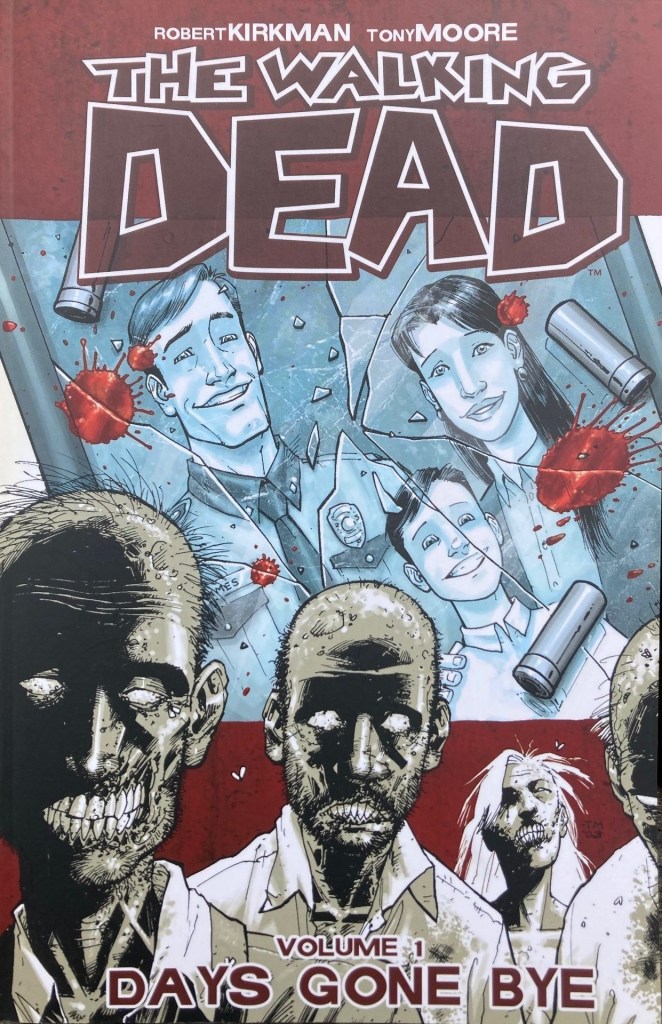
  • The Walking Dead

    Robert Kirkman, Tony Moore and Charlie Adlard, published 2003–19 

    Image Comics, 2003–19, 32 volumes at around 156 pages each 

    Read from 2013 to June 2026 

    Fiction: graphic-novel series, horror, thriller

    *Spoilers* 

    Much like the zombies that populate this apocalyptic franchise, we’ve shuffled a long way, and now after 13 years of reading and surviving, the end is nigh. As such, all 32 volumes are here reviewed together. 

    Starting with our protagonist – Sheriff Rick Grimes – waking from a coma in an abandoned hospital to a freshly arrived apocalypse, zombies are the primary antagonist, but other humans quickly take over as the main threat with the collapse of civilisation.* This is zombies as a backdrop to a social experiment. Initially, this keeps the premise interesting as multiple attempts to restart civilisation, which generally consists of our heroes trying to evolve from hunter-gatherers into a stationary society which has specialised classes, fall afoul of other people’s designs. Sometimes these antagonists are sinister; sometimes they’re just competing to survive. With the upending of the status quo comes a perpetual unease and danger. No explanation is given as to the ‘how’ or ‘why’ of this apocalypse – the dead now come back to life and the toothpaste won’t be going back into the tube as we are plunged into this new world alongside Rick and his family.  

    The main themes are leadership, power, justice, trust, betrayal, whether the enemy of my enemy is my friend and divided we fall. The old system versus new ones is a recurring theme; besides their own group dynamics and struggles (Rick is the reluctant leader), the other groups they encounter all have different social systems and they struggle with the quandary whether to push for change or to accept something good but flawed for what it is, with its undemocratic imperfections.

    The biggest symbolic advantage of the zombie as a trope is sometimes used effectively, sometimes not so much. Zombies as a mirror of humans is really stressed early on, then they just become more of a background nuisance.** They end up forming herds, and the symbolism of this could have been exploited more so. 

    Besides the corruption of youth and innocence (via Rick’s son, Carl), as Rick (our everyman) battles the world, heroes stray into villainous territory and it becomes a cautionary tale of he who fights with monsters might take care. With that said, some of the characters – both our heroes and our antagonists – are flat, such as the Governor, who is depicted at a consistent level of wickedness. Such personalities would arguably flourish in an apocalyptic scenario, but a little more justification for some of the behaviour would have been appreciated. On this point, although it is packed in towards the end, Negan has a more interesting arc, developing from villain to enemy-of-my-enemy to distrusted ally, acting as a foil to Rick along the way. (The quality of his dialogue, defined by his constant imprecations, never improves, however.***) We are invited to consider what makes Rick different to Negan, but for too much of the story he remains too much of a shark for this point to really land.  The diversity of the characters is also interesting.

    As per the above comment about the symbolism, there’s also not too much in the way of subtext, and some of the dialogue can veer from a bit clunky to downright awful (two characters discussing zombies: ‘What happened to these people is a sad thing.’) There are lots of speeches in which either a new hope is established or all hope is lost, and the matters of the day tend to be stated quite baldly – ‘WE ARE THE WALKING DEAD!’, etc. 

    Despite the zombies being a bit plodding, the danger of this world and the horrors that it produces are not to be underestimated. There is some strong stuff here – murder (including of children and babies), rape, torture, dismemberment, cannibalism and people disguising themselves by wearing the skins of the dead (arguably the symbolism is just a tiny bit heavy-handed here). Reader beware – main characters will be killed off and mutilations abound.  

    After an enthusiastic start, that it took me 13 years to finish this series is indicative. Apparently, the writing of the series was wrapped up suddenly, but it’s still definitely too long (there are numerous declarations of ‘It’s time to end this’), and it became hard to care about (and thus subsequently keep up with) the proliferating secondary characters, even as the original cast were killed off and with a late injection of intrigue surrounding Michonne. 

    With all of this said, the relief of reaching the end was mingled with sadness – there is a flashforward to the world of the next generation, in which the world has changed once again and Carl must continue to adapt. At one point, in what I can only describe as a very Lynyrd Skynyrd gesture, a flock of birds flies overheard, signifying the rebirth of a nation. An interesting point is when a character disputes the legacy of Rick, but nothing is made further of this ‘founding-father’ revisionism. There is a weird bit where Michonne, now a judge, makes a speech in which she reads out the blurb of the book (which is the same for every issue). Besides suddenly going a bit meta, the blurb is actually quite misleading, positing a ‘now we are surrounded by death, we must learn to truly live’ premise, which is not the tone of the series (the only characters who seem pleased that the world has reverted to a Darwinist state are clearly those we are not invited to empathise with). What does work a bit better is the end, in which Carl’s bedtime story to his daughter, becomes an epilogue: ‘But this is not a scary story. This is a story about hope.’ 

    In terms of the drawing style, this changes between volumes 1 and 2 and then 12 and 13, simplifying slightly.  It’s in black and white, and I also wondered, given the abundant scenes of gore and rot, colour would have been better (although colourised editions have been produced since I started reading). It’s certainly not minimalist in any other way. 

    Worth reading? …up to around issue 21. I advise reading the compendiums rather than the individual issues.****  

    Worth re-reading? After issue 21, no; the storylines start to recycle.  

    You might like this if you enjoyed:    

    Watership Down by Richard Adams 

    Lord of the Flies by William Golding 

    The Road by Cormac McCarthy 

    *Not to be confused with Cillian Murphy’s misadventures 

    **They are of the old-school, George Romero mould – slow, grumbly, hostile in quite a sullen way. 

    ***Much like in The Midnight Gospel, in a whimsical moment he considers whether maybe zombies are living their best lives.   

    ****Also available at your local bookstore. 
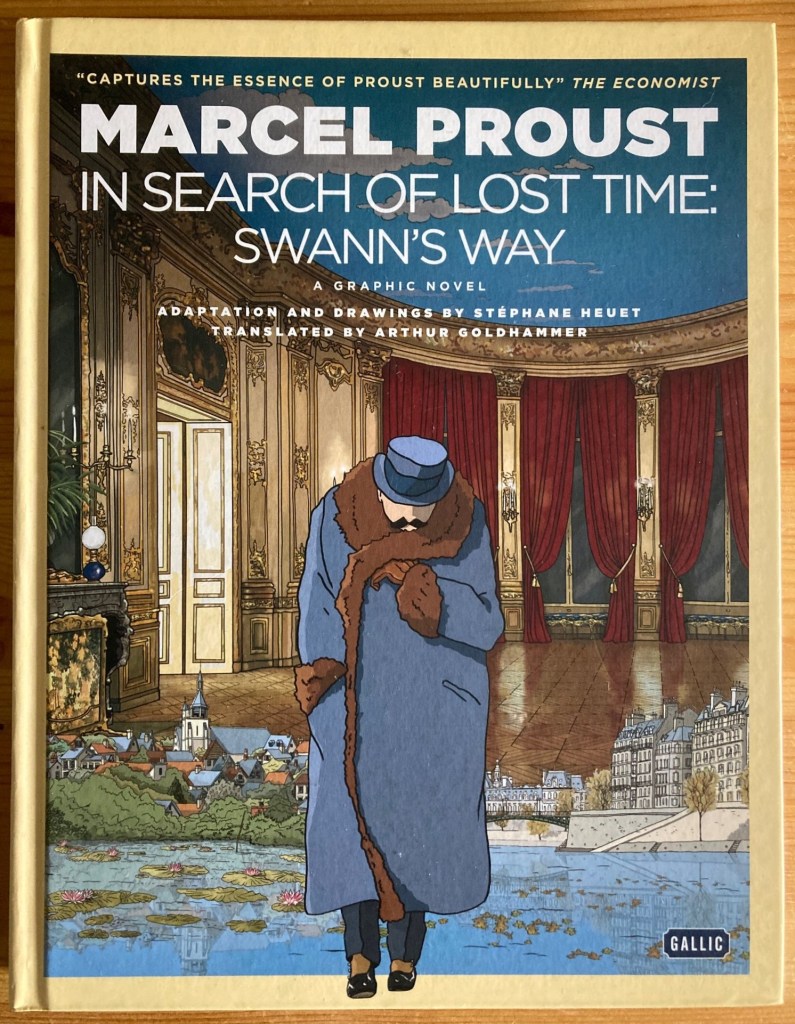
  • In Search of Lost Time: Swann’s Way – A Graphic Novel 

    Marcel Proust, adapted by Stéphane Heuet, 2013, translated by Arthur Goldhammer, 2015  

    Gallic Books, 2016, 224 pages 

    Re-read: December 2025 – May 2026 

    Fiction: graphic novel, modernism

    *Spoilers*

    The original is a canonical piece of modernist literature, a masterpiece focusing on the themes of memory and experience, an idiosyncratic tour de force. The plot, revolving around fin de siècle upper-class French society, complex enough in its own right before the ornate writing style is even taken into consideration, is only as important as the lengthy discursions into experience and memory. The sentences are long, the descriptions are rich and the digressions often. It’s also very long. In fact, it’s the longest book ever; In Search of Lost Time consists of 1.3 million words (novels are typically 70–100,000 words). Compounding this, as mentioned, like much modernist literature (Virginia Woolf, James Joyce, T.S. Eliot, etc.), it’s an intricate, dense read. So I’ve not actually read it.*  

    Can I review an adaptation with knowing the original? Partially and partially only. Obviously, I can merely review this adaptation on its own merits rather than against those of the original or on those of it as a success as an adaptation. However, I do think that reading this graphic-novel adaptation is a pragmatic alternative, and having opted for this choice, I am a younger (or just less old?) reader for it. It’s also worth noting that Swann’s Way is actually just part one of the original seven.** As such, even without having read it, I know that this is must have been a challenging book to adapt. 

    Although it starts off with the surreal vision of a pair of giant eyes drifting across the nighttime waking vision of Proust the narrator, Stéphane Heuet quickly curtails this in favour of a generally more true-to-life, subdued approach. It is drawn in ‘Ligne claire’, which translates to clean lines and little hatching. Think of as a slightly softer, more pastel-ly version of TinTin

    In contrast to this psychedelic opening, the drawing style doesn’t draw attention to itself, but this suits the text. Rather than pushing at the boundaries of consciousness, such as Charles Burns’ Black Hole and Last Look, it’s about memory. 

    Despite Proust starting this story as the narrator, a precociously observant young boy (and later on, a precociously observant middle-aged man), this is a framing device for the story of Charles Swann, a rakehell, albeit quite a mild one. I initially found the section about the narrator more interesting than the sections focusing on Swann, the former being more sensory and the latter being more about people (and in particular, some very self-absorbed people), but Swann becomes more interesting when he becomes more melancholic as he comes to understand the role of sensations and memories – fleeting in nature – in determining his perception of love. I don’t know if Proust intended this to be a satire, but after a while, the fripperies of upper-class life come to be a bit tedious. Regardless, Proust is astute at showing rampant pettiness. 

    As with how the famous*** dipping of the madeleine into tea triggers the story, a passage of music takes Swann back to his lost love and the small details of their courtship, with  Proust connecting memory to epiphany. Besides memory, this also touches upon the theme of pain begetting art, with Vinteuil, the composer of that particular piece of music, drawing from his suffering. 

    Even in graphic-novel form, it’s still text-heavy: it is still a read that demands attention, with short sections of the novel text lifted directly into captions and speech bubbles. No doubt this is an easier read than the original, but there is a lot of dialogue and it is easy to miss details. Proust focused on complex themes and ideas and, as such, every word and panel matters. 

    It’s also a melancholic read. The themes of memory and experience most often translate into disappointment, regret and a disassociated sense of having ossified via living through memories. Swann realises that he has wasted years of his life, too late, and the narrator realises that there is no recreating the feelings conjured by memories. Proust expresses an understanding of how there is often a tension between how we remember things – most poignantly, our zeniths – and how that moment actually was, and how we felt at that time, rather than how we came to feel about it. 

    Initially, I was going to contrast this against Blood Meridian, which I started re-reading around the same time. In Search of Lost Time felt petty when compared to the latter and its strong focus on human nature and death. Upon further reflection, this contrast should instead be a comparison: this is also about life and death, but from a non-violent perspective (body count: one).**** In Search of Lost Time is too complex to be reduced, but my main takeaway is that it is about what we do with our lives, with an understanding that time only ever moves forward, creating an ever-moving canvas upon which create memories both good and bad, and that one day we will die. It’s not a wild ride, but it is true to the life that most people will live. 

    Worth reading? I would read this before attempting the original. 

    Worth re-reading? Given its complexity, with time, yes. 

    If you liked this, you might like: 

    Kingdom, Jon McNaught 

    The Unconsoled, Kazuo Ishiguro 

    The Remains of the Day, Kazuo Ishiguro. 

    *For a while I tried to read a page a day at breakfast (tea, but no madeleines). 

    **Normally, I review serialised graphic novels altogether (The Walking Dead coming soon), but as far as I can tell, only parts one and two (In the Shadow of Young Girls in Flower) have been adapted into graphic novels. 

    ***More so in some circles than others, I suppose.

    ****An old lady who dies of natural causes. 

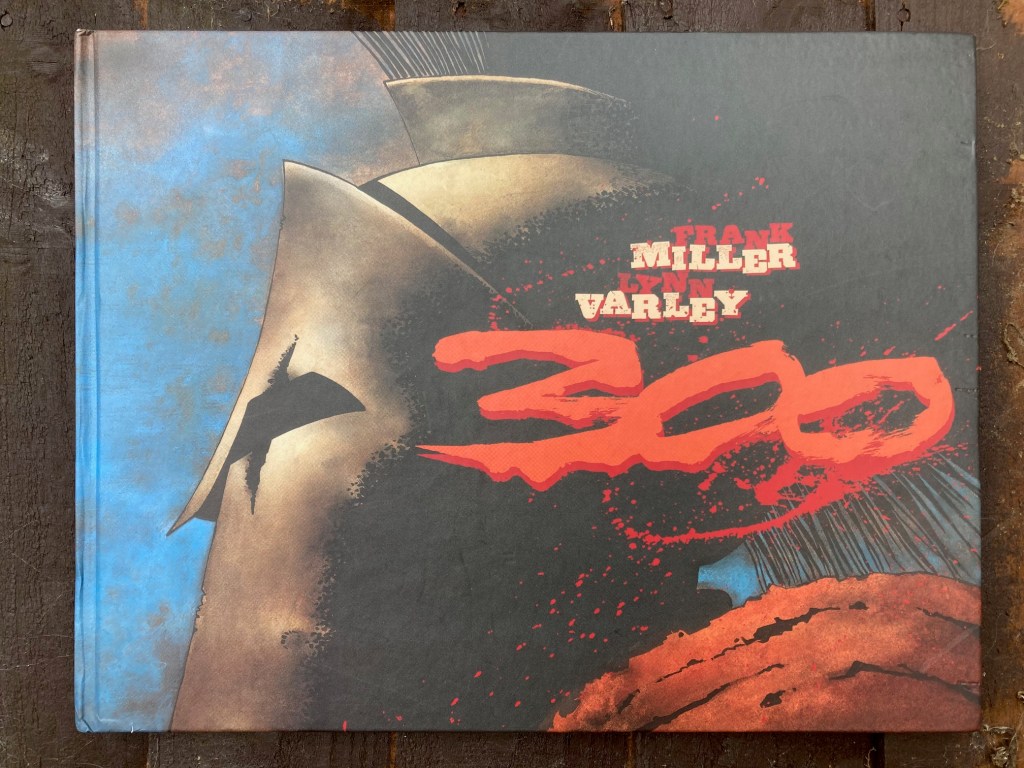
  • 300

    Frank Miller and Lynn Varley, 1999 

    Read March 2023 and re-read September 2025 

    Published by Dark Horse Books, 1999

    Page count: not sure. It’s around a one-hour read. 

    Graphic novel, historical fiction 

    The blood-and-guts film adaption of this inspired every 17 year-old boy circa 2006 to actually believe that they would have held the Hot Gates. Since then, however, I’ve had the chance to mend my ways and reapproach this historic event via Tom Holland’s Persian Fire. Combined with a now fuller, not quite so heroic-mythical, less mental worldview and actually quite glad I am not a Spartan Hoplite*, let’s just say, Miller took certain liberties. 

    A Greek alliance (not Sparta alone) consisting of 7,000 troops, held the pass for most of the battle – not the titular 300 (which 300 does partially acknowledge). The 300 were the holding force left behind when the Spartan king and commander, Leonidis, realised they were about to be outflanked – well, plus the 700 Thespians who were written out of the story by Herodotus, the primary source for this period.** The Greek army was betrayed, but more likely by a shepherd who wanted his fields back from the logjammed Persian army (what’s Greek for ‘get off my lawn?’), than by a deformed pariah of Sparta, jilted at birth for being the weak link in the phalanx. 

    Now that the question of revisionism has been answered – is this a good read? Spartans, what say you?***

    Well, citizen, the format of the book was well chosen, is the first thing they would say. Sized halfway between A4 and A3 landscape, it depicts the fighting and the landscapes of Greece in large scale. There is a lot of use of darkness, with features half-drawn with the other half blacked out – bodies, faces, cloaks, shields, rocks, piles of bodies – all the things you might expect to find at the Hot Gates. It’s a singular style and it’s easy to see Miller’s Sin City and The Dark Knight Returns in here and vice versa. It also gives an idea of the confusion of hand-to-hand fighting, with some panes take a couple of seconds to visually comprehend. 

    Starting in media res, the story moves along at a good pace and is well balanced, providing context about Sparta and why it was the way it was, complimenting the swords and sandals. The perspective is entirely Spartan – the Persians are given short shrift, depicted as the conscripted, decadent, undisciplined invading force of a foppish emperor, who ultimately can only win via underhand tactics. (The limited democracy of Sparta is underplayed and its subjugated neighbours go unmentioned.) 

    Read as a piece of fiction, it’s fine. Besides playing fast and loose with the facts of the event, it somewhat idealises Sparta, although any consideration that goes deeper than ‘those guys sure did kick ass’ should make it clear that it wasn’t a particularly fun place to live. The form of the hero’s journey is told in a way that feels like a story around a campfire, which, as a story drawn from the earliest history book, is fitting.**** It’s a bit short, at around an hours’ read, but this does serve to make it quite a punchy read. THIS WAS SPARTA (KINDA)!

    Worth reading? Yes.

    Worth re-reading? Yes – but now to hold the Hot Gates! 


    *Obviously Sparta of antiquity predates fascism as a philosophy, but there is a big overlap in ideas and practices between the two. 

    **Miller does include the Thespians in his telling, but rather than being part of the last stand, they surrender and are then immediately cut down. 

    ***Go on. Make the noise.  

    ****The Battle of Thermopylae was later set down in history by Herodotus (one of those ancient Greeks whose street cred eschews the need for a surname) in Histories, which is widely considered to be the first history book. 

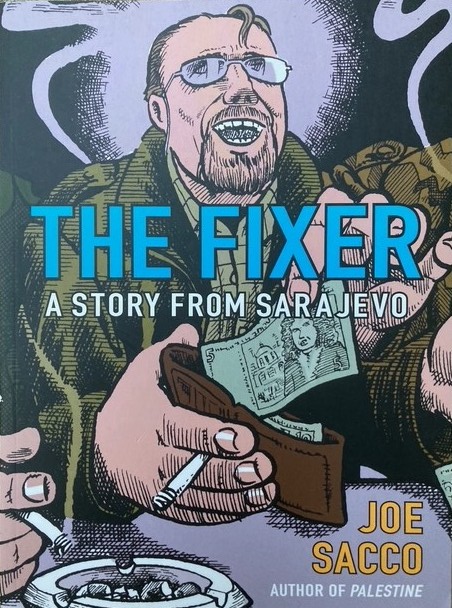
  • The Fixer

    Joe Sacco, 2004 

    Read: June 2025 (bought in Edinburgh) 

    Edition read: Jonathan Cape, 2004, 106 pages 

    Graphic Novel, black and white 

    *Spoilers* 

    The Fixer starts with Sacco’s return to Bosnia – specifically, Sarajevo – in 2001, having been there before during 1995 and 1996,* to continue his – now retrospective – reporting on the Bosnian War. 

    A major theme, constant across Sacco’s oeuvre, is conflicting narratives. Here, the narrative that receives (or demands?) the most (although not entirely uncritical) attention is that of the titular ‘fixer’, Neven. Sacco’s story morphs from that of the Bosnian War to that of Neven. He is a metonym for the whole of the Balkan conflict, as Sacco astutely identifies in his telling of this story, and his understanding of the value of Neven to him as a journalist. A Serb who fought on the side of the Bosnians, Neven is multi-faceted and contradictory. He makes his post-war living by helping journalists, with Sacco constantly unsure whether he is getting a deal or being fleeced, or if Neven is somehow a victim. 

    Sacco has a good sense of story and pace for what could be a morass of details and isn’t afraid to show himself as occasionally clueless and sweating over his own perceived amorality. His black and white crosshatching is as detailed as ever, eschewing exaggerated features in favour of a more restrained, serious style. 

    Worth reading? Yes. 

    Worth re-reading? Yes. 

    *Besides Sarajevo, Sacco also spend time reporting from the Bosnian enclave of Goražde, which resulted in Safe Area Goražde. 

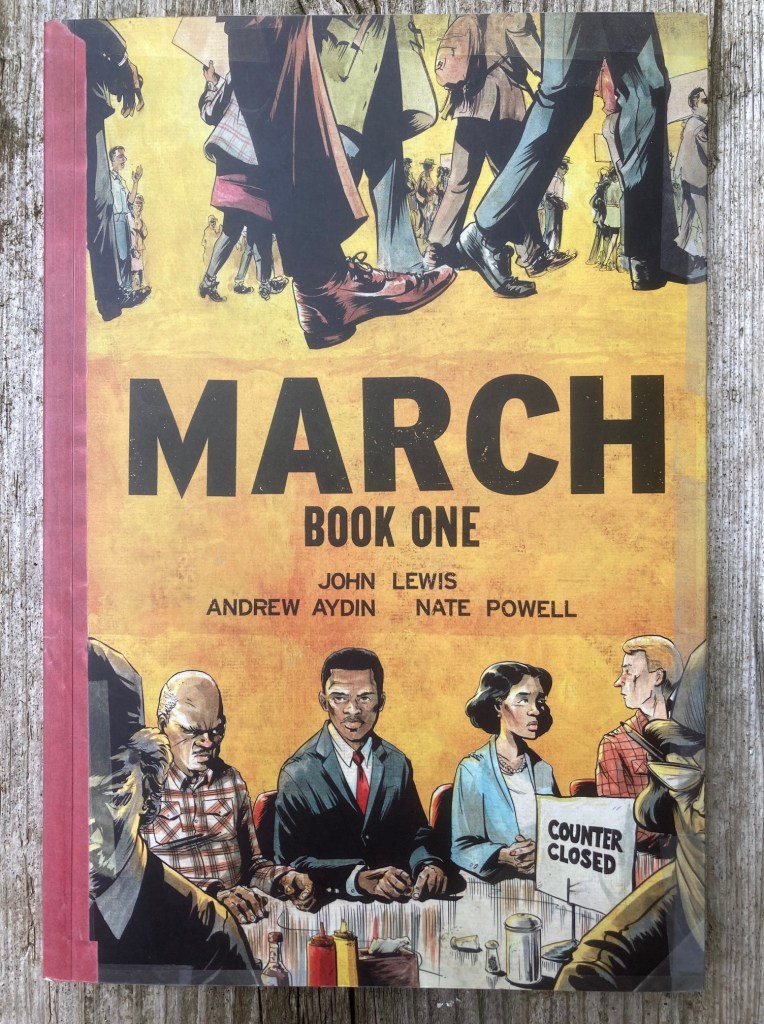
  • March: Book One

    John Lewis, Andrew Aydin and Nate Powell, 2013

    Read: March 2025

    Edition read: Top Shelf Productions, 121 pages

    Non-fiction graphic novel

    Part 1 of 3

    I read this – the opening volume of an autobiographical graphic novel of the American civil-rights activist John Lewis – a coincidental 60 years after the Selma to Montgomery march.

    It moves between the two narratives of Lewis’s day on 20 January 2009, and his life as a child on a sharecropper farmer in Alabama, establishing how one man’s story transformed into history.

    In a style best described as sober (although it is not without creativity – the panes change shape, with content often spilling over outside of them), it has the feel of a documentary (the black and white shading further adds to this), to tell Lewis’s story, including how the civil-rights movement largely worked not in rivers but in drops. The US civil-rights movement – at least in the UK – can sometimes be told in a reductive manner that is reduced to just Martin Luther King and Rosa Parks, with Lewis not a particularly well-known figure (‘Big Six’ was not a term I was familiar with), so this was an educational read. As much as March tells Lewis’s story, it’s also about the story of the civil-rights movement, combining the personal with history, making it as much a memoir as a history book. As volume one of three, it ends with the story and struggle still very much in motion. 

    So – why a graphic novel, especially given that Lewis already has a couple of published memoirs? The dramatic devices, such as the contrast between opening with the civil-rights activists beginning to cross the Edmund Pettus Bridge on 7 March 1965 and Lewis waking up in Washington D.C. on 20 January 2009, as well as the aforementioned black-and-white feel, are powerful, but the references by Lewis and his co-authors to the 1958 comic book Martin Luther King and the Montgomery Story are instructive; where we were, where we are, and where we might be in another 60 years.


    Worth reading? Yes.

    Worth re-reading? Yes.

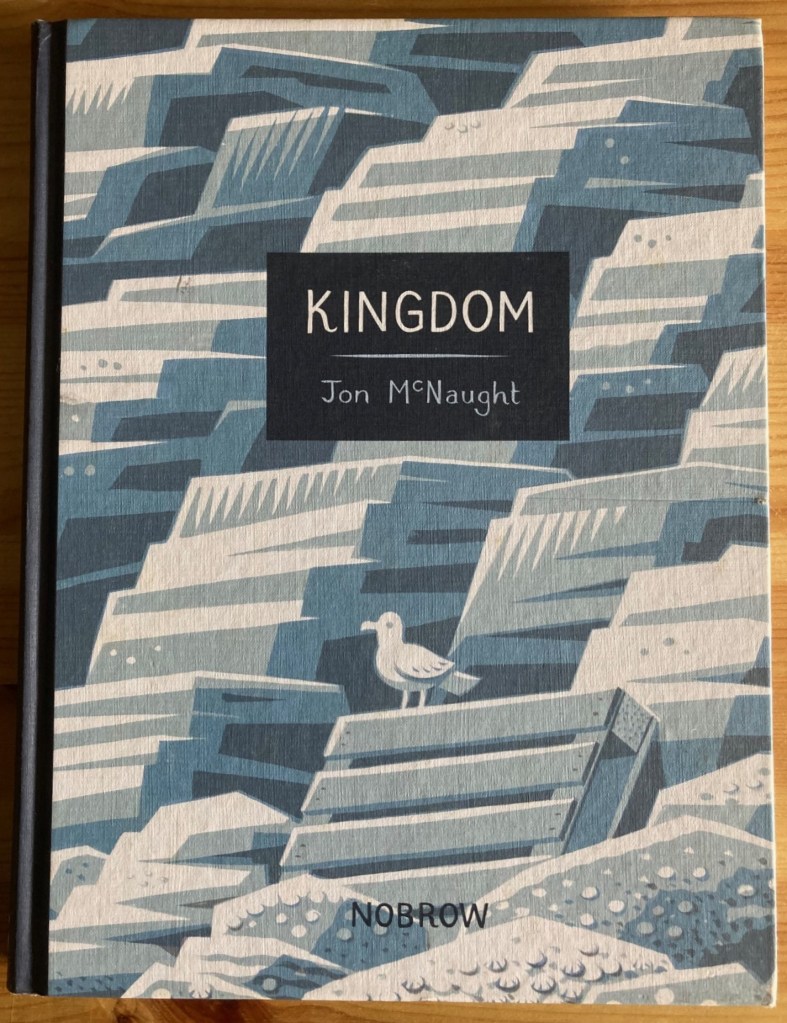
  • Kingdom

    Jon McNaught, 2018

    Read: January 2024

    Edition Read: NoBrow, pages unnumbered

    Graphic novel

    In contrast to my other recent graphic-novel readings (The Road, Safe Area Gorazde, Ducks), Kingdom is not about crimes against humanity. It is far gentler, a slice of life, specifically, of a family holiday. Nothing dramatic or traumatic takes place. An unnamed mum and her two children (Andrew and Suzie) – the former a teenager, the latter around 10 – go on holiday to a caravan park somewhere on the British coast. It is understated and the pacing measured – as such holidays can be. It is a poignant snapshot of the parts of holiday that are rote, mediocre, uninspiring, and enforced fun that turn out to be anything but. Even the nature that surrounds Andrew and Suzie, the two protagonists, also becomes the minutiae of their life on holiday.

    It is written in lots of very small panes, capturing a scene and all of its details (there are lots of onomatopoeias), shot by shot (up to 35 per page). The colour palettes are monochromatic hues of blues and reds, sometimes mixing together. There are relatively few words, and it takes several pages until someone talks.

    It has its melancholic moments; I got the impression that the shot of the mother and Suzie driving away from Great Aunt Lizzie’s house is probably the last time they will ever see her, and despite Andrew making a friend (who is maybe a local, or perhaps someone just like him – on holiday and bored), there is a telling scene where they scorn a group of children, around their age, having fun in the distance. Whereas Suzie is still young enough to be curious about the world, Andrew seems to be keeping it at arm’s length, generally preferring to spend time alone or playing videogames. The mother is generally depicted as trying to do something for her children; at no point does she ever get to do anything for herself.

    Although the whole point of the book is that not much happens, these memories, captured with all of their minute details, are the sort that will stay with the characters. How these children (and sometimes the Mum) relate to their environment is a big part of the story; the Mermaid’s Cave shows how memories can sometimes be better than the reality, but whereas Mum is disappointed about the reality when compared to her memory, Suzie likes it; and so the cycle continues. As such, Kingdom is about how we remember things. The caravan park that they stay at is called Kingdom Fields, but it is also memory that is a realm – a kingdom – in itself.

    Worth reading? Yes.

    Worth re-reading? Yes.

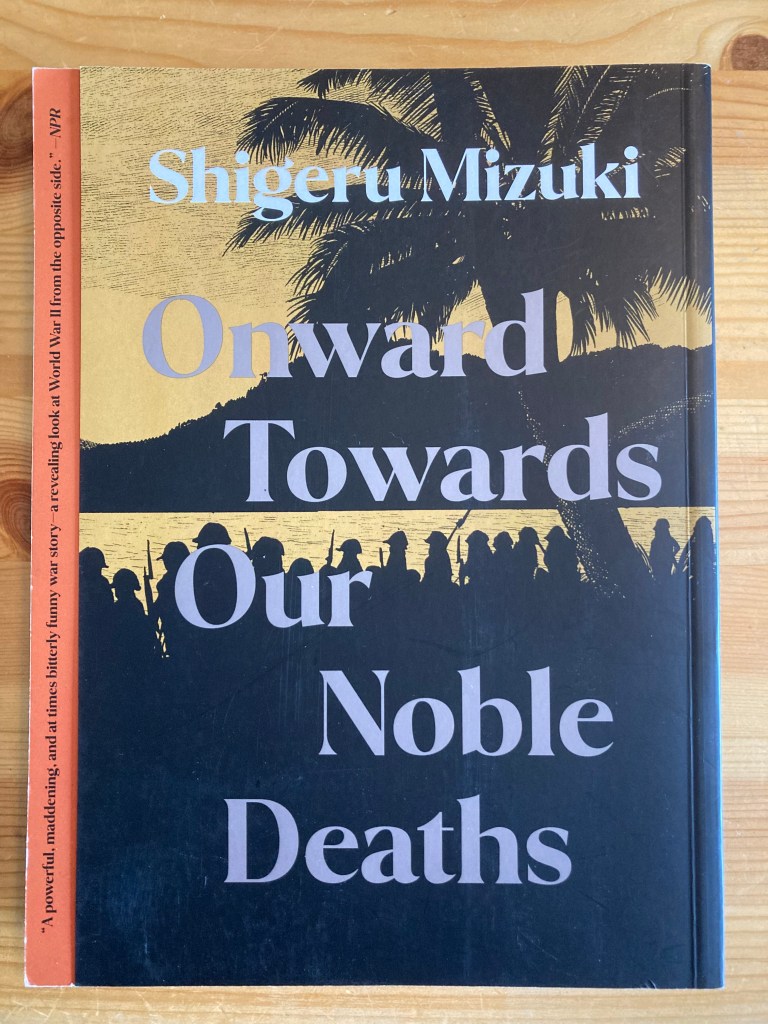
  • Onward Towards Our Noble Deaths

    Shigeru Mizuki, 1973 (translated by Drawn & Quarterly in 2011)

    February – May 2025

    Page count: 372

    Graphic novel

    Onward Towards Our Noble Deaths is a semi-autobiographical, black-and-white graphic novel about a battalion of Imperial Japanese infantry who were commanded to hold New Britain, an eastern island of Papua New Guinea, in 1943, against approaching US forces.

    It dissembles the image of the Imperial Japanese Army as being entirely made up of fanatics; the main characters are conscripts (‘rookies’), who are poorly trained, clumsy, grumble and are subject to abuse from their commanders, including physical beatings for no reason. Shigeru depicts these commanders with little sympathy; they are largely sadistic and inept, and refuse to recognise the strategic advantage that a guerrilla war – as opposed to the culminating banzai charge – would offer. The rank-and-file come across as most likely happy to surrender if they hadn’t been commanded to die fighting  and told by their ranking superiors that to live would be dishonourable.

    In the spirit of its original language and country of publication, it is printed in reverse, read right to left. The style combines somewhat quirky figures – heads and limbs fly from explosions and there are ‘BOOM’ onomatopoeias – with the naturalistic and textured backdrops of the rainforests of Papua New Guinea. This is, until the panels that depict the aftermath of conflict, where the death and destruction is no longer semi-comic and more like inked versions of war photos; prone bodies, trees shorn off, clouds of black smoke. The closing scenes switch exclusively to the photo-realistic drawing-style for these couple of pages, as if to say, what a waste.

    There are lots of characters – enough for a dramatis personae to be provided at the the beginning – who begin to die at a rapid rate as US planes, tanks and troops close in. The US soldiers, when they arrive, are depicted with so few details as to come across as Green Army Men, but as much of the Japanese soldiers’ fight is with malaria, rationing, clean water and sadistic officers. 

    It is hard keeping up with so many characters at times, and placing who is who on first read-through; the only character arc to speak of is of a doctor who ends up openly questioning his superiors’ morality. Fewer characters, with fuller characterisation, would have made this clearer. Likewise, the narrative direction is not always clear, and occasionally details are elided; one situation suddenly leads to the next with no transition presented. On second read-through, this does come to feel like part of the unclear, disorientating experience, but this could have still been delivered with a slightly more considered narrative.

    Obviously, depicting the perspective of Axis troops is to venture out onto thin ice, but this feels less like a justification than a exposé of the abundance of pointless death. One of the few humane officers feels compelled to commit suicide as he did not die in the first charge, and two others are ordered to commit seppuku – one of whom beforehand tears up a keepsake letter into the sea, which turns out not to even be from a girlfriend, but from his mum. On multiple occasions the infantry break into song; ‘Can’t hate the hateful enemy/forced to smile for smug soldiers/why am I stuck working this shitty job/no way out/all for my country’; as they sing this just before making their final charge, panel by panel they are shown simultaneously breaking down into tears.

    It’s not a comprehensive look at the Imperial Japanese Army during World War Two, instead focusing on the author’s experience in the Imperial Japanese Army. He writes himself in as one of the characters, with the key, unsparing difference that instead of just losing an arm and contracting malaria, as he did in real life, the character survives a mauling in the suicide charge, only to be shot by an American soldier. A noble death indeed.

    Worth reading? Yes.

    Worth re-reading? Yes – the added clarity allows the poignant moments to come across more clearly.

    I wonder if surviving the suicide charge wasn’t, rather than an act of cowardice, one final act of resistance as a human being.