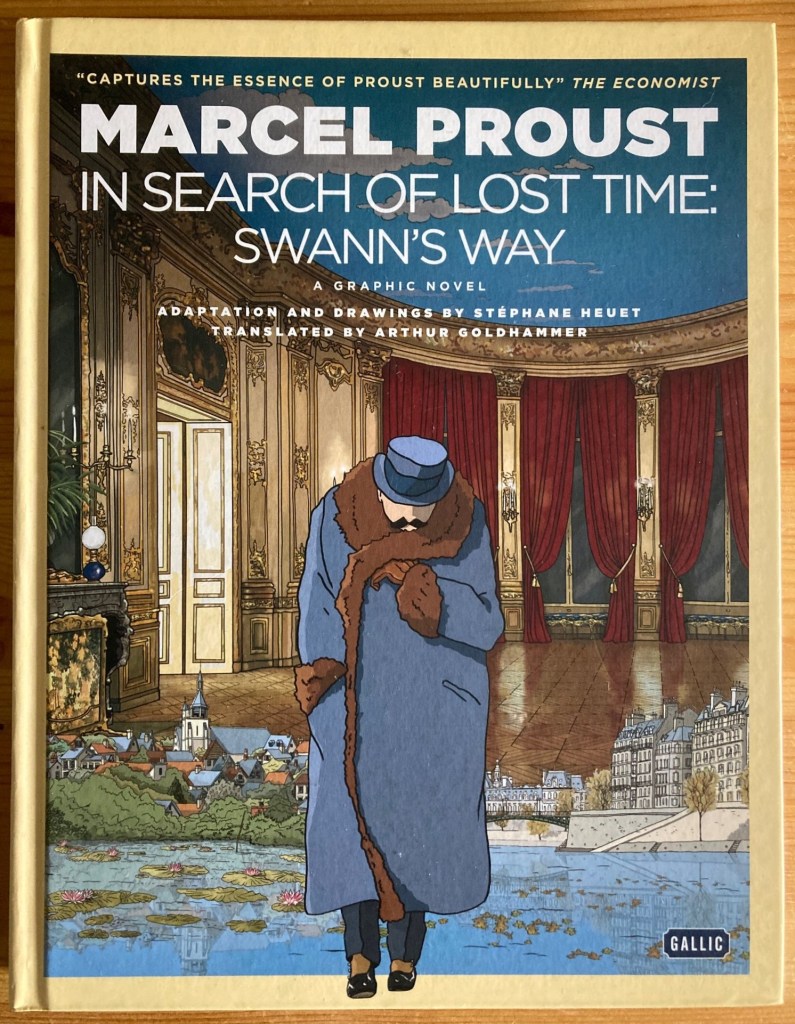
Marcel Proust, adapted by Stéphane Heuet, 2013, translated by Arthur Goldhammer, 2015
Gallic Books, 2016, 224 pages
Re-read: December 2025 – May 2026
Fiction: graphic novel, modernism
*Spoilers*
The original is a canonical piece of modernist literature, a masterpiece focusing on the themes of memory and experience, an idiosyncratic tour de force. The plot, revolving around fin de siècle upper-class French society, complex enough in its own right before the ornate writing style is even taken into consideration, is only as important as the lengthy discursions into experience and memory. The sentences are long, the descriptions are rich and the digressions often. It’s also very long. In fact, it’s the longest book ever; In Search of Lost Time consists of 1.3 million words (novels are typically 70–100,000 words). Compounding this, as mentioned, like much modernist literature (Virginia Woolf, James Joyce, T.S. Eliot, etc.), it’s an intricate, dense read. So I’ve not actually read it.*
Can I review an adaptation with knowing the original? Partially and partially only. Obviously, I can merely review this adaptation on its own merits rather than against those of the original or on those of it as a success as an adaptation. However, I do think that reading this graphic-novel adaptation is a pragmatic alternative, and having opted for this choice, I am a younger (or just less old?) reader for it. It’s also worth noting that Swann’s Way is actually just part one of the original seven.** As such, even without having read it, I know that this is must have been a challenging book to adapt.
Although it starts off with the surreal vision of a pair of giant eyes drifting across the nighttime waking vision of Proust the narrator, Stéphane Heuet quickly curtails this in favour of a generally more true-to-life, subdued approach. It is drawn in ‘Ligne claire’, which translates to clean lines and little hatching. Think of as a slightly softer, more pastel-ly version of TinTin.
In contrast to this psychedelic opening, the drawing style doesn’t draw attention to itself, but this suits the text. Rather than pushing at the boundaries of consciousness, such as Charles Burns’ Black Hole and Last Look, it’s about memory.
Despite Proust starting this story as the narrator, a precociously observant young boy (and later on, a precociously observant middle-aged man), this is a framing device for the story of Charles Swann, a rakehell, albeit quite a mild one. I initially found the section about the narrator more interesting than the sections focusing on Swann, the former being more sensory and the latter being more about people (and in particular, some very self-absorbed people), but Swann becomes more interesting when he becomes more melancholic as he comes to understand the role of sensations and memories – fleeting in nature – in determining his perception of love. I don’t know if Proust intended this to be a satire, but after a while, the fripperies of upper-class life come to be a bit tedious. Regardless, Proust is astute at showing rampant pettiness.
As with how the famous*** dipping of the madeleine into tea triggers the story, a passage of music takes Swann back to his lost love and the small details of their courtship, with Proust connecting memory to epiphany. Besides memory, this also touches upon the theme of pain begetting art, with Vinteuil, the composer of that particular piece of music, drawing from his suffering.
Even in graphic-novel form, it’s still text-heavy: it is still a read that demands attention, with short sections of the novel text lifted directly into captions and speech bubbles. No doubt this is an easier read than the original, but there is a lot of dialogue and it is easy to miss details. Proust focused on complex themes and ideas and, as such, every word and panel matters.
It’s also a melancholic read. The themes of memory and experience most often translate into disappointment, regret and a disassociated sense of having ossified via living through memories. Swann realises that he has wasted years of his life, too late, and the narrator realises that there is no recreating the feelings conjured by memories. Proust expresses an understanding of how there is often a tension between how we remember things – most poignantly, our zeniths – and how that moment actually was, and how we felt at that time, rather than how we came to feel about it.
Initially, I was going to contrast this against Blood Meridian, which I started re-reading around the same time. In Search of Lost Time felt petty when compared to the latter and its strong focus on human nature and death. Upon further reflection, this contrast should instead be a comparison: this is also about life and death, but from a non-violent perspective (body count: one).**** In Search of Lost Time is too complex to be reduced, but my main takeaway is that it is about what we do with our lives, with an understanding that time only ever moves forward, creating an ever-moving canvas upon which create memories both good and bad, and that one day we will die. It’s not a wild ride, but it is true to the life that most people will live.
Worth reading? I would read this before attempting the original.
Worth re-reading? Given its complexity, with time, yes.
If you liked this, you might like:
Kingdom, Jon McNaught
The Unconsoled, Kazuo Ishiguro
The Remains of the Day, Kazuo Ishiguro.
*For a while I tried to read a page a day at breakfast (tea, but no madeleines).
**Normally, I review serialised graphic novels altogether (The Walking Dead coming soon), but as far as I can tell, only parts one and two (In the Shadow of Young Girls in Flower) have been adapted into graphic novels.
***More so in some circles than others, I suppose.
****An old lady who dies of natural causes.


Leave a Reply