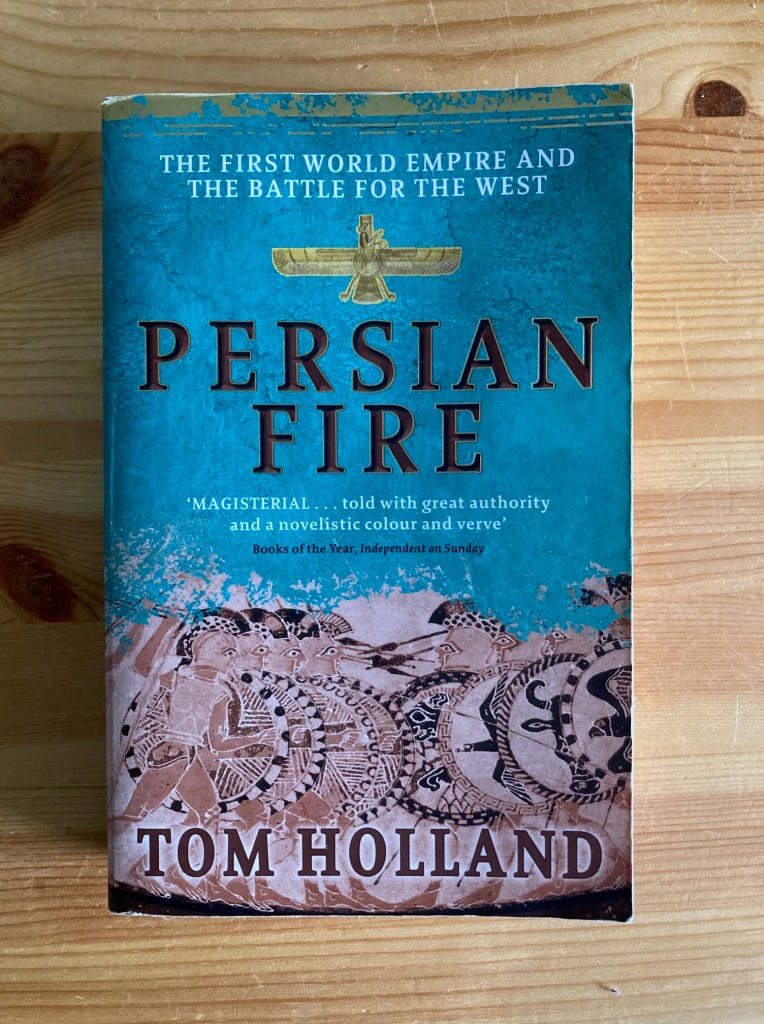
Tom Holland
Read: August 2025
Edition read: 2005, Little Brown, 448 pages
Non-fiction, history
Tom Holland’s Persian Fire details the attempted invasion of modern-day Greece by modern-day Iran, including the battle in which roughly 7,000 Greeks held the Thermopylae Pass against circa 100,000 soldiers of Emperor Xerxes’s invading army for 3(ish) days, in 480BC.
In providing the context of the Greco-Persian Wars, it challenged a somewhat unconscious preconception I had that eras start and end. Rather, they bleed into each other, passing on parts of culture and splitting along the way. It also provided a few rude corrections to the artistic liberties taken by Frank Miller in 300*, not least that the Persian army did not include divisions of ghouls and elephants.
It also altered my understand of what decides history: I was expecting more on the Battle of Thermopylae, but Holland outlines how this was only part of the Greco-Persian Wars, which were years in the making in themselves. Case in point, the Greek alliance – and not just the Spartan army – also made other decisive stands – these one successful, such as the Battle of Salamis and the Battle of Plataea, which ended the Persian attempt to conquer Athens and Sparta. Holland’s writing style is easy to follow, despite the plenitude of names, places and people and the vast scope of time that Persian Fire covers. The narrative is detailed yet well-paced and at points feels like an action story: Holland has a sense for what is engaging and what is the right amount of context.
Worth reading? Yes.
Worth re-reading? Yes.
*Review forthcoming.
 The Page Count
Leave a comment