Tag: Fiction

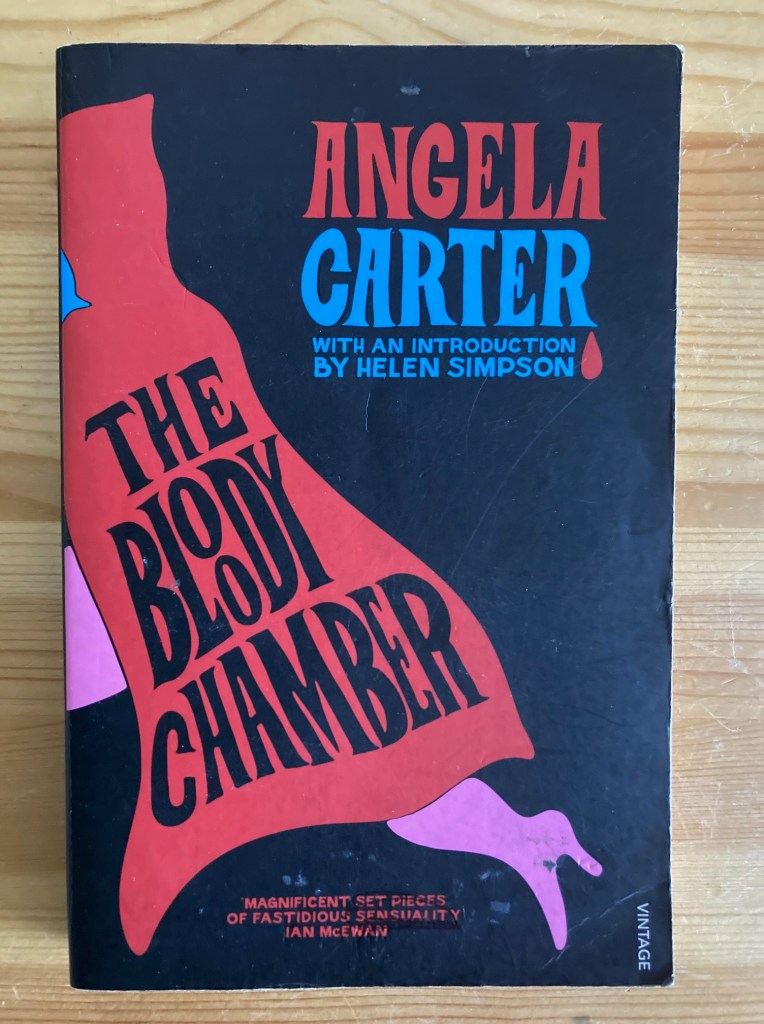
  • The Bloody Chamber

    Angela Carter, 1979 

    Vintage, 2006, 149 pages 

    Read 2011, re-read February–March 2026 

    Short stories/feminist literature/literary fiction 

    *Spoilers*

    I was going to introduce this collection of ten short stories as feminist rewritings of fairy tales. However, Helen Simpson’s introduction instantly states ‘The Bloody Chamber is often – wrongly – described as a group of traditional fairy tales given a subversive feminist twist.’ 

    Fine, I thought. Suit yourself. I won’t.  

    (Whispers) But actually, I will. Just a little bit.

    In The Bloody Chamber, fairy tales generally of the more macabre variety become the points of departure in Angela Carter’s process of writing new ones. In the eponymous first tale, a young French woman gets married to a murderous member of the nobility, only to be rescued by her mother. In The Tiger’s Bride, the protagonist is gambled away by her father to a man disguised as a big cat, in the end becoming a tiger herself. Puss-in-Boots is the story of a rake and his feline companion, who are only ever rewarded for their ways. The Erl-King is a sylvian story of possession and revenge. The Company of Wolves is a young girl taking on a wolf in a universe akin to The Northman, in which ‘Children do not stay young for long in this savage country.’ Wolf-Alice combines a vampire with a protagonist reared by wolves. Simpson is partially right in that these tales are evolutions rather than adaptations, but you can see the overlaps, as brief as they are. 

    Despite an almost-universal familiarity* with the stories that are used as launchpads (in respect to their providence, maybe they should be referred to as ‘tales’ rather than stories), it’s not always immediately apparent where these tales are going and what each element signifies. However, this sense of mystery, combined with Carter’s creativity, makes for compelling reading. This is a multilayered, densely symbolic and, despite its complexity, fun collection of short tales. Sometimes set in days of yore, sometimes rewritten into the twentieth century, most stories are from a female perspective, and that preserve of the short story, the ambiguous ending, recurs. Analysing all of them, and what I think they mean, would make this review 1) very long 2) something closer to academia (such as the Lacanian psychology in Wolf-Alice), but Carter writes creates the option of a close, deep read (and re-reads), or just marvelling at them in a less analytical, although not necessarily less appreciative, manner. Indeed, Carter really plumbs the content of these tales, with some of them based on the same origin story, two drawing from Beauty and the Beast and two (arguably three) from Little Red Riding Hood

    And if the ideas are bold, the writing matches it. Ian McEwan’s frontpage pull quote describes these as ‘Magnificent set pieces of fastidious sensuality’.** Ian, I just so happen to agree. Check this out: 

    And each stroke of his tongue ripped off skin after successive skin, all the skins of a life in the world, and left behind a nascent patina of shining hairs. My earrings turned back to water and trickled down my shoulders; I shrugged the drops off my beautiful fur. 

    Besides beauty, Carter’s continuation of these tales retains their darkness, with brutality present within each of the worlds created. However, here, the conservative bent of the traditional fairy tale is subverted into an embracing of danger. Yes, the protagonists must be vigilant, but also bold; they possess agency and learn to take action. 

    Worth reading? Yes. 

    Worth re-reading? Yes, particularly if you want to get into the subtext(s). 

    * At least in Europe. 

    **While studying this as a student, at some point I ended up just circling a single word of this front-cover quote: ‘sensuality’ (see the above photo). 

    You might like this if you enjoyed: 

    The Ocean at the End of the Lane by Neil Gaiman 

    American Gods by Neil Gaiman 

  • The Unconsoled

    Kazuo Ishiguro, 1995 

    Read: March–April 2026 

    Edition read: Faber and Faber, 2013, 535 pages 

    Fiction, Literary fiction, Post-modernism, Surrealism 

    *Spoilers* 

    A classical piano player, only ever referred to by his surname of ‘Ryder’, arrives in an unspecified, somewhat Germanic city, to give a performance. Between arrival and said performance, errands unfold one after the other into a chain of Kafka-esque side-missions, with the kind of incongruous logic only found in dreams. Time stretches, locations move about (the copy-editor must have had their own nightmares over this one), and otherwise repressed people bring their various crises and make unsolicited confessions to Ryder, in which they assume he is up to speed with whatever they are divulging. This assumed information – which we share Ryder’s ignorance and sometimes bemusement of – remains unexplained to both him and us as readers (for example, Ryder having his picture taken in front of The Sattler Building is hugely controversial – we just never get to know why).  

    This air of mystery is coupled with nearly every character’s excessively polite and precise and utterly verbose dialogue, which occasionally results in paragraphs several pages long. As such, the action and the plot unfold slowly. Although tense, it’s nowhere near ominous enough to be considered a thriller or horror novel (nor does it have the pay-off).   

    Rather, the novel lends itself to interpretation rather than explanation. Mine is that, in this dream-like state, the city is Ryder; maybe his self-perception, maybe his unconsciousness, and that he is trying to resolve some traumatic event – or maybe just overwhelming disappointment (one of the major themes) – with this trauma/disappointment simultaneously embodied and split into multiple characters, with each of these representing something that Ryder feels about himself. 

    A few examples: Stephan believes that his childhood inability to commit to his piano lessons caused his parents’ marriage to break down. And much as how Stephan’s parents ultimately never do watch him perform, nor do Ryder’s parents visit. Brodsky, once a conductor and now an alcoholic, is psychologically hung up on his wound (the nature of which is hinted at but never specified), with both of these issues estranging his wife. Despite a late resurgence, his conducting of the orchestra goes badly askew. Miss Collins, the said estranged wife, finally loses her patience, telling him ‘You’ll always go back to your one true love. To that wound!’ We are repeatedly told that the whole city – i.e., Ryder – and its reputation is dependent upon its ability to produce a genius musician, for which it turns to an outsider, Ryder, for help (unsuccessfully). Ryder, although clearly talented, is displaced even in his own dream/mind/sense of selfhood/sense of being, staying in a hotel (rather than at home) as he struggles to fulfil these expectations. 

    The variation upon this a couple of characters who it slowly becomes apparent are drawn from Ryder’s life and not just his mind, but his memory of which has been repressed. The most tragic of these are Sophie and Boris, to whom he appears respectively to be a husband and father figure. 

    Despite their symbolic prevalence, these characters are well-rounded and relatable. Taken together, the nature of these characters, with their combination of deep-seated unhappiness and repression, has a clear significance as symbolic elements. Despite the many unsolicited, detailed divulgences that Ryder is exposed to, nearly every character has an otherwise subdued, inhibited personality. Little in the way of obvious resolution is delivered and whatever has placed our protagonist in this position – or mental state – remains concealed. As such, The Unconsoled is a melancholic read; how we thwart the promises and expectations of our talent without even realising it, until only hindsight is left (‘Oh dear, Mr Ryder, I’m much too old to be standing at any crossroad […] If this had all happened even just seven or eight years ago […]This is hardly the time to be starting out with a whole new set of hopes and fears and dream.’) Ryder’s parents never arrive; Stephan recites his piece as support act, but the whole point, that his parents witness his talent, is thwarted; Brodsky’s conducting of the orchestra falls apart; Ryder’s performance never happens. Yes, this is a Kazuo Ishiguro novel. 

    If you enjoyed, or rather, enjoyed how sad Never Let Me GoThe Remains of The Day or Nocturnes made you, you’ll like remaining unconsoled to this one too. 

    Worth reading? Yes. Don’t be daunted by its length or its deliberate wordiness, it’s a compelling read. 

     Worth re-reading? Yes. This could even illuminate some interesting foreshadowing. 

    You might like this if you enjoyed: 

    The Third Policeman by Flann O’Brien 

    A New Name: Septology VI-VII by Jon Fosse

    Never Let Me Go by Kazuo Ishiguro 

    The Remains of The Day by Kazuo Ishiguro

    Nocturnes by Kazuo Ishiguro

  • Sword Song

    Rosemary Sutcliff, 1997 

    Red Fox Classics, 2001 

    272 pages 

    Read December 2023 

    Historical fiction, YA fiction 

    *Spoilers* 

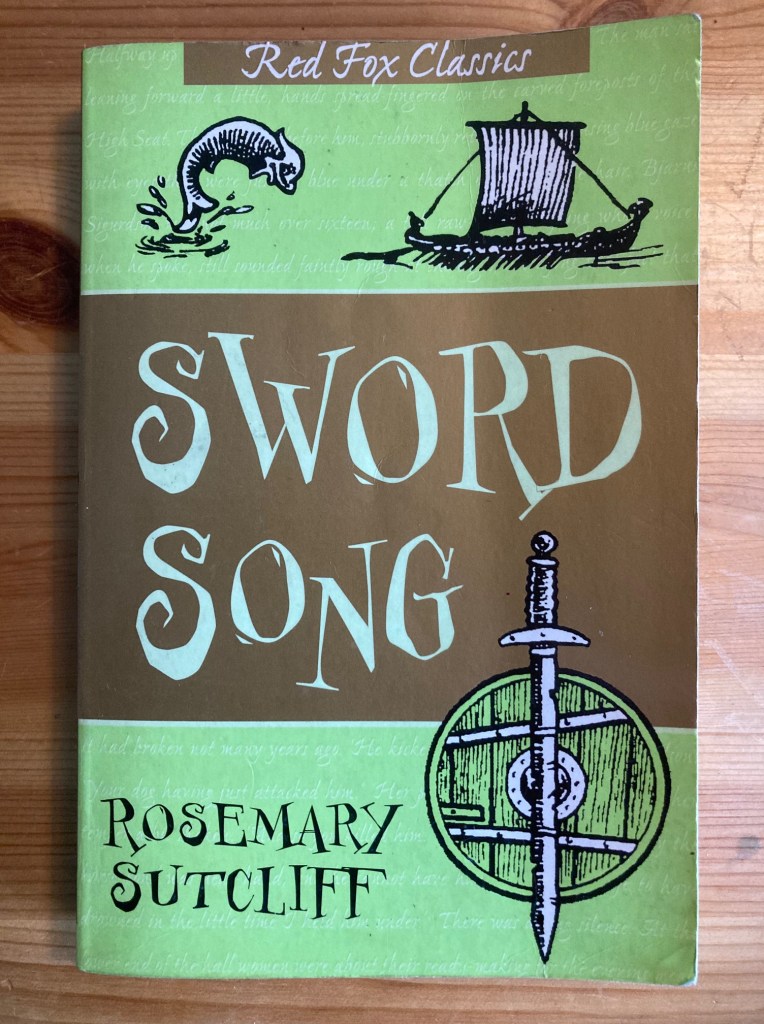
    Bjarni, exiled from his settlement for five years for breaking an oath (and only indirectly for committing manslaughter), proceeds to make his way through the Viking world as a mercenary and sailor. What with being a solid Norse lad, this entails the expected abundance of seafaring and feuds. However, Sword Song was not entirely the picture of Viking life that I expected; Scandinavia is eschewed in favour of Viking settlements in the Celtic nations, and the non-martial aspects of Viking life, whilst not foregrounded, are given more space than I anticipated. 

    The slightly old-timey dialogue (‘Is it well with the bairn?’) and the use of placenames of yesterday (‘the Outer Isles’ for the Outer Hebrides and ‘Sutherland’ for the Highlands) lends it a feel of a time before lore, when homes were considered in a more fluid manner and certainly before the concept of a united kingdom. It is not always initially exactly clear where the story is taking place and I enjoyed this defamiliarisation, placing us in our protagonist’s calf-skin boots through five years of adventuring. 

    Its emphasis on adventure makes it a YA book (I mean, look at that front cover), although, while the violence is not gratuitous, nor is it shirked from. In Bjarni’s universe, whilst not a given, death by violent means is readily accepted. In other ways, the richness of details, especially on nature and boats, makes it a gratifying read as an adult: ‘Just where moorland fell away to machair a stream came down from the higher ground, pushing its way through a narrow glen suddenly and unexpectedly choked with trees-a-tangle, birch and rowan and willow and thorn’. This appeal to more considered tastes tempers the pace and prevents it from devolving into the monotony of just being sword fight after sword fight, which, conversely, is what I found hard work when I first bought this when I was 11 or 12 (RRP: £4.99) and sword fighting was a lot more important to me than bucolic vistas. Upon picking it up (20 years-plus later) I half-expected to DNF it again. Instead, I very much found the opposite: the break-up of the sword fighting is what helps make it a compelling read. The abundant descriptions of nature and place-setting that Sutcliff incorporates into her descriptions, without being overwrought, emphasises how these were peoples of the land and of the sea, and in a way, nation builders.  

    It feels well-researched, or at the least, convincingly researched, and both Norse and Christian mythology are touched upon, although they are not central to Bjarni’s worldview. These religions coexist, but primitive, brutal and tribalistic traditions abound in all wheres; feuds, funerals, how animals are treated, going into battle. With all of that said, the underlying zeitgeist is of an incremental shift from paganism to Christianity – the bigger picture paired with the individual experiences of Bjarni. Sutcliff also doesn’t shy away from incoporating the Vikings’ penchant for taking thralls – or slaves – and how some people did not have a chance to make their own way through the world. 

    I would have liked it if there had been a bit more introspection on Bjarni’s part: earlier on in the book ‘he was well enough content, though still there was an ache in him somewhere like the ache of an old wound when the wind is from the east’, but this is pretty much it. He seems to take five years of what seems to be regularly scheduled drama in stride, and is apparently content to wander with rarely a trace of homesickness.  

    Towards the end, he reflects upon how his people call home wherever they lay their head: 

    And suddenly, he was realising something that he had not realised before; that while he come of a people who could uproot easily, whose home was as much the sea as the land [Anghared] was of another kind […] She was flung out into a strange world that held nothing familiar, a cold place; he could feel the cold in her. 

    But there is little talk of how this strange, cold world has affected him. How has he changed by the end? I’ve not read any of Sutcliff’s other books, but as this was published post-humously (I don’t know if that included any of the writing and editing process), I suspect that this may have contributed to this slight sense of underdevelopment. 

    Worth reading? Yes. 

    Worth re-reading? Yes. 

  • The Honourable Schoolboy

    John le Carré, 1977 

    Edition read: Penguin Modern Classics, 664 pages 

    Read: August – October 2025 

    Spy fiction 

    Part II of the Karla Trilogy.  

    *Spoilers* 

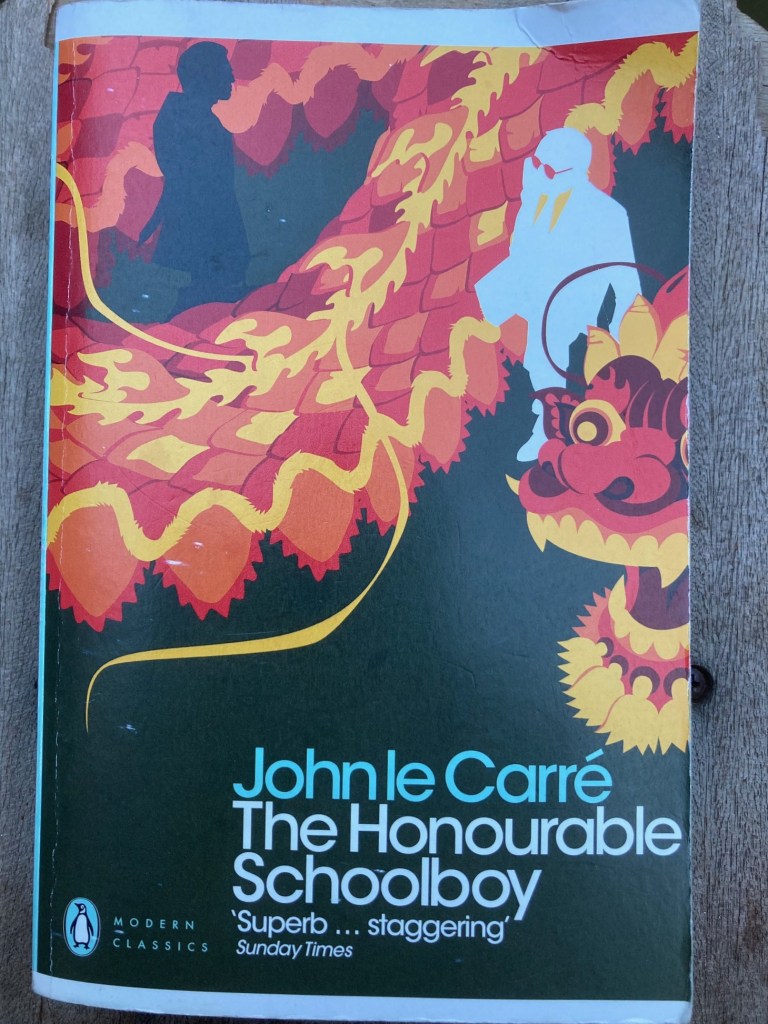
    The sequel to Tinker, Tailor, Soldier, Spy, the plot is set in motion by the dissemination of Bill Haydon’s act(s) of betrayal.* It’s now 1974 and George Smiley and Peter Guillam are rebuilding the secret service, here always referred to rather archly as The Circus. The reinstated intelligence analyst Connie Sachs revisits investigations that Haydon had suppressed and finds what looks to be a money-laundering operation centred in Hong Kong. 

    Jerry Westerby is called back to London from rural Italy (where he had bolted to when he found out that Haydon had possibly betrayed him to the Soviets), where he is writing a novel (‘me neither’), ostensibly on leave from his journalistic duties, in which capacity he is sent to Hong Kong to follow this lead. 

    And just this much of the plot, comprising just the set-up of the premise, is complicated enough. As with his characters, le Carré’s plotting and dialogue is sophisticated and worldly.** I will be honest and say that I couldn’t follow the plot through every single juncture; the amount of exposition is limited, people talk in jargon (or not at all), and the amount of trail covering and switching and deliberate wrongfooting by spies and their handlers is byzantine. Guillam’s perspective is the closest that there is to the reader’s, with Smiley even gently mocking him at one point for not being able to piece together just what the hell everyone is up to and what it all means. However, despite this density and length (I found it useful to keep a dramatis personae), it’s a page turner. Besides the human element (why do all of these clever, erudite people seem so wretched?), the reader has to find out the answers and to see where it’s all heading at the same pace (if not a bit behind) as the – oft highly resourceful – characters. It does wander into James Bond territory just a bit when it turns out that Westerby, besides being a journalist and spy, is an expert on racehorses.  Thankfully, Westerby – the titular honourable schoolboy – doesn’t turn out to be a winning jockey. By and large, instead of stunts, this is a world dominated by suspicion and sadness and full of fittingly distrustful and unhappy characters.   

    Worth reading? Yes. 

    Worth re-reading? Yes. Read the Smiley novels in sequence.** 

    ‘Not allowed a past in this game. Can’t have a future either.’


    *In an uncharacteristic bit of narrative leniency from le Carré, the first page provides all the exposition you need to bring you up to speed. However, I still recommend reading Tinker, Tailor, Soldier, Spy beforehand. 

    **‘“The case has firmed up a little, so perhaps it would be sensible to fix a date. Give us the batting order and we’ll circulate the document in advance.” 

    “A batting order? Firmed up? Where ever do you people learn your English?”’ 

  • The Offing

    Benjamin Myers, 2019  

    Read: September 2024 – April 2025 (stuck in the book traffic jam) 

    Edition read: Bloomsbury Publishing, 2020, 260 pages 

    Fiction – Bildungsroman 

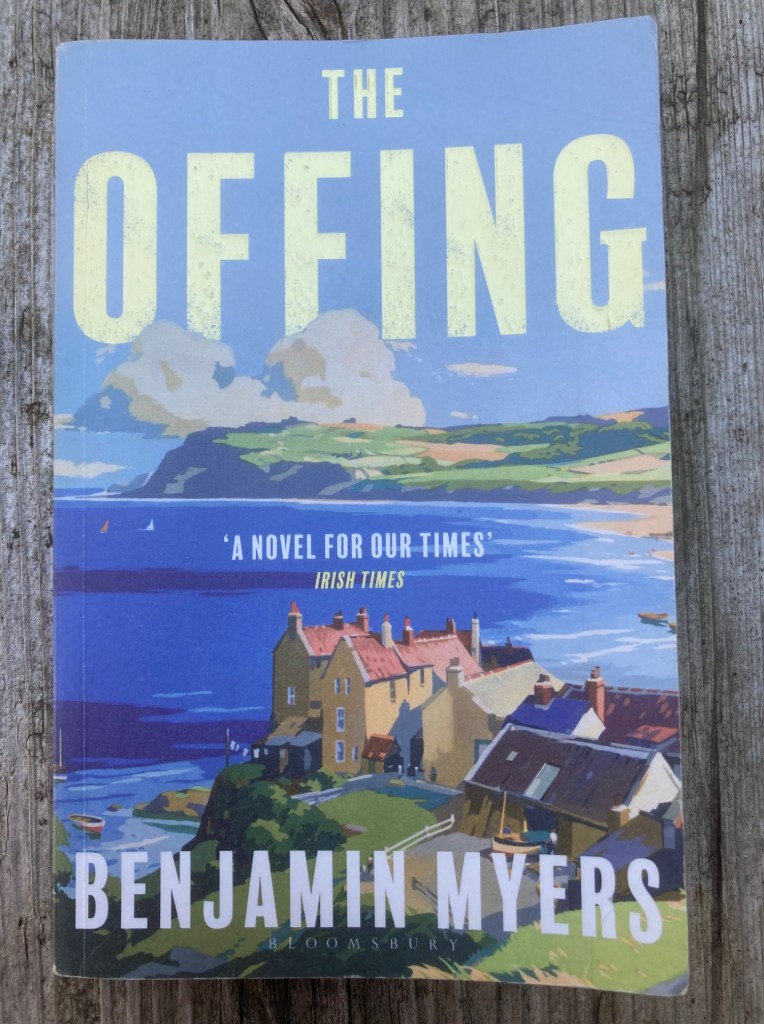
    The plotline of The Offing is slightly more pedestrian than Myer’s more typical ‘Northern Gothic’ novels; working-class boy (Robert) from post-WW2 English mining town meets eccentric upper-class woman (Dulcie), who has retreated from society due to long-lost love, where they experience mild culture clash and she exposes him to the better things in life. 

    Told in the first person, the story takes an analeptic form, which somewhat explains the rich vocabulary, but for a narrator introduced as painfully ancient, he has a remarkable memory for details. Read this deliberately rich vocabulary with patience and the five senses get a workout; the colours, smells, feelings, sights and sounds of nature all feature regularly and prominently and there are some great turns of phrase (‘The ashen sea roared in the distance like a football stadium witnessing an extra-time injustice’). However, the plentitude of what I came to feel were overly frequent and verbose descriptions of nature did get monotonous. 

    There are two main sections – Robert by himself, which if anything is slightly more interesting, capturing the landscape(s) of northern England as he walks across it, and then when he encounters Dulcie. There is a subplot about poetry, which seems slightly meta – is Myers talking about how Northern working-class people aren’t supposed to like poetry, but if you take them out the pits, they do? 

    If there had been something else happen, it could have had a more compelling sense of drive; unfortunately, besides the over-the-top descriptions, the stakes just feel a bit low. 

    Worth reading? No, even though I came into this wanting to like it – Myers has written some brilliant books. 

    Worth re-reading? No. Myer’s other books – The Gallows Pole and These Darkening Days – however, are well worth a read.