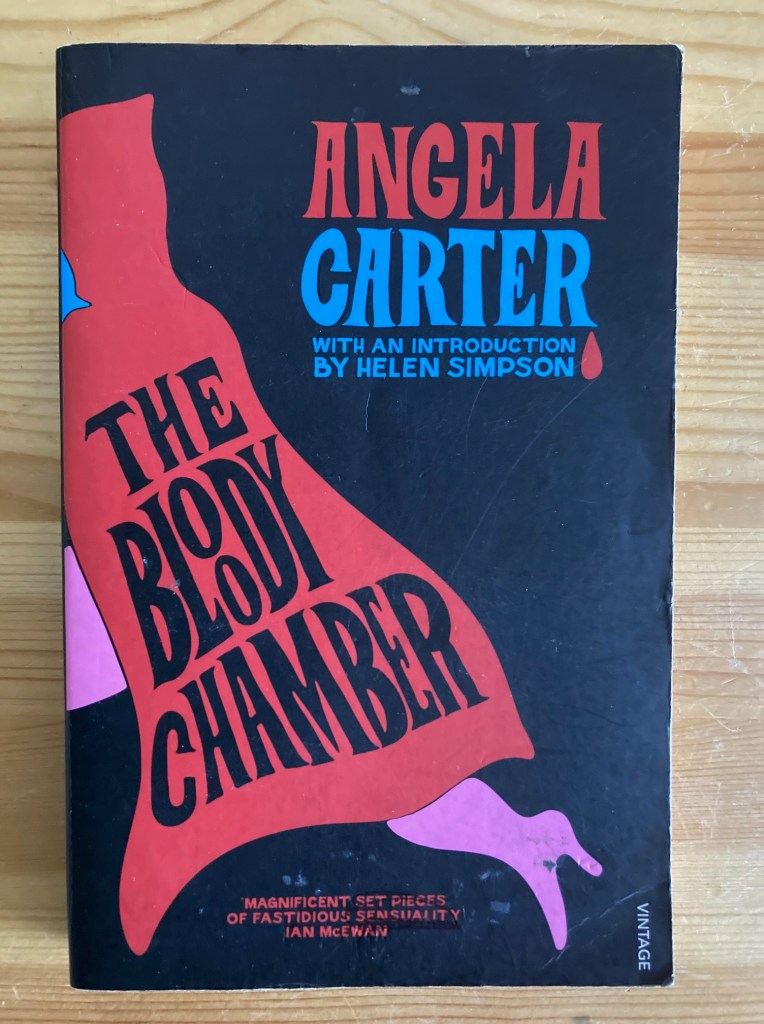
Angela Carter, 1979
Vintage, 2006, 149 pages
Read 2011, re-read February–March 2026
Fiction, short stories, feminist literature, literary fiction
*Spoilers*
I was going to introduce this collection of ten short stories as feminist rewritings of fairy tales. However, Helen Simpson’s introduction instantly states ‘The Bloody Chamber is often – wrongly – described as a group of traditional fairy tales given a subversive feminist twist.’
Fine, I thought. Suit yourself. I won’t.
(Whispers) But actually, I will. Just a little bit.
In The Bloody Chamber, fairy tales generally of the more macabre variety become the points of departure in Angela Carter’s process of writing new ones. In the eponymous first tale, a young French woman gets married to a murderous member of the nobility, only to be rescued by her mother. In The Tiger’s Bride, the protagonist is gambled away by her father to a man disguised as a big cat, in the end becoming a tiger herself. Puss-in-Boots is the story of a rake and his feline companion, who are only ever rewarded for their ways. The Erl-King is a sylvian story of possession and revenge. The Company of Wolves is a young girl taking on a wolf in a universe akin to The Northman, in which ‘Children do not stay young for long in this savage country.’ Wolf-Alice combines a vampire with a protagonist reared by wolves. Simpson is partially right in that these tales are evolutions rather than adaptations, but you can see the overlaps, as brief as they are.
Despite an almost-universal familiarity* with the stories that are used as launchpads (in respect to their providence, maybe they should be referred to as ‘tales’ rather than stories), it’s not always immediately apparent where these tales are going and what each element signifies. However, this sense of mystery, combined with Carter’s creativity, makes for compelling reading. This is a multilayered, densely symbolic and, despite its complexity, fun collection of short tales. Sometimes set in days of yore, sometimes rewritten into the twentieth century, most stories are from a female perspective, and that preserve of the short story, the ambiguous ending, recurs. Analysing all of them, and what I think they mean, would make this review 1) very long 2) something closer to academia (such as the Lacanian psychology in Wolf-Alice), but Carter creates the option of a close, deep read (and re-reads), or just marvelling at them in a less analytical, although not necessarily less appreciative, manner. Indeed, Carter really plumbs the content of these tales, with some of them based on the same origin story, two drawing from Beauty and the Beast and two (arguably three) from Little Red Riding Hood.
And if the ideas are bold, the writing matches it. Ian McEwan’s frontpage pull quote describes these as ‘Magnificent set pieces of fastidious sensuality’.** Ian, I just so happen to agree. Check this out:
And each stroke of his tongue ripped off skin after successive skin, all the skins of a life in the world, and left behind a nascent patina of shining hairs. My earrings turned back to water and trickled down my shoulders; I shrugged the drops off my beautiful fur.
Besides beauty, Carter’s continuation of these tales retains their darkness, with brutality present within each of the worlds created. However, here, the conservative bent of the traditional fairy tale is subverted into an embracing of danger. Yes, the protagonists must be vigilant, but also bold; they possess agency and learn to take action.
Worth reading? Yes.
Worth re-reading? Yes, particularly if you want to get into the subtext(s).
* At least in Europe.
**While studying this as a student, at some point I ended up just circling a single word of this front-cover quote: ‘sensuality’ (see the above photo).
You might like this if you enjoyed:
The Ocean at the End of the Lane, Neil Gaiman
American Gods, Neil Gaiman


Leave a Reply