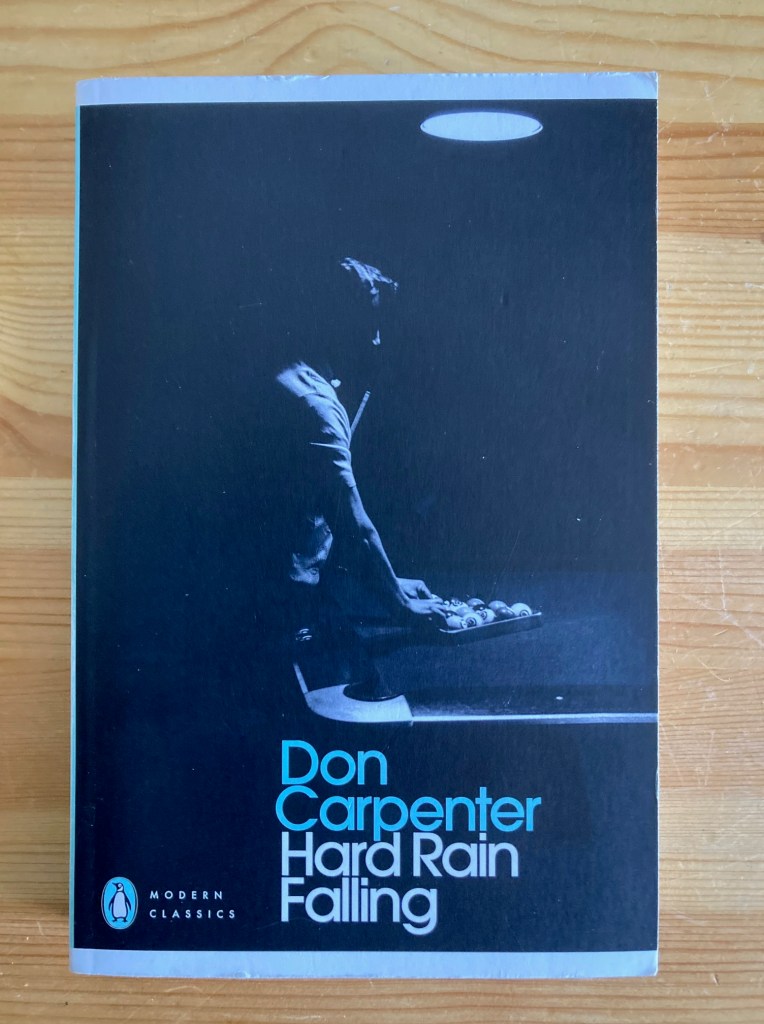
Don Carpenter, 1966
Penguin Modern Classics, 346 pages
Read April 2026, re-read May 2026
Fiction, Noir, Crime
*Spoilers*
I picked this up because of the Bob Dylan song and assumed, both being products of the 1960s, one must have been named after the other. However, whereas Dylan’s A Hard Rain’s A-Gonna Fall feels broadly prophetic, in Don Carpenter’s first novel, Hard Rain Falling, the hard rain in question isn’t prophetic – it is already happening, and the hard rain is life itself.
The lives of two men – one white, one black – become intertwined in post-Second World War America.* Jack and Billy, both from poor backgrounds, one shaped by the orphanage system and the other by racism, meet both each other and various highs and lows in poolhalls and prisons.
Jack has no sense of a future, making choices without consideration for their consequences. Raised in the Darwinian environment of an orphanage, he fights, drinks and steals his way into his first stint in prison. Billy, in contrast, is talented and does have a sense of a future that he wants, but is also black in 1940s and 1950s America. They go on to endeavour to escape their poor origins, but only with partial success, reuniting in a prison cell.
There’s social commentary: Jack hates the lack of humanity applied to the marginalised; as an orphan, he learns that the struggle is against a system, not an individual; he despises those who assume authority while also understanding that he would be the same should he be in charge; and he is shrewd enough to see through the prevalent racism. When an authority figure finally does ask Jack what he wants, he is stunned into silence. And from Billy’s perspective, even at the novel’s instigation he is already so ground down that he rarely allows himself to be anything other than pragmatic, bitterly reflecting later on in the book that one day his children will have to learn what racism is and sarcastically asking another black man when racial injustice will end.
Nonetheless, this is less a novel of social protest than one of the human condition, framed through the perspective of the marginalised. Jack and Billy live on the edge of society, but their struggle is against themselves as well as against the system. If they had more normal childhoods – i.e., if they were born as the rich character Bronson, rather than as themselves – they would still have a lot of the same questions (as Bronson does at the end, ‘sometimes wak[ing] up at night and feel[ing] it all [slip] through his fingers.’)
This is where Hard Rain Falling becomes something more than poolhalls, fighting and pulling; an idiosyncratic combination of the big ideas and a streetwise sensibility emerges over the course of the book, elevating it above being just a walk on the wrong side of the tracks. With a re-read, this seemed more like a book about everything: society, isolation, money, racism, love, parenthood, a sense of purpose. It’s all in there – except for the answers.
Even with the inclusion of these big ideas, it is still narrative-driven and a quick read. Initially, the structure, consisting of a couple of acts, seems slightly unusual, but this book is better understood as really being Jack’s story, rather than that of Jack and Billy. Although the story is set up to represent them as joint protagonists, as the story goes on, Billy becomes a kind of deuteragonist.
Although Jack is never an unintelligent character, he very much starts his character arc as an insensitive soul leading a dissolute life. When we are introduced to him, all he wants are temporary things – food, drink, a woman, clothes, a fast car. Likewise, when we meet Billy, he is already street – or rather, poolhall – smart. These dubious origins develop into Jack and Billy’s search for meaning. Billy starts off the story as the more naturally philosophical soul, already full of existential dreads and fears of insignificance, whereas Jack’s story involves him becoming more feeling, more aware, in large part due to Billy. The scene on the beach marks this change, with the last third of the book consisting of Jack having enough freedom to realise his constraints and that he is still missing something.
Carpenter’s fantastic insights into the human condition are aided and abetted some great writing: ‘How do you wake up? It was one thing to know that you had been asleep all your life, but something else to wake up from it, to find out you were really alive and it wasn’t anybody’s fault but your own. Of course that was the problem.’ He pulls off the unenviable task of being both expansive and insightful while making it believable that two guys from the street would think and talk this way. A weakness is that he pens better male than female characters, with the women written in a far less sympathetic manner; Sally is impatient, patronising, easily bored, inconsiderate and self-centred. Given that Jack is not supposed to be a great guy, a better-rounded character would have been more sympathetic here.
Worth reading? Yes.
Worth re-reading? Yes – the depth of the novel really emerges on a second read.
You might like this if you enjoyed:
Suttree by Cormac McCarthy
On the Road by Jack Kerouac
The Dharma Bums by Jack Kerouac
*It was interesting to compare these characters and settings to Jack Kerouac’s, with their very different perspectives on post-war America. Whereas Kerouac’s search generated writing (initially) full of life, Jack struggles to enjoy anything on his path to meaning.


Leave a Reply